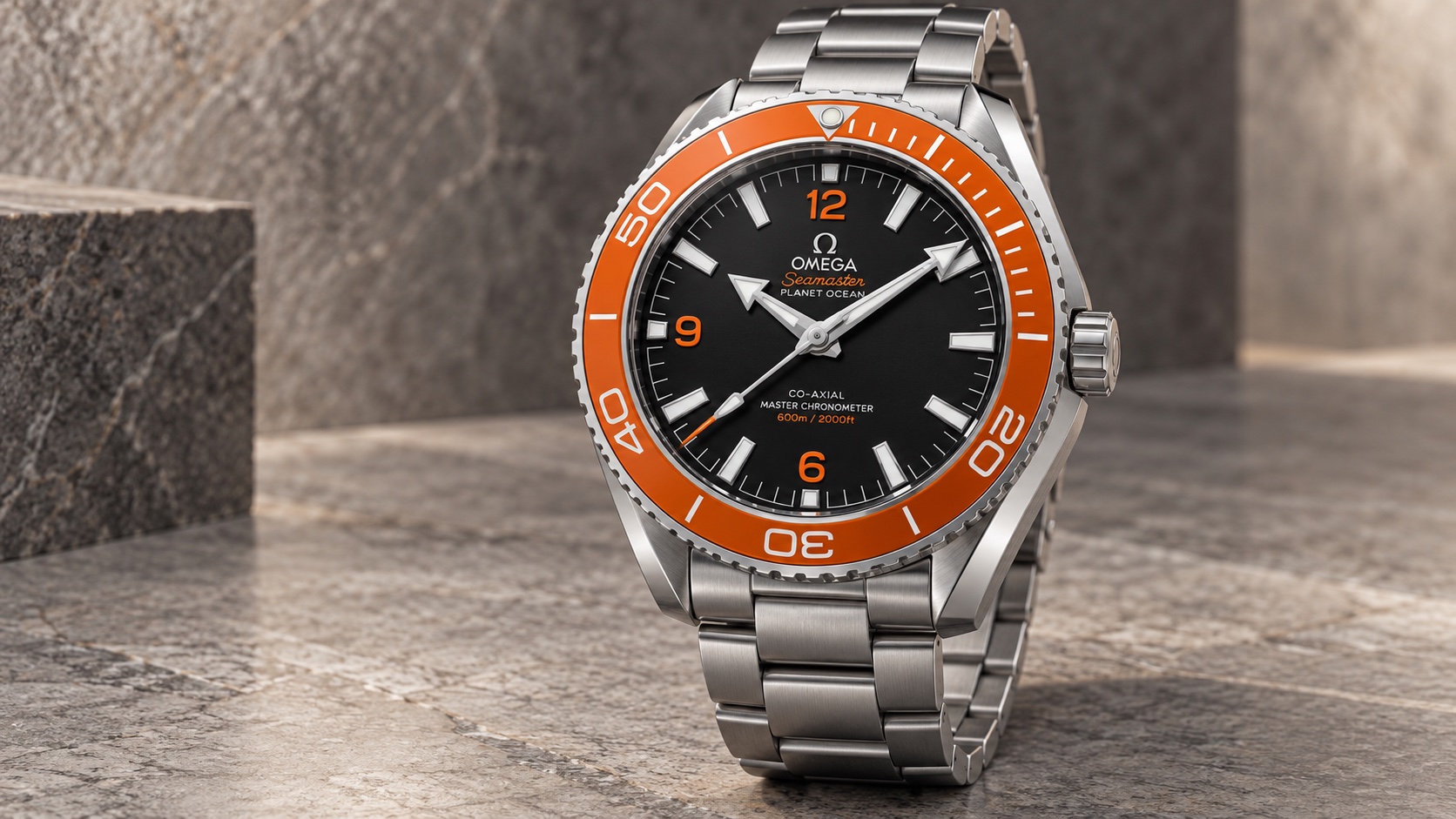
The old shortcut says the Planet Ocean is the bulky one and the Diver 300M is the easier everyday watch. For these current references, that is no longer an adequate comparison. Their published thicknesses differ by just 0.01 mm, while the redesigned Planet Ocean is shorter along the wrist.
This guide compares the orange-bezel 217.30.42.21.01.003 with the steel-dial, mesh-bracelet 210.30.42.20.06.002. Both omit the date. Their real differences are colour, case span, mass and bracelet character, rather than a simple choice between a thick diver and a thin one.
The references compared
| Feature | Planet Ocean 217.30.42.21.01.003 | Diver 300M 210.30.42.20.06.002 |
|---|---|---|
| Case diameter | 42 mm | 42 mm |
| Thickness | 13.79 mm | 13.80 mm |
| Lug-to-lug | 47.50 mm | 49.70 mm |
| Approximate weight | 177 g | 158 g |
| Movement | 8912 automatic | 8806 automatic |
| Reserve | 60 hours | 55 hours |
| Water resistance | 600 m | 300 m |
| Calendar | No date | No date |
| Bezel / bracelet | Orange ceramic / steel links | Titanium / steel mesh |
Specifications: Omega current Planet Ocean specifications; Omega steel-dial Diver specifications.
Which generations of Seamaster are being compared?
The Planet Ocean began in 2005. Its fourth generation, introduced in 2025, retained the 600 m identity while changing the architecture, adopting a flat crystal and removing the helium valve. The resulting proportions need to be judged separately from earlier generations.
The Diver 300M dates to 1993, but this particular branch arrived in the 2024 expansion. It uses a brushed steel dial and titanium bezel in place of the familiar ceramic-wave treatment, with mesh providing another distinctive texture. Both watches therefore revisit established Omega identities. The Planet Ocean changes a reputation for bulk through construction, while the grey Diver changes the visual mood of a familiar shape.
Equal thickness does not mean equal presence
The Planet Ocean measures 13.79 mm thick and 47.50 mm lug-to-lug. The Diver is 13.80 mm thick and 49.70 mm long. A buyer concerned about case span has a concrete reason to try the Planet Ocean first, despite older assumptions about the family.
The Diver’s approximate 158 g weight is lower than the Planet Ocean’s 177 g. That reverses the advantage when mass is the main concern. The two pieces demonstrate why thickness, length and weight should be considered separately instead of reduced to one description such as wearable.
The crystal also changes the side view. The Planet Ocean’s flat sapphire contributes to its new outline, while the Diver uses a dome. Try both under a sleeve and look at the entire profile, not merely at the numerical height.
Orange or an industrial palette?
The Planet Ocean’s orange ceramic bezel makes the watch an obvious colour choice. Against its matt black dial, the bright details become part of the identity rather than a small accent to notice later. It suits someone who wants a sports watch to be the lively element in otherwise restrained clothes.
The Diver’s brushed PVD steel dial and titanium bezel create a narrower palette. That can be appealing if you like the collection’s case but want less visual decoration than the familiar blue wave model. The absence of waves is an important preference, not just a material specification.
Neither watch is the neutral answer for everyone. If orange is what attracts you to the Planet Ocean, choosing a quieter watch for theoretical versatility may leave you unsatisfied. If you already know bright colours become tiring, the grey Diver offers a more coherent daily choice.
Two bracelets, two kinds of texture
The Planet Ocean uses articulated steel links with an adjustable folding clasp and diver extension. The Diver’s steel mesh creates a much finer repeating pattern around the wrist. That difference is likely to remain noticeable long after the reserve figures have become familiar.
Assess the position of each clasp and how the bracelet folds beneath your wrist. The lighter published weight does not automatically make the mesh your preferred fit. A watch head that looks right needs an attachment you enjoy using.
The movements do not create a dramatic split
Both are automatic Master Chronometer models. The Planet Ocean’s calibre 8912 offers 60 hours of reserve, compared with 55 hours for the Diver’s 8806. Five hours may provide useful margin, but it is unlikely to dominate a choice between such different exteriors.
Both also omit the date, keeping the display focused on central hands. That helps symmetry and removes a calendar-setting task after a long rest. A buyer who regularly uses a watch’s date should recognise that both exact references give up the function.
The Planet Ocean retains twice the published water rating, at 600 m against 300 m. For an everyday owner, the more consequential achievement is that it now provides that specification without the thickness difference the old shorthand implies.
Which one belongs on your shortlist?
Choose the current Planet Ocean if its orange colour, shorter span and linked bracelet are the combination you want. Choose the grey Diver if lower published weight, mesh and a more subdued face appeal more.
The right answer changes when the references change. A dated comparison of older models should not decide this purchase. These two current watches offer truly different visual and physical priorities, with remarkably little difference in their published height.
Based on manufacturer information. Specifications checked on 8 September 2026.
Image: AI-generated editorial illustration of the Omega Planet Ocean 600M 42 reference 217.30.42.21.01.003 fourth generation. Fine dial details, bezel markings and finishing may differ from the production watch.


