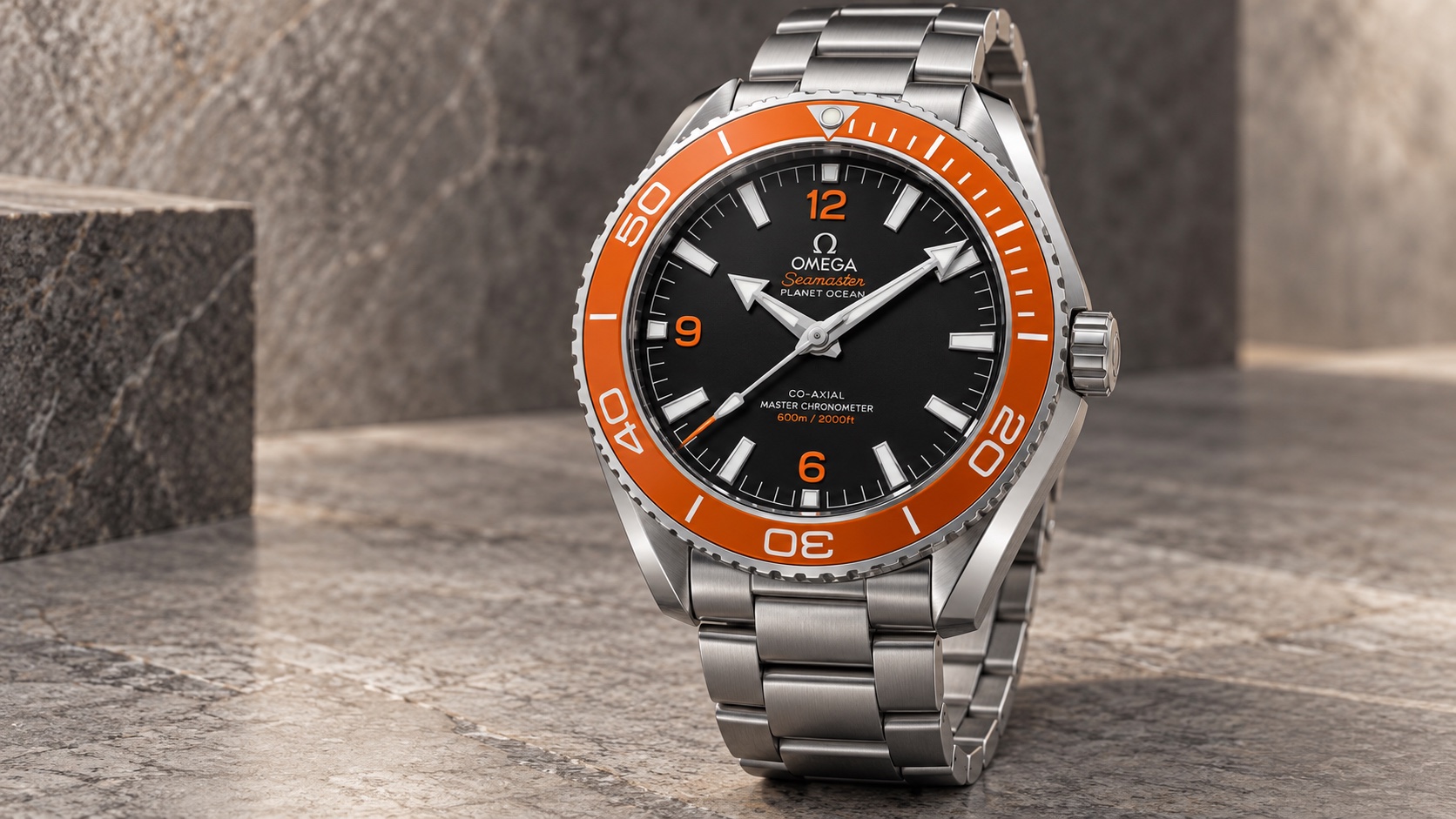
The Planet Ocean’s reputation for bulk deserves a current-reference check. The fourth generation, introduced in 2025, keeps the 600-metre brief but changes the case architecture, uses a flat front crystal and removes the helium escape valve. It is a substantial redesign, not just a fresh orange bezel.
The orange 217.30.42.21.01.003 is still a bold watch. Its appeal is that the technical brief now comes in a flatter, more tightly drawn package. If previous Planet Oceans interested you but felt visually excessive, this is the version worth examining before dismissing the family altogether.
The history behind the choice
Omega introduced the Planet Ocean in 2005, drawing on the Seamaster 300’s earlier design language while establishing a distinct modern diving collection. Orange became one of its recognisable signals. Twenty years later, the fourth generation returned to the brand’s history for different ideas, taking structural cues from Seamasters of the 1980s and 1990s. The result is more angular and flatter. Swatch Group’s November 2025 launch account describes a reduction from 16.1mm on standard third-generation models to 13.79mm, alongside a new case construction and titanium back. That is useful history because it changes the buying question. This reference should be assessed as a redesigned watch, rather than carrying every assumption formed about its predecessors.
The exact reference
| Specification | Published detail |
|---|---|
| Reference | 217.30.42.21.01.003 |
| Case | 42mm stainless steel |
| Thickness / length | 13.79mm / 47.50mm lug-to-lug |
| Dial / bezel | Matt black / orange ceramic |
| Movement | Automatic calibre 8912; Master Chronometer |
| Stated reserve | 60 hours |
| Water resistance | 600m |
| Published weight | Approximately 177g |
| Crystal | Flat sapphire; antireflective treatment both sides |
| Back | Grade 5 titanium; screwed in |
| Bracelet | Steel; adjustable folding clasp and diver extension |
| Attachment width | 21mm |
The side view explains the redesign
The flat sapphire front and titanium caseback contribute to a more compressed profile. Omega also removed the helium valve that had long been a visible part of the collection. The case consequently offers a different outline even before its dimensions are measured.
Those changes make the watch more relevant to someone who liked the Planet Ocean’s boldness but wanted less vertical presence. They do not turn it into a thin dress watch. At a quoted 177g on its steel bracelet, it still supplies a substantial object. The sensible question is whether this redesigned proportion suits you, not whether the family’s reputation has been erased by one smaller thickness figure.
Orange remains a commitment
The orange ceramic bezel and matching dial numerals are integral to this reference’s personality. They make the watch easy to distinguish from a conventional black diver. Against the matt black face, that colour is a deliberate accent rather than a subtle detail discovered only close up.
If you enjoy a sports watch as the colourful element in an otherwise plain outfit, this is a compelling arrangement. If you want the same watch to disappear in every setting, another colour within the family may be more appropriate. Buy orange because it is the version you want to keep seeing. A signature colour is only an advantage when it agrees with your taste.
A simpler face and a different back
The current calibre 8912 supports a calendar-free display. That leaves the dial focused on the hour markers and central hands. For buyers who value uninterrupted symmetry, the absence of a date is part of the appeal. For those who check the calendar repeatedly, it is a feature to give up knowingly.
The titanium back carries the Seahorse emblem rather than presenting a view of the movement. That choice suits the redesign’s technical emphasis. Someone who enjoys inspecting a mechanical calibre should notice the change before buying. A closed back is not an inferior object, but it offers a different kind of satisfaction from a transparent one.
The bracelet completes a substantial diver
The 600-metre rating remains a defining Planet Ocean figure, but the redesigned case is only one part of the current package. The steel bracelet includes an adjustable clasp and diver extension. Those serve different scales of adjustment, linking ordinary fit with the more specialised purpose behind the collection.
The 21mm lug width and closed titanium back also distinguish this reference’s physical architecture. It is not just the earlier watch with the visible helium control deleted. Case, back, crystal and bracelet combine to produce the new outline. That is the strongest way to assess the redesign: as a coordinated set of changes to a deliberately substantial diver, rather than a single thickness number enlisted to promise that every concern about bulk has disappeared.
What to compare before choosing
The Diver 300M offers a different case-and-dial language, with its own recognisable bezel and bracelet options. The Aqua Terra moves towards a simpler everyday silhouette without the prominent diving bezel. These are useful alternatives because they answer different preferences rather than merely occupying lower positions in a depth-rating hierarchy.
Choose the new Planet Ocean when you want the orange identity, a substantial sports watch and the redesigned case proportions. Revisit another Seamaster when your main aim is a watch that feels visually quiet beneath every cuff. This fourth generation improves the case for everyday use, but the reason to buy it remains affection for its particular presence. It is most convincing for someone who wants a purposeful watch and appreciates that the new architecture makes that purpose easier to accommodate.
Specifications and sources checked on 8 September 2026. Omega current Planet Ocean specifications; Swatch Group fourth-generation launch; Omega London launch follow-up; Omega Seamaster history.
Image: AI-generated editorial illustration of the Omega Planet Ocean 600M 42 reference 217.30.42.21.01.003 fourth generation. Fine dial details, bezel markings and finishing may differ from the production watch.


