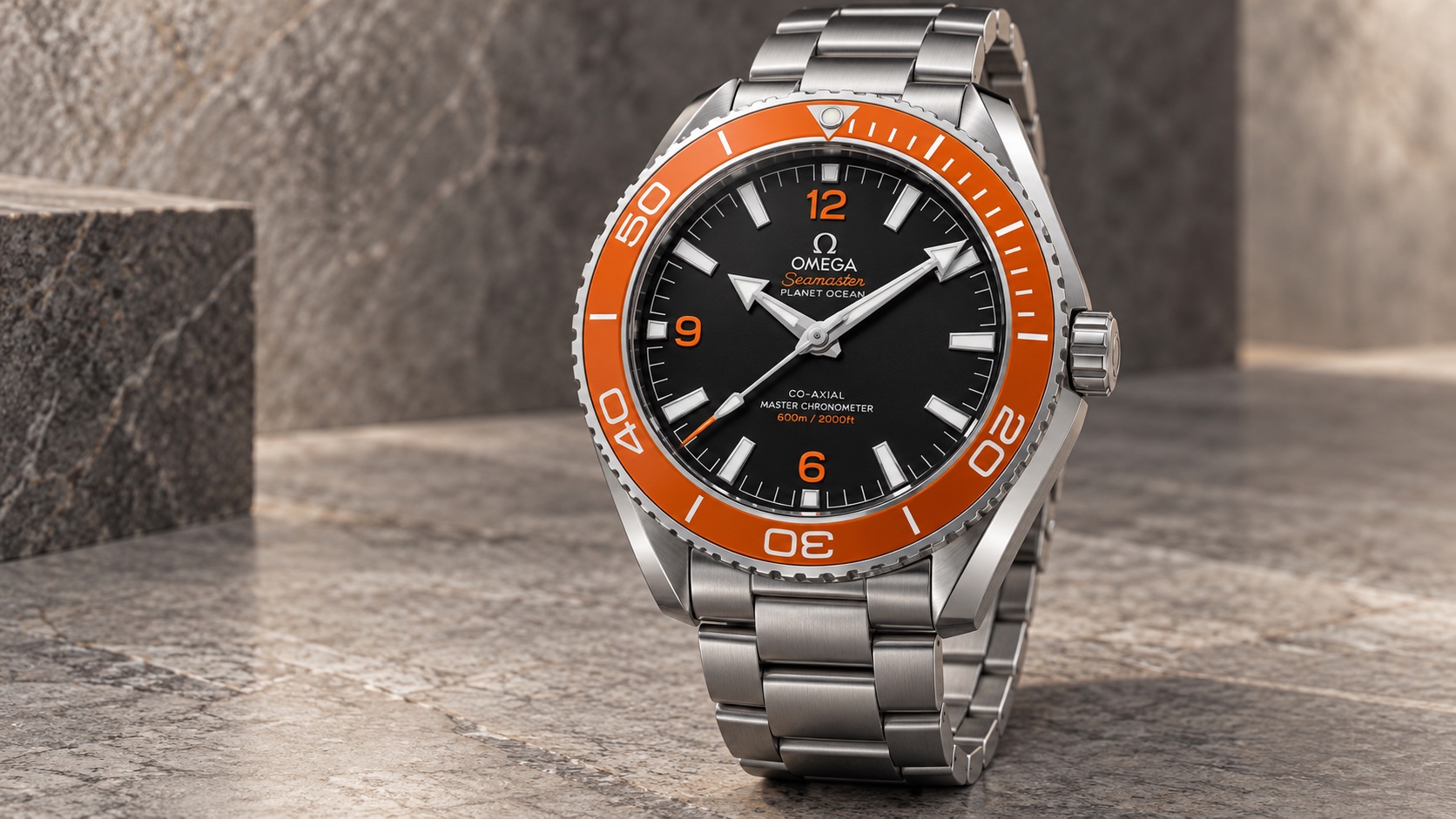
The largest depth number is the least effective way to choose between these three watches for daily wear. DOXA offers 1,200m, Omega 600m and Blancpain 300m, but the practical differences appear when you look at the case, strap and time between winding sessions. Those are the features you will encounter while wearing the watch to lunch.
The current Planet Ocean, steel Fifty Fathoms and SUB 300T Professional all have a serious diving identity. They express it with different materials and proportions. Start by deciding whether you want Omega’s angular modern case, Blancpain’s polished presentation on fabric, or DOXA’s broad steel frame around an orange face.
Three exact configurations
| Watch and reference | Case and thickness | Water rating | Movement reserve | Configuration |
|---|---|---|---|---|
| Omega 217.30.42.21.01.003 | 42mm; 13.79mm | 600m | 8912 automatic; 60h | Steel bracelet; orange ceramic bezel |
| Blancpain 5010 1130 NABA | 42.3mm; 14.3mm | 300m | 1315 automatic; 120h | Black NATO; domed sapphire bezel insert |
| DOXA 840.10.351.10 | 42.5mm; 13.65mm | 1,200m | Swiss automatic; 38h | Steel beads-of-rice bracelet; orange dial |
The references are important here. The Omega is the fourth-generation 2025 design; the Blancpain is the polished-steel 42.3mm watch on a black NATO strap; the DOXA is the Professional on its steel bracelet. A price or specification for another generation can describe a substantially different object.
The history explains their different shapes
Blancpain’s Fifty Fathoms began in 1953, with the modern family adding a domed sapphire bezel in 2003 and calibre 1315 in 2007. DOXA’s SUB 300 appeared in 1967; its orange dial and specialised bezel became recognisable parts of the maker’s diving language. Omega’s Planet Ocean is younger, dating to 2005, although it draws on earlier Seamaster ideas. Its 2025 redesign takes the collection in a flatter, more angular direction. These histories help explain what you see, without suggesting that any current reference is an unchanged historical instrument.
Bulk is a matter of more than diameter
The diameters occupy a narrow 42–42.5mm band, yet their outlines differ noticeably. Omega publishes a 47.5mm lug-to-lug measurement. DOXA lists 44.5mm case length, alongside its broad 42.5mm width. The DOXA can therefore be worth trying if some long-lugged divers have proved awkward, while its wide cushion shoulders remain a substantial visual presence.
The Blancpain’s 14.3mm thickness needs to be considered with the supplied NATO strap. Fabric passing under a case changes the height above the wrist. Its polished case and sunburst black dial also give it a different appearance from a purely utilitarian instrument. Try the complete watch instead of mentally replacing its strap before you have assessed it.
The reserve makes a surprisingly large difference
Blancpain’s 1315 uses three series-coupled barrels to provide 120 hours, or five days. Omega specifies 60 hours for its 8912. DOXA gives 38 hours for its automatic movement without naming the calibre on the exact page.
If you alternate among several watches, those capacities describe different habits. A sufficiently wound Blancpain can tolerate a longer break; the Omega covers more than two days; a DOXA set aside on Friday evening is likely to need restarting for Monday. The highest pressure rating therefore belongs to the shortest-reserve watch in this group. Capability does not increase along one simple scale.
Read the face before admiring the engineering
The Omega combines a matt black dial with an orange ceramic bezel. The DOXA puts the orange inside the dial and surrounds it with a more elaborate steel timing scale. Blancpain’s black-on-black arrangement is quieter in colour, with the domed sapphire bezel supplying its own surface detail.
Look at how quickly you separate the hands from their backgrounds and how much of the overall width is dial rather than bezel. A large case does not guarantee a large time display. For ordinary elapsed-time reminders, assess the ring you can read easily, not simply the most complicated-looking one.
The valve is not a daily-use score
The current DOXA has a helium-release valve. The redesigned Planet Ocean removes that feature while retaining a published 600m rating. A helium valve relates to saturation-diving conditions; it is not an additional control that makes everyday timekeeping better.
Similarly, the DOXA’s no-decompression bezel belongs to its specialist design history. Actual diving requires appropriate equipment, procedures and a watch in suitable condition. This comparison does not turn a catalogue pressure number into a test of an individual used example.
Choose the character you will use
Put the Planet Ocean first if its redesigned proportions and orange ceramic frame appeal. Choose the Fifty Fathoms for its particular polished case, black display and long-running movement. Choose the DOXA when the orange dial and cushion shape are positive reasons to own it. Its official UK listing was £1,890 on 8 September 2026; comparable GBP figures were not established here for the other two. The useful shortlist is built around those exact watches, rather than the winner of a depth-rating contest.
Based on manufacturer information. Specifications checked on 8 September 2026.
Sources: Omega current Planet Ocean specifications; Swatch Group fourth-generation launch; Fifty Fathoms exact reference; 2025 steel model and calibre history; Fifty Fathoms sapphire bezel and finishing; DOXA UK SUB 300T Professional 840.10.351.10; DOXA official history.
Image: AI-generated editorial illustration of the Omega Planet Ocean 600M 42 reference 217.30.42.21.01.003 fourth generation. Fine dial details, bezel markings and finishing may differ from the production watch.


