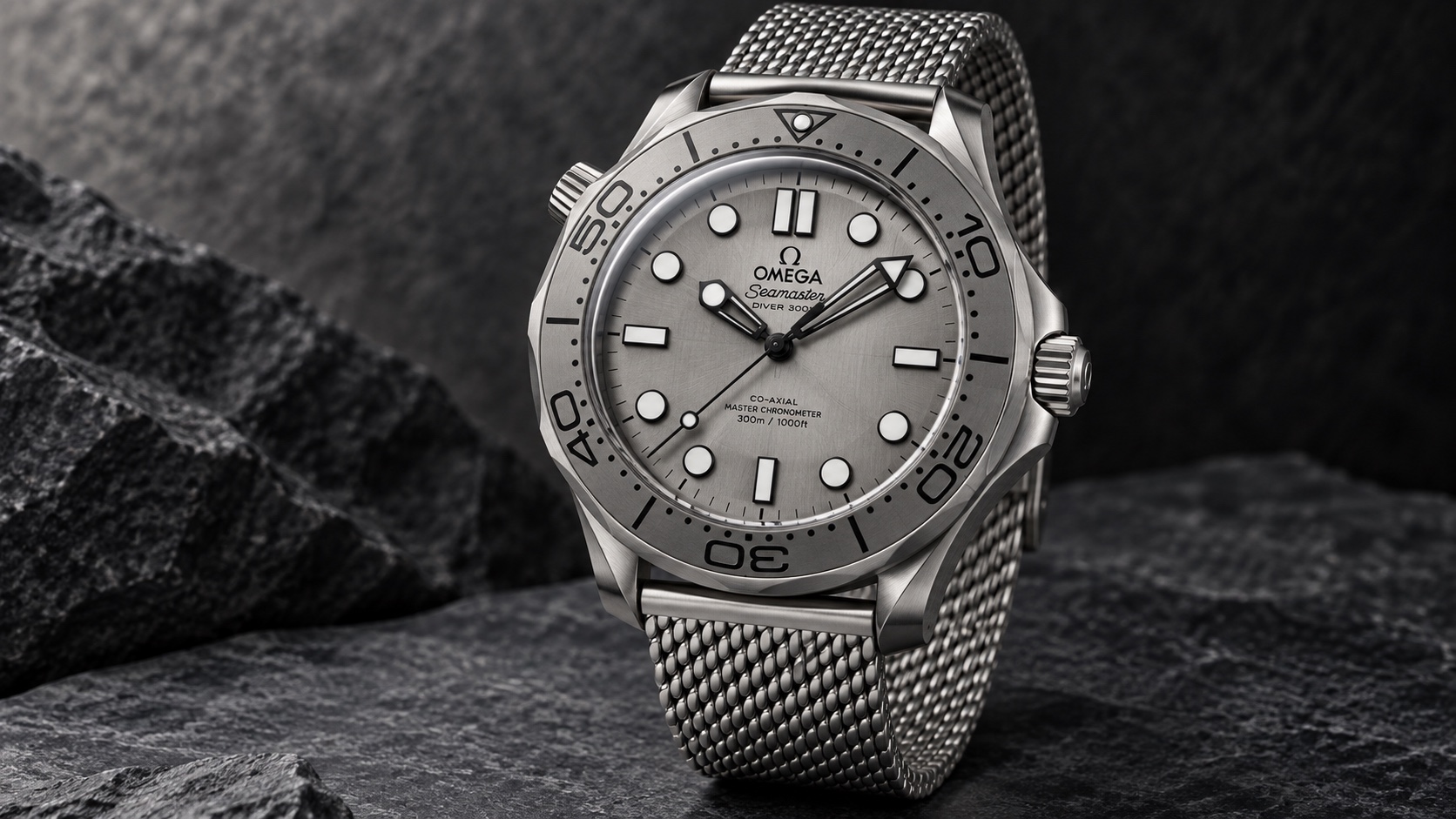
Submariner versus Seamaster comparisons often assume one familiar blue wave-dial Omega. This one uses a different Diver 300M: the grey steel-dial 210.30.42.20.06.002 on mesh. Against the black Submariner Date, that makes the calendar, bezel material and bracelet as important as the brand names.
Choose the Rolex when its date display, black ceramic timing scale and Oyster bracelet are the package you want. Choose the grey Omega when a no-date face, titanium bezel and mesh attachment are positive attractions. The shared three-hundred-metre rating establishes a common diving-watch category, but it does not make the two designs interchangeable.
The references compared
| Feature | Submariner Date | Grey Diver 300M |
|---|---|---|
| Reference | 126610LN-0001 | 210.30.42.20.06.002 |
| Case | 41mm Oystersteel | 42mm stainless steel |
| Dial / date | Black; date and Cyclops | Brushed grey steel; no date |
| Bezel insert / ring | Black Cerachrom ceramic | Grade 5 titanium bezel |
| Movement | Automatic 3235 | Automatic 8806; Master Chronometer |
| Reserve | Approximately 70 hours | 55 hours |
| Water resistance | 300m | 300m |
| Bracelet | Oyster; Glidelock | Steel mesh |
Two histories behind the decision
The Submariner began in 1953, with the Date joining its history in 1969. The current Rolex has developed through later material and movement changes while preserving a recognisable black-dial diving layout. Omega’s Diver 300M arrived in 1993 and has supported several different interpretations of its distinctive case and hands. The grey no-date reference belongs to the range introduced in 2024, rather than being the classic blue ceramic-wave configuration. These histories explain why model names alone are insufficient. Both families have changed over time, and the selected Omega deliberately makes a different visual argument from the one often used in older comparisons. The meaningful choice is between two present configurations, not between fixed stereotypes of each brand.
The date is a genuine dividing line
The Submariner Date places its calendar under a magnifying Cyclops at three. That is useful information presented conspicuously. It changes both the face and the surface of the crystal, making the calendar part of the watch’s identity rather than a discreet addition.
The grey Omega has no date. Its hands and hour markers can therefore occupy the dial without a calendar window interrupting the layout. Neither arrangement is automatically more practical for every owner. If the watch is your regular source for the date, the Rolex has a clear advantage. If an uninterrupted diving face is what you enjoy, this Omega offers it without requiring you to ignore a function you never wanted.
Grey steel and titanium produce another kind of Seamaster
The Omega’s brushed PVD steel dial is not a ceramic wave dial, and its bezel is titanium. Those material choices create a cooler, more monochromatic composition than the familiar blue model. The Rolex instead puts a black ceramic scale around its black face, producing a stronger dark centre within the steel case.
This is why a general claim about which brand makes the more colourful or decorative diver is unhelpful. These particular watches reverse several easy assumptions. The grey Omega can appeal precisely because the dial treatment and bezel are restrained in colour, while the Rolex’s contrasting scale provides a more conventional diving-watch frame. The choice should begin with the actual surfaces you prefer.
Mesh versus three broad links
The Omega’s mesh gives the attachment a fine repeated texture, distinct from the Oyster bracelet’s three-piece construction. This affects the visual transition out of the case and the character of the full watch. A close photograph of the watch head misses much of the comparison.
The selected Rolex includes Glidelock adjustment in its clasp. That is a concrete part of its bracelet proposition and worth considering alongside the broad-link appearance. Compare the complete fastening and sizing arrangements rather than assuming any metal bracelet will behave identically. The mesh has to be something you want to wear, not merely a temporary attachment you accept because the Omega dial is interesting.
The movements support different complete watches
The Rolex offers a longer stated reserve, while the Omega carries Master Chronometer certification. Both are automatic movements supporting their respective displays. Those attributes deserve consideration, but neither replaces deciding whether you want a date, a ceramic bezel or mesh.
Choose the Submariner Date for its specific combination of calendar, black scale and adjustable Oyster bracelet. Choose the grey Diver 300M for the no-date brushed face and its different material-and-attachment treatment. If you actually want the blue ceramic-wave Omega, compare that exact reference instead: it has a different movement and calendar arrangement. A good comparison identifies the watch you are buying before deciding which name should win.
Specifications and sources checked on 8 September 2026. Submariner Date specifications; Grey Diver 300M specifications; Submariner history; Omega 2024 Diver development.
Image: AI-generated editorial illustration of the Omega Seamaster Diver 300M 210.30.42.20.06.002. Fine dial details, bezel contours and finishing may differ from the production watch.


