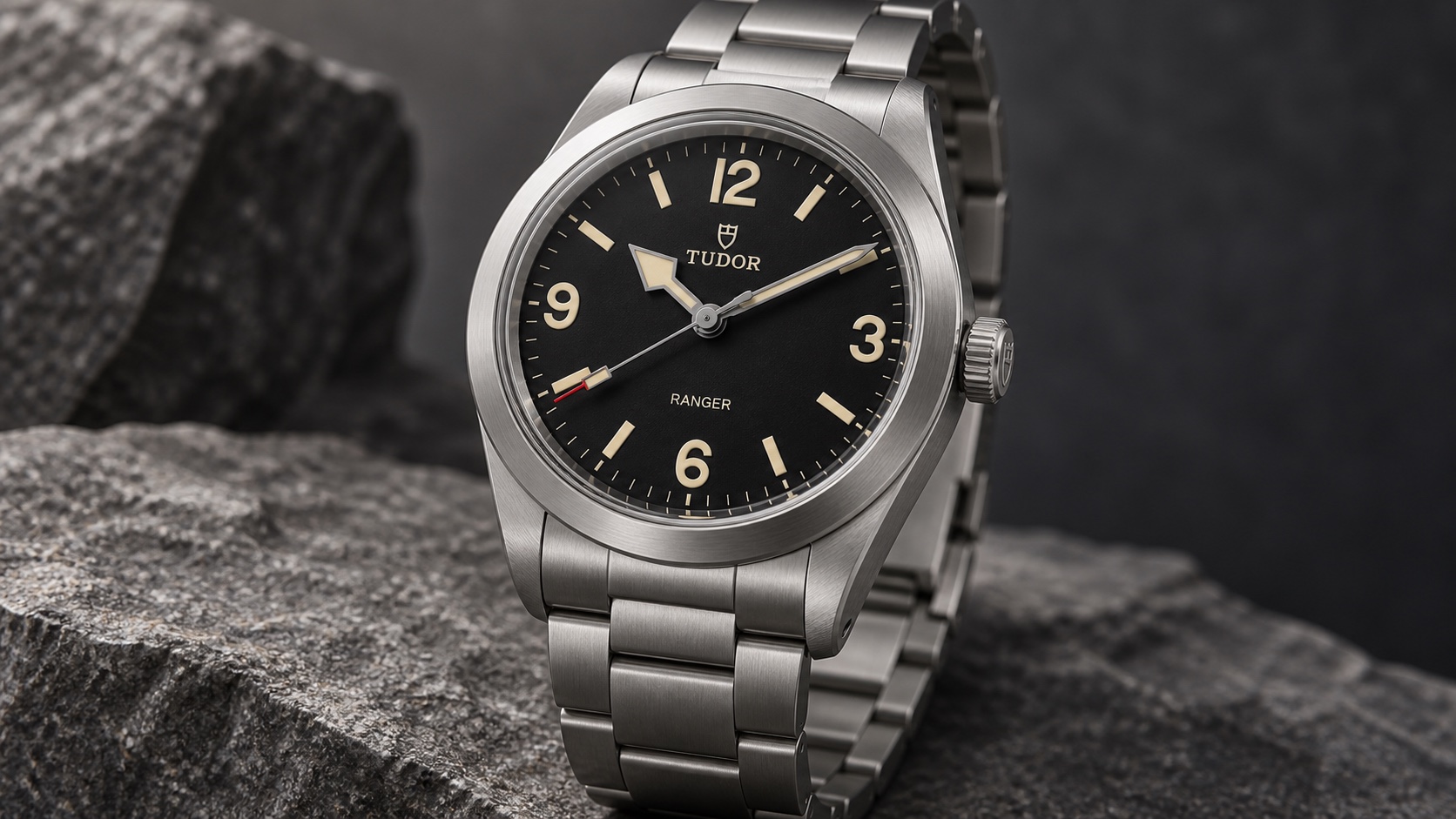
Two clear black dials can hide quite different purchase decisions. The Tudor Ranger gives you four large numerals, no date and a steel bracelet with an adjustable clasp. The IWC Mark XX adds a calendar and a five-day reserve in a thinner case, supplied here on leather.
The Ranger M79950-0001 is the more bracelet-focused field-watch proposition. The Mark XX IW328201 is the pilot-style alternative for someone who wants a restrained case and longer autonomy. Decide which of those ordinary benefits you will use before asking which brand makes the more impressive watch.
The references compared
| Feature | Tudor M79950-0001 | IWC IW328201 |
|---|---|---|
| Diameter / thickness | 39 / 12 mm | 40 / 10.8 mm |
| Movement | MT5402 automatic; COSC | 32111 automatic |
| Reserve | Approximately 70 hours | 120 hours |
| Date | No | Yes |
| Water resistance | 100 m | 10 bar |
| Crystal | Domed sapphire | Convex sapphire; pressure-drop retention |
| Supplied attachment | Steel bracelet with T-fit | Black calfskin with EasX-CHANGE |
| Lug width | 20 mm | 20 mm |
Specifications: Ranger 39 specifications; Mark XX exact specifications.
Expedition and aviation roots behind the two dials
Tudor’s Ranger history distinguishes the collection’s 1960s dial language from the Oyster Prince watches used on the British North Greenland Expedition. The 2022 Ranger marked that expedition’s seventieth anniversary, but it was not a literal reissue of a Ranger carried throughout the journey.
The Mark XX’s historical reference is IWC’s Mark 11, developed for the Royal Air Force in 1948. The modern watch preserves the emphasis on organised, readable information while updating the case, movement and strap system. Both draw on functional watch design without requiring a modern owner to recreate an expedition or aviation role. Their histories explain the faces; their current specifications should decide how well they suit your week.
Which form of simplicity do you prefer?
The Ranger’s 3, 6, 9 and 12 arrangement gives the dial a deliberate rhythm. Its arrow hour hand and absence of a date keep the display strongly recognisable. Removing functions does not make the watch anonymous when those shapes are the attraction.
The Mark XX offers a fuller sequence of Arabic numerals and the familiar orientation triangle at twelve. Its date is a practical addition for someone who checks the calendar repeatedly. The dial still remains straightforward, but it is organised around more information.
A good comparison is to look at each from a normal reading distance. Decide which hand-and-numeral arrangement you prefer before studying the movement. A reserve number will rarely make you love a dial that initially leaves you indifferent.
The wider IWC is thinner
The Mark XX’s 40 mm diameter exceeds the Ranger’s by 1 mm, yet its 10.8 mm thickness is 1.2 mm less. That makes it worth trying if you want a broad, clear face without much height under a sleeve.
The Ranger’s 12 mm case reinforces its substantial everyday character. The smooth satin bezel and steel bracelet keep the exterior visually consistent. It can be the more attractive choice when you want a watch that feels deliberately robust in appearance, even without a rotating timing ring.
Neither comparison requires treating leather and bracelet as interchangeable. The supplied attachment changes the outline, balance and fit. These exact references should be assessed as complete watches, not as two bare cases in a diameter contest.
Five days is a useful difference
IWC specifies 120 hours of reserve for calibre 32111, against approximately 70 hours for Tudor’s MT5402. Both can suit a normal rotation when adequately wound. The IWC offers substantially more room for several days away from the wrist.
That extra capacity matters if you often change watches midweek or leave one behind for a short trip. If you wear the same watch every day, the distinction may rarely affect the routine. The Ranger’s lack of a date also makes restarting it simpler when it does stop.
Tudor identifies the MT5402 as COSC certified. IWC’s principal published attractions here include the extended reserve, automatic winding and construction details such as a crystal secured against pressure-drop displacement. Those are different features, rather than a ready-made quality ranking.
The bracelet may settle a close decision
The Ranger’s T-fit clasp is a strong reason to choose its steel configuration. It addresses small changes in bracelet fit during normal use. A buyer who wants to remain on steel should give that feature proper attention.
The IWC’s EasX-CHANGE system makes swapping compatible straps part of the ownership proposition. Black calfskin provides a restrained starting point, especially with shirts or knitwear. If you intend to buy a bracelet instead, compare the actual alternative reference and complete price.
The better everyday choice
Choose the Ranger if you prefer its numeral pattern, want no calendar and value the supplied adjustable steel bracelet. Choose the Mark XX if the thinner case, date and five-day reserve address your routine more directly.
Both publish a 100 m or equivalent 10-bar rating. The deciding differences therefore lie in display, attachment and proportions, rather than an imagined gulf between field and pilot watches. Buy the one whose ordinary details make you want to wear it more often.
Based on manufacturer information. Specifications checked on 8 September 2026.
Image: AI-generated editorial illustration of the Tudor Ranger 39 reference M79950-0001. Fine dial details, hand shapes and finishing may differ from the production watch.


