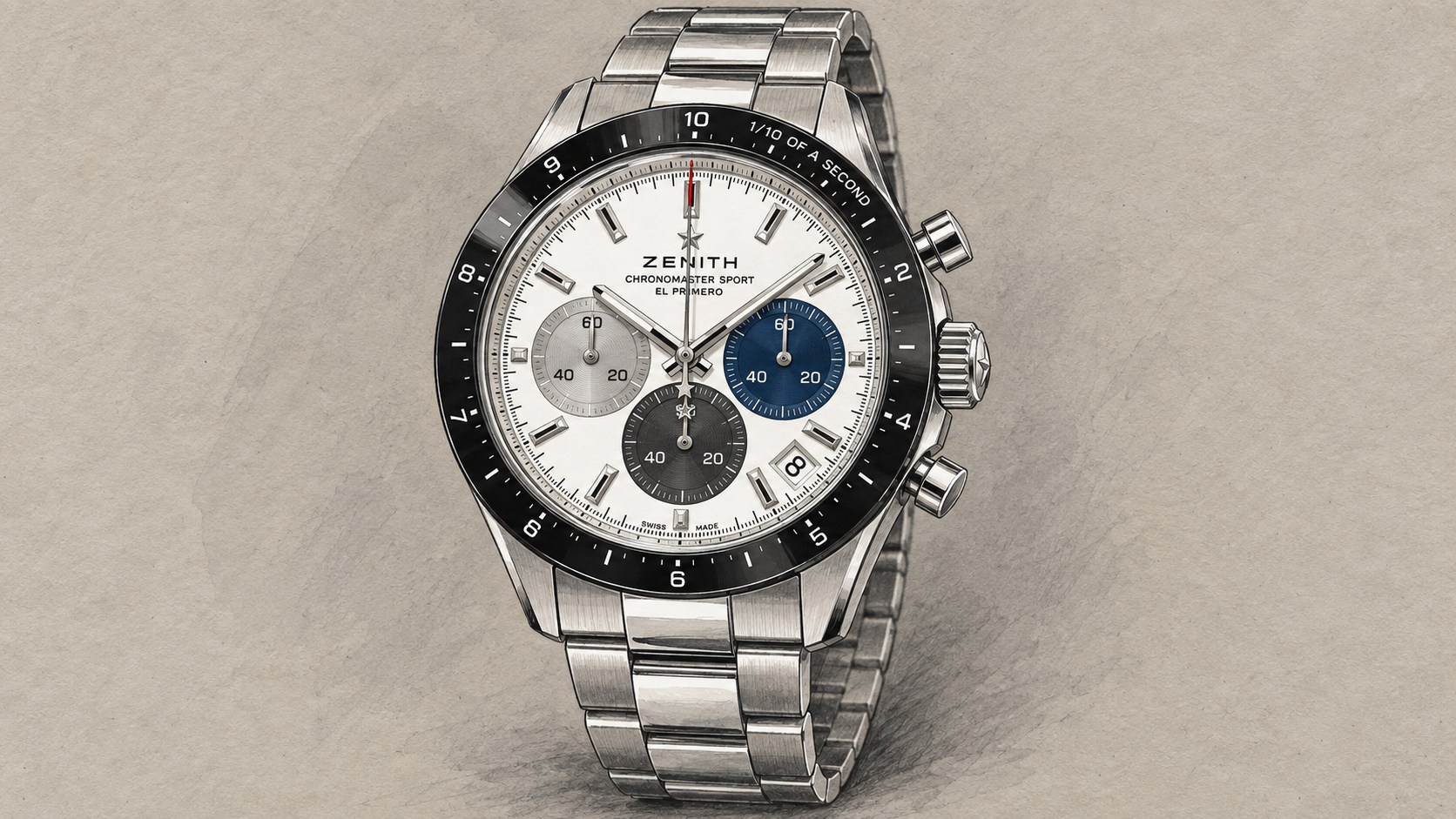
These chronographs are separated by more than automatic versus manual winding. The Zenith’s long timing hand completes a circuit in ten seconds, making its one-tenth-second display immediately conspicuous. The Moonwatch uses a more conventional seconds circuit and separate minute and hour counters.
Choose the Chronomaster Sport if that rapid display, coloured registers and automatic movement are the reason you want a chronograph. Choose the Moonwatch if its black dial, longer-hour timing layout and manual-winding identity are the attractions. The watches both time events, but they give the act of starting and reading the chronograph a different visual character.
The references compared
| Feature | Chronomaster Sport | Moonwatch Sapphire |
|---|---|---|
| Reference | 03.3100.3600/69.M3100 | 310.30.42.50.01.002 |
| Case diameter | 41mm | 42mm |
| Movement | Automatic El Primero 3600 | Manual Omega 3861 |
| Reserve | Approximately 60 hours | 50 hours |
| Long timing hand | One revolution in 10 seconds | One revolution in 60 seconds |
| Elapsed counters | 60 seconds; 60 minutes | 30 minutes; 12 hours |
| Bezel | Ceramic; one-tenth-second scale | Tachymeter |
| Calendar | Date at 4:30 | No date |
| Water resistance | 10 ATM | 50m |
Two histories behind the decision
El Primero began in 1969, and Zenith’s 2021 Chronomaster Sport combines several historical design cues with the newer calibre 3600. The coloured registers recall the A386, while other elements draw on the brand’s black-bezel and bracelet chronographs. Omega’s Speedmaster story includes NASA qualification in 1965 and use during the Apollo lunar programme. The current sapphire Moonwatch carries that visual identity into a later movement and transparent-back configuration. Neither current reference is the exact historical watch behind its story. The useful comparison is how the makers use that inheritance: Zenith makes a modern high-frequency display central to the action, while Omega retains a more familiar elapsed-time arrangement and manual-winding relationship.
The Zenith bezel is not a tachymeter
The Chronomaster Sport’s ceramic ring is graduated for fractions of a second. Its long chronograph hand moves around that scale once every ten seconds, with elapsed seconds collected separately at three and minutes at six. The faster circuit is a display of the timing mechanism’s resolution.
The Moonwatch’s tachymeter serves a different calculation based on elapsed time over a known unit. Treating the two black bezels as equivalent would hide a major functional distinction. A buyer attracted by the Zenith’s spinning hand should also understand how the other registers complete the reading. It is an engaging display, but its numbers must be read as a system.
The Omega gives the hours their own counter
The Moonwatch combines a thirty-minute counter with a twelve-hour register. The selected Zenith instead provides elapsed seconds and sixty minutes, alongside running seconds. That changes the events for which the dial is immediately convenient.
For someone who enjoys tracking longer stretches with a dedicated hour counter, the Omega layout has a clear attraction. For someone primarily fascinated by short-interval measurement and the visible one-tenth display, the Zenith makes its specialism explicit. Neither advantage requires a claim that human button presses achieve laboratory timing precision. The interesting difference is how each watch presents elapsed time once the mechanism is running.
Winding changes the daily interaction
The Zenith winds automatically and offers approximately sixty hours of reserve. The Moonwatch is manually wound with a stated fifty-hour reserve. If you want the chronograph to gain energy while worn, that is a straightforward Zenith benefit.
The Omega makes more sense when winding is an interaction you positively enjoy. Its transparent back also leaves the movement visible without an automatic rotor crossing the view. This is a choice about the kind of mechanism you want to handle and see, rather than an automatic movement being universally more convenient or a manual one universally more authentic.
Colour, calendar and the final choice
The Zenith’s white face and three differently coloured counters produce a more varied composition than the Moonwatch’s black dial. A date window at half past four adds another function and another interruption. The Omega omits the calendar, keeping the three-register layout visually more self-contained.
Choose the Chronomaster Sport when the fast timing hand, automatic winding and colourful El Primero identity make it the chronograph you want to operate. Choose the sapphire Moonwatch when the manual movement, no-date dial and hour counter are the preferred package. If you are chiefly attracted to the history, compare how those historical associations survive in the current watches. The object you buy is the modern reference on the table, not a substitute for the event which made its family famous.
Specifications and sources checked on 8 September 2026. Chronomaster Sport specifications; Zenith design history; Moonwatch technical sheet; Omega Apollo history.
Image: AI-generated editorial illustration of the Zenith 03.3100.3600/69.M3100. Fine dial details and finishing may differ from the production watch.