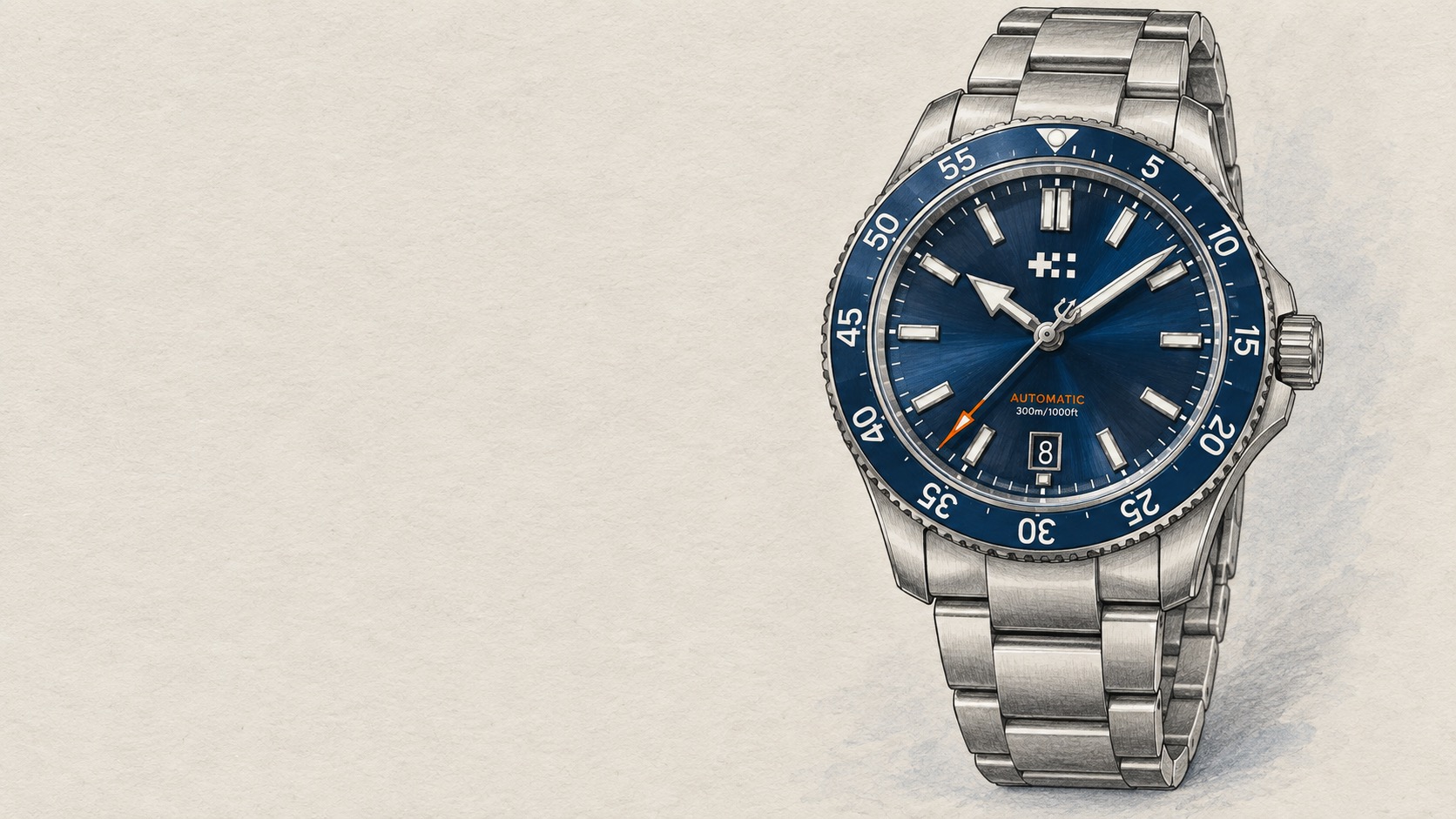
Two modern divers can share a 300 m rating and still solve the everyday-watch problem differently. The Christopher Ward C60 Trident Pro 300 gives you a relatively slim 40 mm case and a conventional three-link bracelet. The 41.5 mm Oris Aquis builds its identity around a more distinctive case-to-bracelet relationship.
This comparison uses the blue C60 on its Bader bracelet and the green Aquis with calibre 733-1. The Oris is not a Calibre 400 model, so a five-day reserve does not belong in the argument.
The references compared
| Feature | C60 C60-40ADA31S0BB1-B0 | Aquis 01 733 7787 4157-07 8 22 04PEB |
|---|---|---|
| Diameter | 40 mm | 41.5 mm |
| Thickness | 11.3 mm | Not stated in source used |
| Dial | Blue lacquer | Green |
| Movement | SW200-1 automatic | 733-1 automatic |
| Reserve | 38 hours | 41 hours |
| Water resistance | 300 m | 300 m |
| Bezel | Blue ceramic; fixed steel inner ring | Ceramic minutes-scale top ring |
| Attachment width | 20 mm | 22 mm interhorn width |
| Bracelet | Steel Bader; ratchet micro-adjustment | Steel; Aquis-specific design |
Specifications: Christopher Ward exact blue 40 mm Bader reference; Oris Aquis exact-reference specifications.
How two recent diver redesigns set their priorities
The C60 Trident Pro 300 development story describes a response to enthusiast feedback, with the 2022 generation placing more emphasis on a slimmer profile. Its modern diver vocabulary remained familiar, while proportion and bracelet usability became central selling points.
The 2024 Aquis redesign refined an established silhouette through changes to the case, crown protection, dial details and bracelet. Oris also coordinated the hands and hour-marker shapes as part of that revision. These histories point to incremental design choices rather than dramatic reinvention. Christopher Ward stresses a familiar diver made easier to accommodate, while Oris develops a recognisable family whose integrated-looking outline is part of the attraction.
The C60 gives you a useful fitting benchmark
The selected C60 measures 40 mm across, 11.3 mm thick and 47.45 mm lug to lug. That makes its dimensions unusually straightforward to assess before a fitting. If thickness is your main objection to divers, the 11.3 mm figure is a reason to investigate it.
The Aquis is 41.5 mm across. Its bracelet and case are designed to form a more distinctive continuous shape, so simply adding 1.5 mm to your mental picture of the C60 will not tell the whole story.
Look at the way each bracelet turns below the case and where the clasp rests. A watch you enjoy from above must also sit properly from the side. The published diameter is the beginning of that assessment, not its conclusion.
The bracelet is part of the decision
Christopher Ward’s Bader bracelet uses screw links, quick release and a ratcheting micro-adjustment system. Those features are relevant if you expect to alter the fit during the day or change the attachment regularly.
The Aquis has its own steel bracelet shape and attachment geometry. The listed 22 mm interhorn measurement does not turn it into the same strap proposition as the C60’s more conventional 20 mm lugs. For an owner who likes the supplied bracelet, that distinctive design may be a strength rather than a limitation.
Choose the complete bracelet watch you prefer first. A plan to replace its most recognisable component immediately can indicate that a different model would suit you better.
Neither reserve creates a large rotation advantage
The C60’s SW200-1 is specified at 38 hours, while the Aquis 733-1 offers 41. The three-hour difference is small beside the changes created by when you remove the watch and how fully it is wound.
Both provide automatic time and date in this comparison. Neither offers the long reserve associated with some other watches in the same manufacturers’ catalogues. The exact calibre matters more than the family name.
If leaving a watch from Friday to Monday without resetting is essential, neither published figure makes that a dependable full-weekend solution. If you wear the watch frequently, the shared automatic routine may be more important than those few hours.
Blue or green, familiar or distinctive?
The C60 combines a blue ceramic bezel with a slim fixed steel inner ring. That extra boundary divides the timing scale from the dial and gives its face a recognisable detail within a familiar diver layout.
The green Aquis uses shaped hands and shield-like markers, with the case and bracelet doing more of the work in establishing its identity. It is a stronger candidate if you want a design that remains recognisable beyond the brand printed on the dial.
Both use sapphire at the front and publish 300 m water resistance. Oris specifies a mineral-glass display back for this reference, a detail that is easy to miss when sapphire is discussed as though it covers every window.
Which one belongs on your shortlist?
Choose the C60 when a slim documented profile, convenient Bader adjustment and a conventional attachment layout answer your everyday needs. It makes a clear case through proportions and practical details.
Choose the Aquis when its green face and distinctive steel architecture are the reasons you keep returning to it. The shared depth rating and similar reserves leave room for design preference to decide, provided you compare the actual 733-1 reference rather than borrowing specifications from a different Aquis.
Based on manufacturer information. Specifications checked on 8 September 2026.
Image: AI-generated editorial illustration of Christopher Ward C60-40ADA31S0BB1-B0. Design details are approximate; this is not a product photograph.


