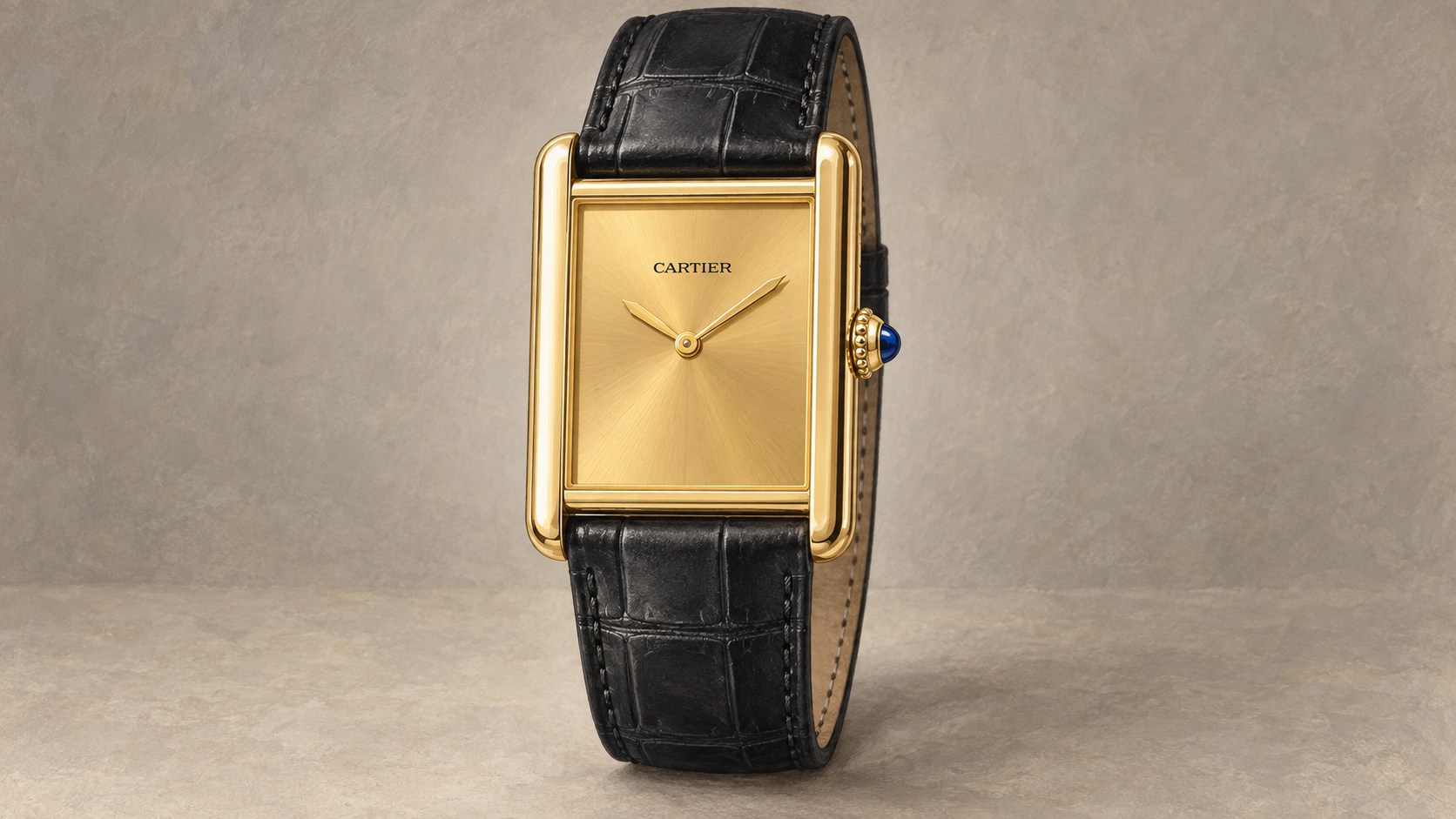
The word Large becomes unreliable as soon as you cross from one rectangular-watch collection to another. Cartier calls the WSTA0136 a large Tank Must, while the Tank Louis WGTA0211 uses a medium label at the same published length and width. The Reverso in this comparison stretches much farther along the wrist.
Begin with those dimensions and the actual dial, not the size adjective. These watches share a non-round outline, but they propose three distinct purchases: a gold manually wound Tank, a steel quartz Tank, or a reversible mechanical case with small seconds.
The rectangle changes the meaning of size
| Exact reference | Published length × width | Thickness | Movement | Material and display |
|---|---|---|---|---|
| Cartier Tank Louis WGTA0211 | 33.7 × 25.5mm | 6.6mm | 1917 MC manual; 37h | Yellow gold; golden two-hand dial |
| Jaeger-LeCoultre Reverso Q3858524 | 45.6 × 27.4mm | 8.51mm | 822 manual; 42h | Steel; small seconds; reversible Monoface |
| Cartier Tank Must WSTA0136 | 33.7 × 25.5mm | 6.6mm | High Autonomy quartz | Steel; silvered two-hand dial |
Jaeger-LeCoultre’s 45.6mm figure is its documented lug-to-lug length. Cartier publishes the complete 33.7 by 25.5mm dimensions for both selected Tanks. Neither should be reduced to a comparison of width against the diameter of a round sports watch.
The case shape carries the history
Cartier dates the Tank design to 1917 and the Tank Louis development to 1922. Its long side elements frame the dial and lead into the strap, making the surrounding structure central to its identity. The Reverso emerged from a challenge to protect a watch crystal during polo, followed by a patent application in 1931. Its case could slide and turn over within a cradle. Those are different solutions with different visual consequences: the Tank draws the strap into its outline, while the Reverso makes a moving case part of the object.
The Tank Must keeps ownership particularly simple
The WSTA0136 uses High Autonomy quartz with hours and minutes only. There is no calendar to correct after a short month and no mainspring to wind before an occasional dinner. That makes the design itself the reason to choose it.
Steel, a silvered dial, blue sword-shaped hands and black grained calfskin give it a restrained combination of colours. The beaded crown uses a synthetic spinel cabochon. Those details matter when comparing it with the gold Tank Louis rather than treating both as the same watch with a different price.
Quartz convenience still includes eventual battery replacement and sensible care. High Autonomy should not be converted into an unsupported promise about the remaining battery life of a particular watch sitting in stock.
The Tank Louis makes the gold visible
The WGTA0211 pairs yellow gold with a golden sunray-effect dial and golden-finished hands. It is a more continuous warm-coloured object than the steel-and-silver Tank Must. Choose it because that appearance appeals, rather than because manual winding must be an upgrade for every wearer.
The 1917 MC provides 37 hours of reserve. This is a watch to wind as part of getting ready, especially when it has been left for more than a day or two. Its dimensions remain compact, and the 6.6mm thickness gives a useful starting point for a close cuff.
Other current Tank Louis references use different movements, including automatic versions. The family name alone does not identify this one’s winding routine, dial or size.
The Reverso is a longer and more mechanical proposition
The Q3858524 uses a steel Monoface case, a silvered-grey dial and a small-seconds display. Monoface matters: the reversible construction does not mean this reference has a second time-zone dial on the other side. Its back can be appreciated as a surface in its own right.
At 45.6mm along the wrist and 8.51mm thick, it has a different footprint from either Tank. The black Fagliano Collection calfskin strap and 20mm attachment complete that longer outline. Try it with the strap appropriately fastened and check the case ends from the side.
The manually wound calibre 822 offers 42 hours. If seeing a seconds display and operating the reversible case are part of the attraction, the Reverso supplies forms of interaction absent from the two-hand Tanks.
Let the whole arm into the fitting
Look at each watch with your arm lowered, then check it beside a normal sleeve. A close photograph can make a compact rectangle fill the frame and obscure its real scale. Also assess whether the fine hands remain clear against the dial under ordinary indoor light.
All three use leather and modest water ratings, so frequent soaking should not be central to the brief. Choose the Tank Must for quartz readiness, the Tank Louis for its golden composition and manual routine, or the Reverso for the moving case and small seconds. The rectangle is the starting point; the exact design and operation should finish the choice.
Based on manufacturer information. Specifications checked on 8 September 2026.
Sources: Tank Louis Cartier WGTA0211 specifications; Cartier Tank Louis history and 2025 development; Cartier Tank design principles; Current Reverso Classic Large specifications; Reverso design and 1931 history; Cartier UK: Tank Must Large WSTA0136 specifications; Cartier: day-to-day watch care recommendations; Cartier: watch care, battery service and repair.
Image: AI-generated editorial illustration of the Cartier WGTA0211. Fine dial details and finishing may differ from the production watch.


