Take three watches from a drawer on Monday morning and they may ask very different things of you. A mechanical watch may need winding and setting. A battery-powered quartz watch may still show the time. A solar quartz watch may be running comfortably, provided it has received enough light. Those everyday differences are often more useful than a debate about which technology is more prestigious.
Automatic describes a way of winding a mechanical watch. Quartz describes a way of regulating time electronically. The categories therefore refer to different parts of the process, although they are commonly used as shorthand for two familiar kinds of watch.
Where the energy comes from
In a conventional automatic watch, a mainspring stores energy and powers the movement. A rotor responds to movement of the watch and winds that spring. The familiar balance and escapement regulate how the stored energy is released through the mechanism.
A quartz movement uses an electrically driven crystal oscillator as its timing reference. Electronics translate that reference into the display, which can be analogue hands or digital numerals. The energy may come from a replaceable battery or a rechargeable cell, including one charged by light.
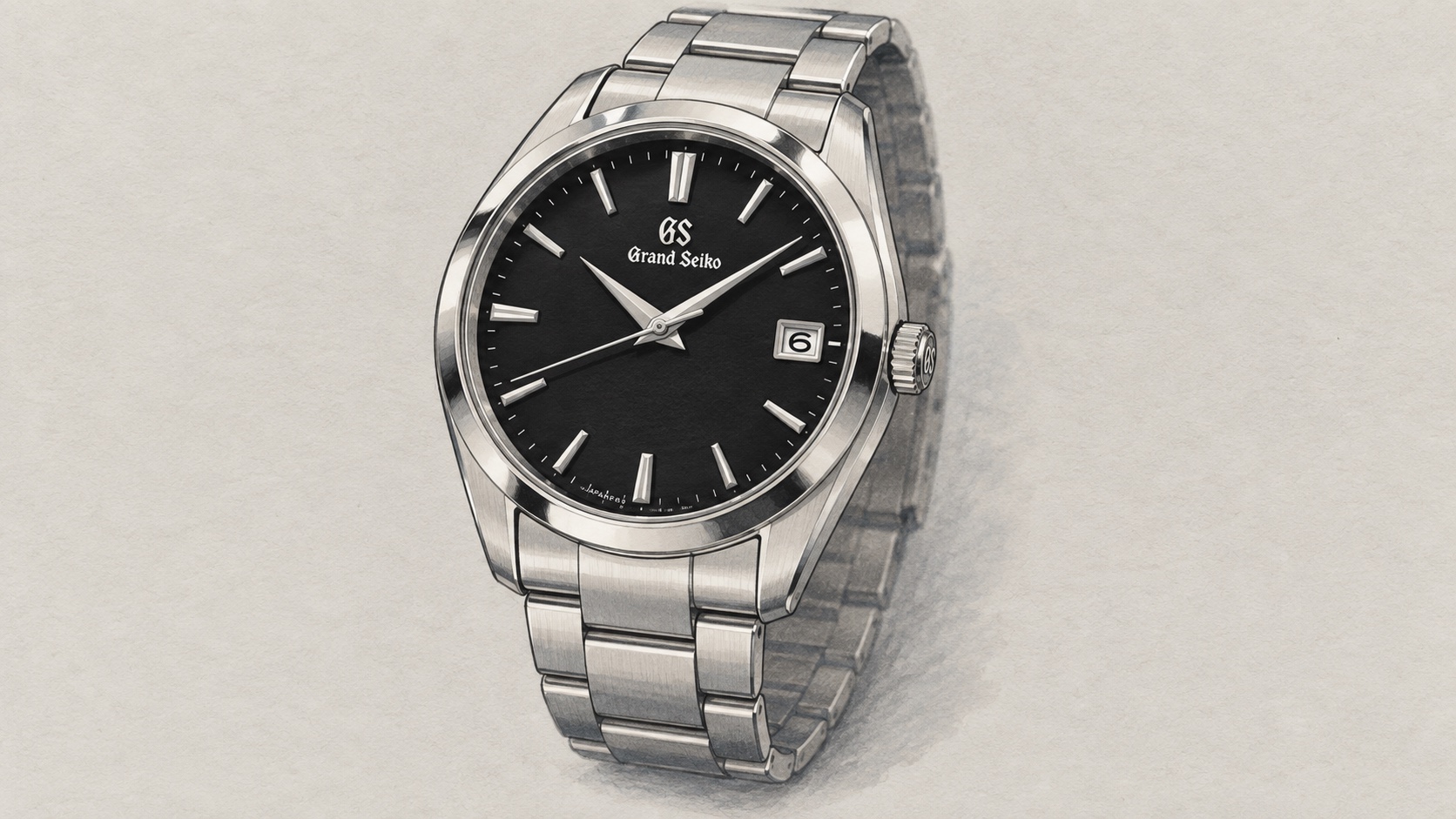
Digital is consequently not a synonym for quartz, and quartz does not mean the watch has to display numbers on a screen. The Grand Seiko SBGP011 looks like a traditional three-hand watch with a date, while the Casio A168 uses a digital display. Both are quartz.
Three watches show the range
| Reference | System | Published timekeeping and energy details |
|---|---|---|
| Rolex Datejust 36 126234-0051 | 3235 automatic | Approximately 70-hour reserve; minus 2 to plus 2 seconds/day after casing |
| Grand Seiko SBGP011 | 9F85 quartz | Plus or minus 10 seconds/year; approximately 3-year battery life |
| Casio A168WA-1 | Digital quartz | Plus or minus 30 seconds/month; approximately 7-year battery life |
The time units are essential. Seconds per year, per month and per day are very different specifications. Reading only the number ten, thirty or two without its unit reverses the meaning of the comparison.
The table also shows that quartz covers a wide range. Grand Seiko’s 9F85 is designed around high precision and an independently adjustable hour hand, while the Casio offers a compact digital display with everyday functions. Choosing quartz does not settle the budget, design or level of engineering.
The 1969 turning point
Seiko put the Quartz Astron on sale on 25 December 1969. Its own historical account describes the challenge of reducing a quartz timekeeping system to wristwatch size, including the oscillator, integrated circuit and motor needed to operate the hands.
The original Astron was a gold-cased watch, a useful reminder that quartz did not begin simply as shorthand for an inexpensive product. Over subsequent decades, the technology became available across a much broader range. Today’s choice includes both highly accessible digital watches and carefully finished analogue quartz models.
What happens when you stop wearing it
A conventional automatic runs until its stored mechanical energy is depleted. The Datejust’s approximately 70-hour reserve is a fully wound reference point, not a promise that any brief period on the wrist has filled the spring. After it stops, time and date need attention.
A battery-powered quartz watch continues running while its battery has sufficient energy, whether or not it is being worn. That can be convenient for a watch used only occasionally. Battery life is still an estimate under stated conditions, so it belongs in the ownership plan.
Solar quartz adds a different habit: provide the light exposure specified by the maker. Putting it permanently in a dark drawer is not equivalent to keeping a conventional battery watch ready. The movement type explains the routine you need to support.
What draws buyers to mechanical watches
The mechanism itself can be part of the enjoyment. An owner may like the act of winding, the visible motion through a caseback or the idea of spring-powered timekeeping. Those are reasonable preferences even when a quartz alternative offers a stronger numerical accuracy specification.
Likewise, choosing quartz for convenience does not imply a lack of interest in watches. The 9F85’s independently adjustable hour hand is an example of an ownership feature worth appreciating on its own terms: it lets the local hour change without stopping the seconds indication.
Choose the routine you want
If you want a watch that can sit between occasional outings with minimal resetting, quartz deserves a close look. If interacting with a mechanical movement is part of the attraction, an automatic may suit you even when it needs restarting after a break.
Then compare the actual references. The Datejust, Grand Seiko and Casio differ in dimensions, materials, display and price positioning as well as movement. Let the technology support the experience you want, and choose the watch whose appearance and functions make you want to put it on.
Based on manufacturer information. Specifications and sources checked on 8 September 2026.
Sources: Rolex Jubilee configuration; Rolex Oyster configuration; Rolex Datejust history; Grand Seiko UK boutique SBGP011; Grand Seiko GS9 Club movement history; Grand Seiko calibre 9F85; Grand Seiko Japan SBGP011; Casio UK A168WA-1YES; Casio 1990s history: A168 launch in 1995; Casio water-resistance care guidance; Seiko quartz operation and development; Seiko Quartz Astron launch history; Rolex automatic winding principle.
Image: AI-generated editorial illustration of the Grand Seiko SBGP011. Design details are approximate; this is not a product photograph.