The GMT-Master II and Black Bay Pro share the feature many travellers want most: a separately adjustable local hour. Their similar reserves also make the movement headline a poor way to separate them. The useful differences sit around the dial and bracelet.
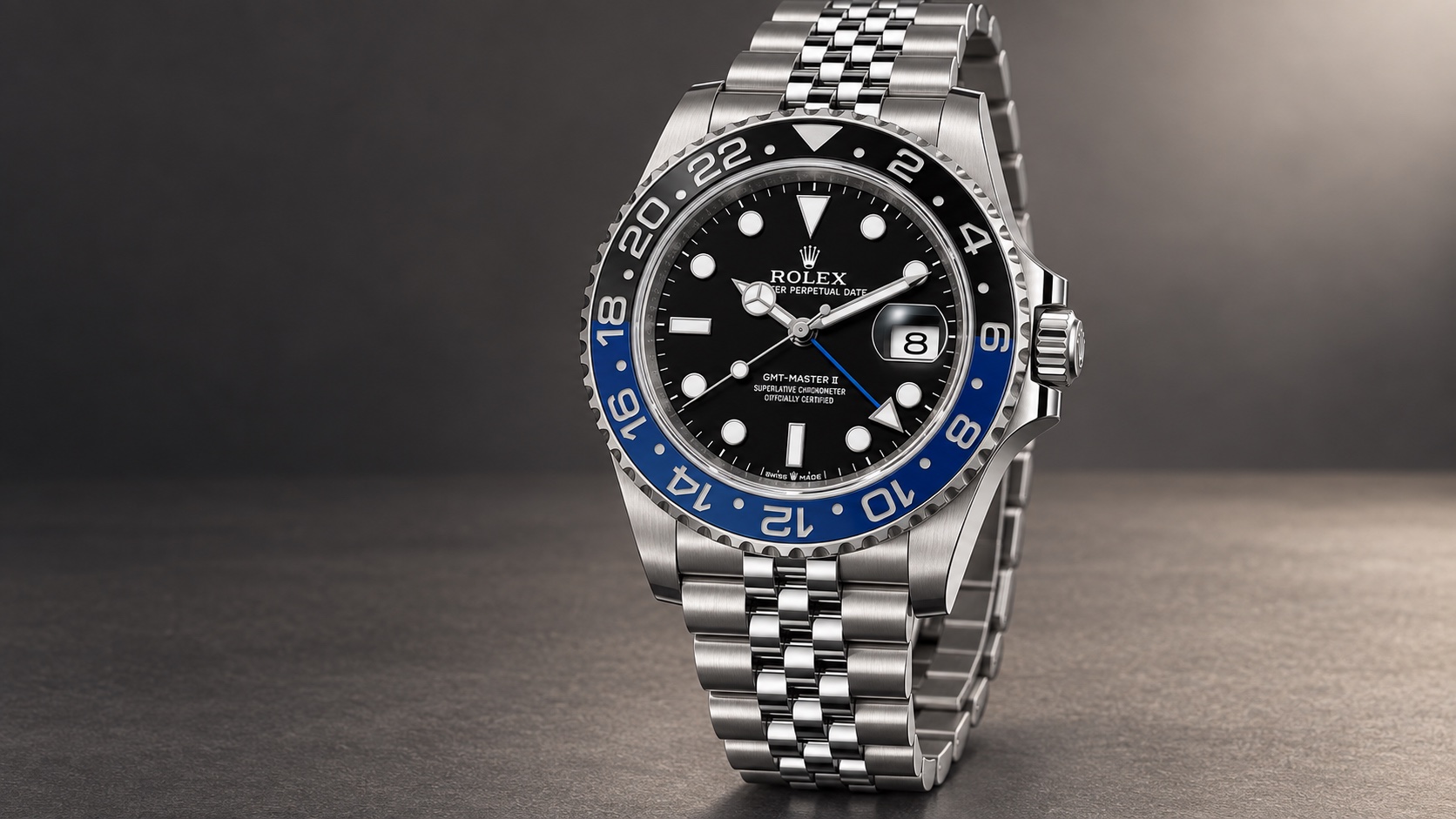
The selected Rolex uses a blue-and-black ceramic bezel that rotates and a Jubilee bracelet. The Tudor keeps its twenty-four-hour scale fixed in engraved steel, with a rivet-style bracelet and T-fit adjustment. Choose between those complete designs rather than assuming the Tudor is merely a smaller version of the Rolex. The fixed bezel gives it a substantially different brief.
The references compared
| Feature | GMT-Master II | Black Bay Pro |
|---|---|---|
| Reference | 126710BLNR-0002 | M79470-0001 |
| Case diameter | 40mm | 39mm |
| Movement | Automatic Rolex 3285 | Automatic Tudor MT5652 |
| Reserve | Approximately 70 hours | Approximately 70 hours |
| Local hour | Independently adjustable | Independently adjustable |
| Bezel | Rotating blue/black ceramic | Fixed engraved steel |
| Date | At three; Cyclops | At three; no magnifier |
| Water resistance | 100m | 200m |
| Bracelet | Jubilee; Oysterlock; Easylink | Rivet-style steel; T-fit |
Two histories behind the decision
Rolex introduced the GMT-Master in 1955, with the later GMT-Master II of 1982 adding the independently adjustable local-hour architecture associated with the modern family. The Black Bay Pro takes another route through Tudor’s instrument and expedition-oriented design language, using familiar Snowflake hands and a fixed steel scale. The useful historical distinction is not a ranking of the two brand names. It is the relationship between the display and its intended interaction. The Rolex family developed around a rotating bezel as part of its time-zone system; the Tudor Pro makes the surrounding scale a permanent frame. Their current movements share a travel-friendly adjustment idea while the watches present that idea differently.
The Rolex bezel offers a movable reference
Rotating the GMT-Master II’s twenty-four-hour bezel changes the scale read against its additional hand. This can support another offset once the watch is configured and its display understood. The blue and black halves also give the surrounding ring a strong visual identity.
The Pro’s engraved steel bezel stays in place. That creates a simpler fixed relationship between the twenty-four-hour hand and its scale, as well as a plainer exterior. If a movable GMT bezel is part of the function you want, the Tudor cannot substitute for it. If the fixed steel ring is precisely the appearance you prefer, the Rolex’s extra interaction need not be an advantage.
Shared hour adjustment leaves room for the exterior
Both watches let the main local-hour hand change independently, which is useful when moving between whole-hour time zones. Both provide approximately seventy hours of reserve. Those shared features prevent the comparison from becoming a simple contest between a travel GMT and a fundamentally different kind of movement.
The Tudor’s greater stated water resistance is a separate specification. It does not change the GMT operation, just as the Rolex’s rotating ring does not determine the depth rating. Keeping the functions separate produces a clearer shortlist: decide which time-zone display you want, then weigh the other construction and bracelet features on their own merits.
The calendar and bracelet create different levels of detail
The Rolex’s magnifier makes the calendar conspicuous on the right side of the crystal. Its five-piece Jubilee links add another set of small reflective surfaces around the wrist. The Tudor has an unmagnified date and a bracelet whose rivet-style details support its more historically styled appearance.
Both are calendar watches, but the date is presented differently. If a larger visible numeral is helpful, the Cyclops is a positive Rolex feature. If you prefer an uninterrupted crystal, the Tudor has a reason to lead the choice. The same applies to the bracelets: Jubilee should be selected because you like its appearance and construction, not simply because it accompanies the better-known watch.
Adjustment details should remain attached to the reference
This Rolex configuration combines Oysterlock and Easylink. The Tudor bracelet uses T-fit. Those are different named systems, so a comparison should examine their actual operation rather than describing both vaguely as an adjustable clasp. The complete bracelet can be as important as the one-millimetre diameter difference.
Choose the GMT-Master II when the rotating blue-and-black bezel, magnified date and Jubilee are the package you want. Choose the Black Bay Pro when a fixed steel frame, Tudor hands and T-fit bracelet make the more convincing instrument. If you are attracted to the Pro specifically because it looks different, that is a stronger foundation than treating it as a placeholder while still wanting the Rolex’s defining features.
Specifications and sources checked on 8 September 2026. GMT-Master II specifications; Rolex GMT history; Black Bay Pro specifications; Tudor Pro operation and design.
Image: AI-generated editorial illustration of the Rolex GMT-Master II 126710BLNR-0002 on Jubilee bracelet. Fine dial details and finishing may differ from the production watch.


