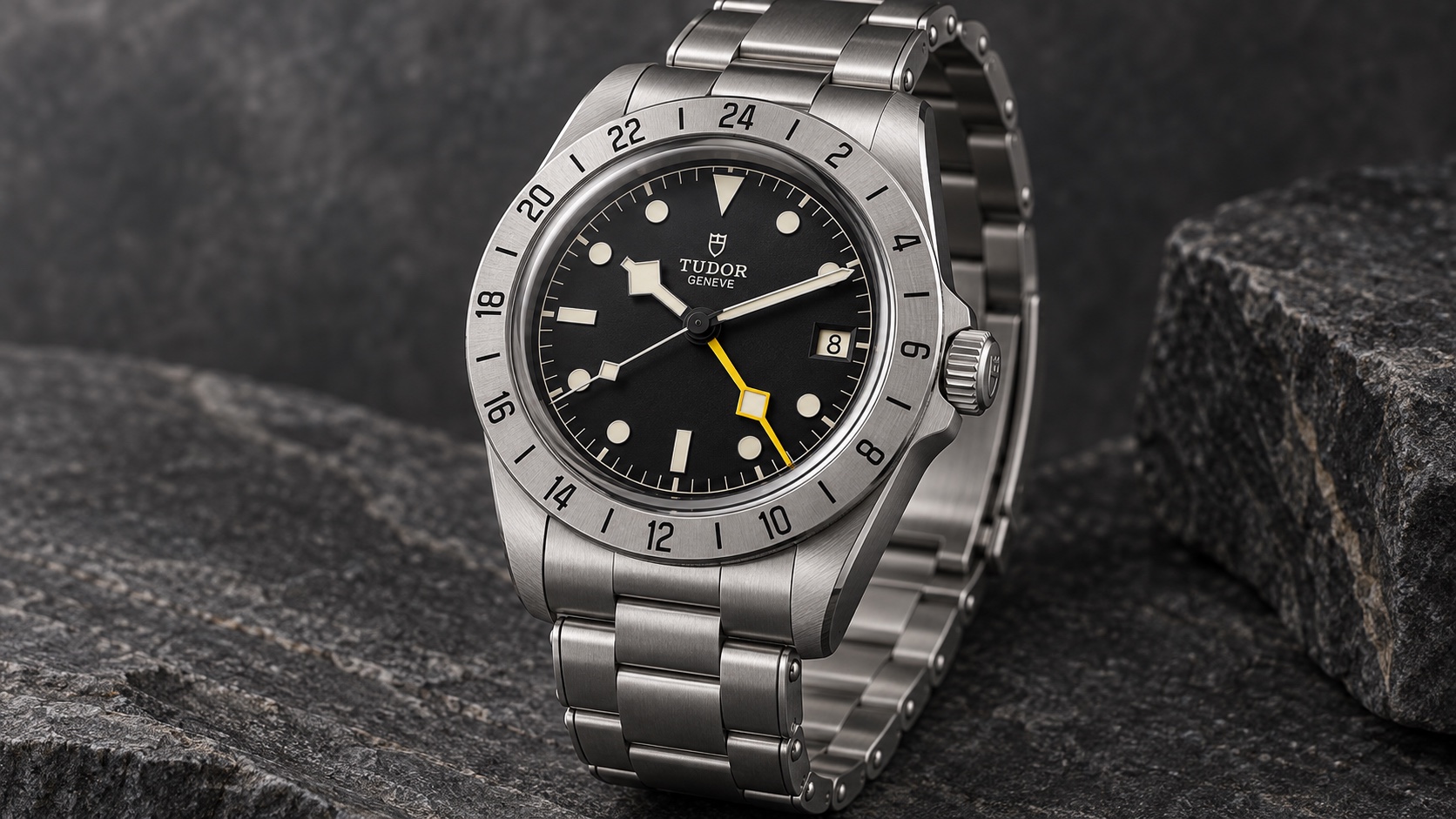
The Black Bay Pro’s most useful feature is easy to miss in a photograph. The short hour hand can jump independently when you cross a time zone, while the yellow hand continues to show home time. That is a stronger reason to consider it than a general desire for an expedition-looking watch.
Its compromise is equally clear: Tudor puts that system into a 39mm case which stands 14.6mm high. The diameter sounds restrained; the full object is deliberately substantial. This guide makes the case for its particular GMT arrangement, then asks whether the fixed steel bezel and case architecture are the version of that idea you want.
The history behind the choice
The historical connection behind the Black Bay Pro is broader than a single diving reference. Tudor supplied Oyster Prince watches for the British North Greenland Expedition of 1952 to 1954. Those expedition watches were not Black Bay Pros, and attaching the modern model’s name to them would flatten an interesting history. Today’s watch translates that exploratory association through a contemporary travel complication and a robust-looking steel exterior. Its bracelet adds another historical reference: the visible rivet style recalls bracelets of the 1950s and 1960s, although the current construction uses solid links. The result combines several parts of Tudor’s vocabulary. It is best understood as a modern interpretation of practical watchmaking, rather than a precise reissue of the equipment worn in Greenland.
The exact reference
| Specification | Published detail |
|---|---|
| Reference | M79470-0001 |
| Case | 39mm steel; 14.6mm thick |
| Lug width | 20mm |
| Dial | Domed black; date at 3 |
| Bezel | Fixed steel; 24-hour scale |
| Movement | Automatic MT5652; integrated GMT; COSC |
| Stated reserve | Approximately 70 hours |
| Local hour | Independently adjustable forwards or backwards |
| Water resistance | 200m |
| Crystal | Domed sapphire |
| Bracelet | Riveted steel; T-fit clasp |
The distinction between home time and local time
The yellow Snowflake hand makes one circuit in twenty-four hours and reads against the bezel. The shorter hour hand shows local time on the ordinary twelve-hour dial. Because local time can be changed independently, arriving in a new zone need not involve rebuilding both displays from scratch.
Tudor couples the date to that local-hour indication. Moving backwards across midnight also moves the calendar to the previous day. This is a particularly relevant detail when travelling west or correcting an overshoot. It gives the GMT system an internally consistent role: the main hands and date describe where you are, while the yellow hand preserves the reference time you chose to keep.
Why the bezel stays still
The fixed steel bezel keeps a twenty-four-hour scale permanently in the same position. There is no second colour division, and no rotating ring to change the relationship between the scale and the yellow hand. The display therefore has a certain directness. Once you know what each hand represents, the two time zones occupy predictable places.
The cost of that simplicity is reduced flexibility compared with a rotating GMT bezel. A GMT-Master II allows its external scale to be repositioned; the Pro does not. If you frequently track a third location, that difference deserves more attention than a comparison of case polishing. If you mainly move between local time and one home reference, the Pro’s fixed arrangement may be the cleaner answer.
A compact diameter with a substantial profile
The polished and satin steel case is an important part of the design. At 39mm it avoids the broad outline of some travel watches, but the domed sapphire and 14.6mm height create a markedly different impression from a thin everyday three-hander. The bezel’s exposed steel reinforces that architectural quality.
This is the one physical question to settle in person: whether that vertical presence appeals to you. The T-fit clasp can refine bracelet adjustment, but it cannot turn a tall watch into a flat one. The Pro makes more sense when you like its compact, solid-looking proportions than when you are hoping the diameter figure will make the rest of the case disappear.
An integrated GMT, not a decorative extra hand
Tudor describes the MT5652 as a movement with an integrated GMT architecture. Its approximately seventy-hour reserve and COSC certification accompany a complication that directly changes how the watch is set. Those details support the Pro’s practical story more convincingly than the general suggestion that any watch with an extra hand is a travel essential.
For a desk-based owner following a colleague abroad, the second zone can still be useful. But the jumping local hour becomes especially relevant when the watch itself travels. If you rarely need two zones, the yellow hand and numbered bezel are primarily design preferences. That is a legitimate reason to enjoy them, although a simpler Tudor could then provide the same essential daily function with less information on the dial.
The alternatives and the verdict
The Ranger removes the GMT hand, date and numbered bezel for a cleaner field-watch approach. The Black Bay 54 replaces the fixed twenty-four-hour scale with a movable elapsed-time bezel. These are different tools, rather than inferior versions of the Pro. The Rolex GMT-Master II offers another approach to the travel brief, notably with a rotating ceramic bezel.
Choose the Pro if independent local-hour setting is useful and the all-steel frame is part of its appeal. Its strongest argument is the relationship between the hands, date and fixed scale. If your first priority is a low case profile, start elsewhere: the Pro’s character and its principal compromise are inseparable.
Specifications and sources checked on 8 September 2026. Black Bay Pro specifications; Black Bay Pro GMT operation and design; Tudor expedition history; Rolex GMT-Master II comparison.
Image: AI-generated editorial illustration of the Tudor Black Bay Pro M79470-0001. Fine dial details, hand shapes and finishing may differ from the production watch.


