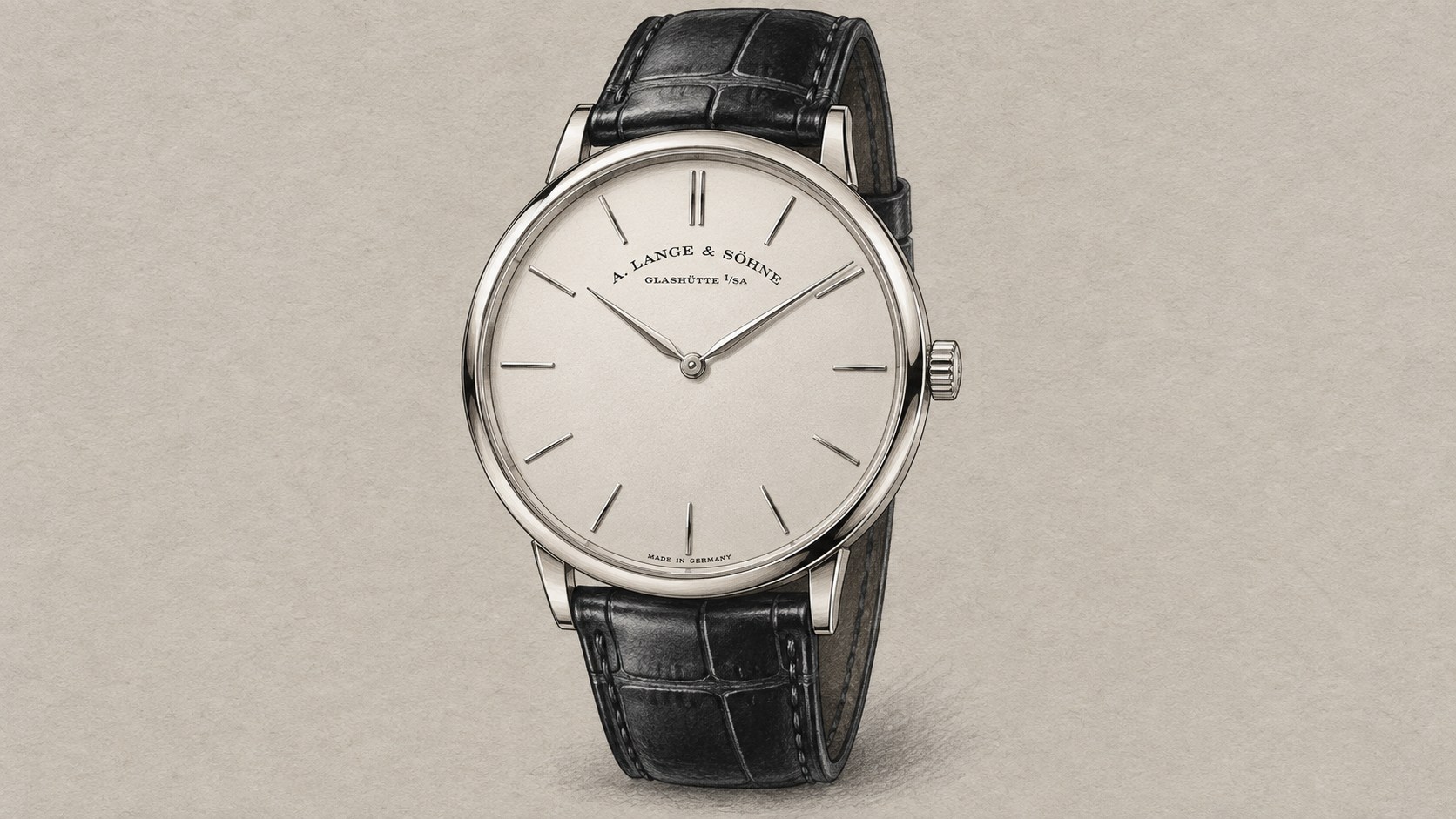
The Saxonia Thin asks a sharper question than most luxury watches: are the hands, markers, case and movement enough? There is no seconds display to animate the face and no date to add everyday information. Reference 201.027 concentrates its appeal into a white-gold case, a silver dial and the mechanism revealed on the other side.
That reduction is attractive when you enjoy small differences in proportion. It can feel unrewarding if your interest depends on operating complications or seeing several indications move. The 37mm Saxonia is strongest as a deliberate choice of restraint, with a remarkably slim case making the limited display feel like a complete design decision.
The history behind the choice
Lange introduced the Saxonia Thin in 2011, establishing a two-hand expression within a family which also accommodates more elaborate complications. The collection subsequently appeared in several diameters, while goldstone dials arrived in 2018 and 2020 and onyx editions followed in 2025. That development is revealing: the basic display can take on a very different character through material and surface rather than additional functions. The white-gold 201.027 remains the quieter proposition, using an argenté dial instead of a dramatic mineral or sparkling treatment. Its historical role is therefore not to reproduce a single antique watch. It represents Lange’s modern examination of how much visual and mechanical interest can remain after a wristwatch is reduced to hours and minutes.
The exact reference
| Specification | Published detail |
|---|---|
| Reference | 201.027 |
| Case | 18-carat white gold; 37mm diameter; 5.9mm thick |
| Dial | Argenté; solid silver |
| Functions | Hours and minutes |
| Movement | Manual calibre L093.1 |
| Reserve / frequency | 72 hours / 3Hz |
| Movement height / parts | 2.9mm / 167 |
| Back | Sapphire display back |
| Water resistance | 3 bar |
| Strap | Black alligator; white-gold prong buckle |
The dial makes proportion unavoidable
Removing the seconds hand changes how you look at the face. There is no rapid motion to draw attention away from the relationship between the hands and the applied markers. Their lengths, profiles and positions become the main subjects, rather than background elements supporting a complication.
The argenté colour provides a restrained setting for that arrangement. It also avoids the strong material spectacle of the goldstone or onyx versions. Choose it when you want the details to reveal themselves gradually. If you would rather have one striking surface dominate the watch immediately, another Saxonia Thin dial may express the same basic idea in a way that better suits your interest.
Thinness is a structural choice
A case height below six millimetres is not just a convenience to mention after discussing the dial. It contributes directly to the watch’s character as a small, flat object. The side view completes the restraint suggested by the two-hand face.
The 37mm diameter also keeps the expanse of silver dial relatively contained. Compare the complete object during a fitting, including the curved lugs and the transition into the black strap. A large dial opening can change the apparent scale of a simple watch, so the headline diameter is only a starting point. The relevant judgement is whether the thin frame and open face have the balance you wanted.
The manual movement is the second face
The L093.1 is only 2.9mm high, yet Lange gives it a stated seventy-two-hour reserve. Its flat barrel is part of the architecture which allows the slender case to remain mechanically interesting. Through the sapphire back, the three-quarter plate becomes a visual signature very different from the spare dial.
There is an appealing contrast between the two sides. The front asks you to notice what has been omitted; the back rewards attention to what has been made. Manual winding reinforces that relationship because there is no rotor moving across the view. This is a watch for someone who can find pleasure in that arrangement without needing the mechanism to advertise itself continuously through an open dial.
Finishing has to matter to the buyer
Lange’s account of the Saxonia Thin emphasises small finishing tasks, including the careful alignment of chamfers between components. It is a useful explanation of where effort can reside in a watch whose functions appear simple. The extra work does not have to create a new indication to be meaningful.
It does, however, have to matter to the person paying for it. Someone principally interested in the quantity of information displayed may find a more complicated watch more satisfying. The Saxonia’s argument depends on the execution of the limited components you can see and the movement you can turn over to inspect. Buying it because simplicity is supposedly the correct taste would miss the personal preference on which the design relies.
What you give up, and what you gain
The absence of running seconds removes an immediate visual indication that the watch is operating. The lack of a date means the wrist is not a source for calendar information. Manual winding adds a regular interaction. These are real characteristics, but together they also preserve the very still, uncluttered face that distinguishes the Saxonia Thin.
The Calatrava 6119G offers a useful alternative with small seconds and a decorated bezel. A Tank Louis Cartier changes the geometry and lets a rectangular gold frame do more of the visual work. Choose the Saxonia when a round, exceptionally slim case and an almost silent dial are the attraction, while a carefully executed manual movement supplies the detail you want to revisit. Its limited display is enough when those are the details you value most.
Specifications and sources checked on 8 September 2026. Saxonia Thin exact specifications; Saxonia Thin design and movement history; Calatrava 6119G comparison.
Image: AI-generated editorial illustration of the A. Lange & Söhne 201.027. Fine dial details and finishing may differ from the production watch.


