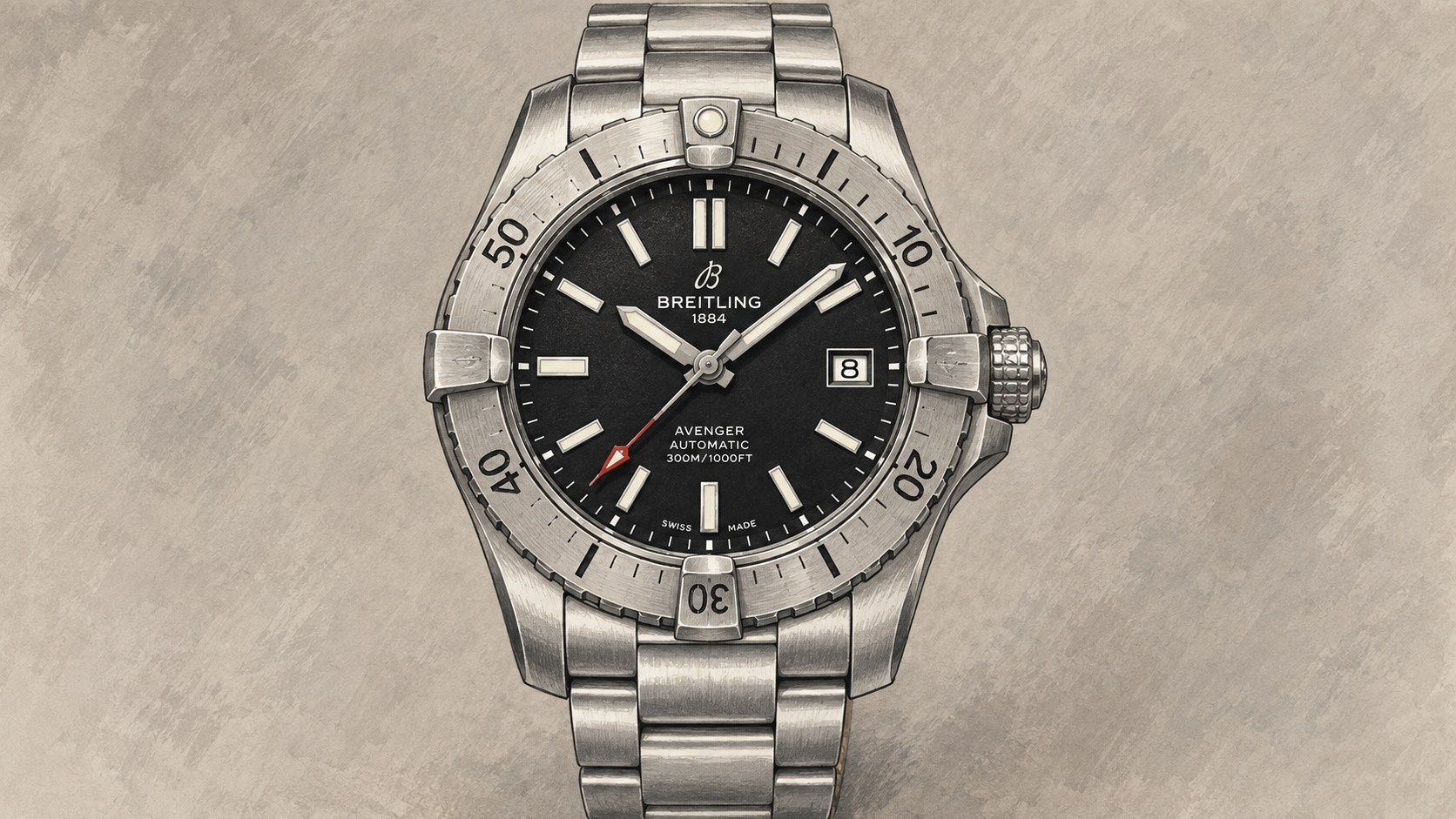
The three-hand Avenger is an attractive way to separate an interest in Breitling’s sporting case design from a desire to own a chronograph. It retains a rotating bezel, prominent controls and a calendar, but the dial does not need to accommodate elapsed-time counters. Reference A17328101B1A1 puts that clearer brief on a steel bracelet.
The result is still a substantial 42mm watch, not a quiet formal alternative. Its appeal is the decision to concentrate the Avenger’s character rather than maximise its complication count. The main compromise is the shorter reserve of calibre 17 compared with the manufacture chronographs elsewhere in the range.
The history behind the choice
Breitling dates the Avenger’s first release to 2001, placing it within the company’s continuing association with military aviation. It is therefore a comparatively modern line, rather than a 1950s pilot watch recreated under a new reference. The later redesign distinguishes three principal approaches: a B01 chronograph, a GMT and the simpler Automatic 42. That separation gives the current collection a clearer set of choices, while preserving its assertive aviation-oriented appearance. The historical point is not that an owner needs a cockpit to justify the watch. It is that the Avenger developed a different role from the calculating Navitimer or the more formally styled Premier. This automatic version expresses that modern sporting identity with fewer competing functions on the face.
The exact reference
| Specification | Published detail |
|---|---|
| Reference | A17328101B1A1 |
| Case | 42mm steel; 12.15mm thick |
| Lug width | 22mm |
| Movement | Automatic Breitling 17; COSC certified |
| Stated reserve | Approximately 38 hours |
| Frequency | 28,800 vibrations per hour |
| Display | Three hands and date |
| Bezel | Unidirectional; ratcheted |
| Crown | Screw-locked; two gaskets |
| Crystal | Cambered sapphire; antireflective both sides |
| Water resistance | 300m |
| Bracelet | Three-row stainless steel |
Why the three-hander deserves its own comparison
Removing chronograph counters changes the hierarchy of a watch. The ordinary time and date become the main information, with the rotating bezel available for elapsed intervals. That makes the Automatic 42 more direct than a chronograph while retaining an additional function outside the crystal.
This is not simply the Avenger to consider when the larger model is unavailable. A buyer who rarely starts a stopwatch can reasonably prefer the simpler face. A buyer who enjoys operating pushers should choose a chronograph deliberately. The two watches support different interactions, and the most useful one is not necessarily the one with the greater number of displays.
The bezel links aviation styling with ordinary timing
The current reference has a unidirectional ratcheted bezel and a screw-locked crown. Those specifications make the control arrangement more important than a general claim of ruggedness. There is a physical scale you can move, and a crown which must be secured after setting.
For someone who uses a rotating bezel regularly, keeping it is a meaningful advantage over a smooth-bezel field watch. It supplies an extra task without filling the dial with another hand or counter. The date also remains available, distinguishing this Avenger from the no-date Superocean considered alongside it. These small functional choices give the three-hander a coherent everyday role beyond its aviation association.
Calibre 17 is not the B01
Breitling specifies the COSC-certified calibre 17 for the Automatic 42, with approximately thirty-eight hours of reserve. The manufacture B01 belongs to the chronograph versions. Treating every redesigned Avenger as though it received that movement would misrepresent what this reference offers.
The shorter reserve is most relevant when you regularly leave the watch unworn for more than a day. It matters less when the Avenger is your frequent companion. A longer reserve would be convenient, but it would not automatically give you the cleaner dial that makes this version interesting. The right comparison weighs the actual movement brief alongside the simpler display, rather than allowing either detail to conceal the other.
Steel and the 42mm case set the tone
This reference uses steel for both case and bracelet. The three-row bracelet gives the watch a continuous metal setting, while the 22mm opening keeps the attachment visually broad. It is a different proposition from the ceramic and titanium Night Mission chronographs, whose material descriptions should not be transferred to this automatic.
The published 12.15mm thickness is useful context beside the 42mm diameter. The watch is assertive across the wrist, but the absence of a chronograph helps define a different overall proportion from the larger models. During a fitting, check the complete case-and-bracelet outline and the crown side once. That is more informative than assuming every Avenger must have the same physical character.
Superocean, GMT or this Avenger?
A Superocean Automatic 42 offers another use of calibre 17 with a diving-led face and no date. The Avenger GMT adds a second-zone display and changes the bezel’s reading task. The B01 chronograph supplies pushers and elapsed-time counters. These alternatives clarify the Automatic’s position rather than making it seem incomplete.
Choose the three-hander when a date, movable timing scale and steel Avenger exterior are the features you actually want. Choose the GMT or chronograph when you have a positive use for their displays. The Automatic 42 is most convincing when its simplicity is deliberate: a sporting watch whose additional information stops at a useful calendar and a bezel, leaving the main time easy to prioritise.
Specifications and sources checked on 8 September 2026. Avenger Automatic 42 specifications; Avenger redesign and family comparison; Avenger origins in 2001; Superocean Automatic 42 comparison.
Image: AI-generated editorial illustration of the Breitling A17328101B1A1. Fine dial details and finishing may differ from the production watch.


