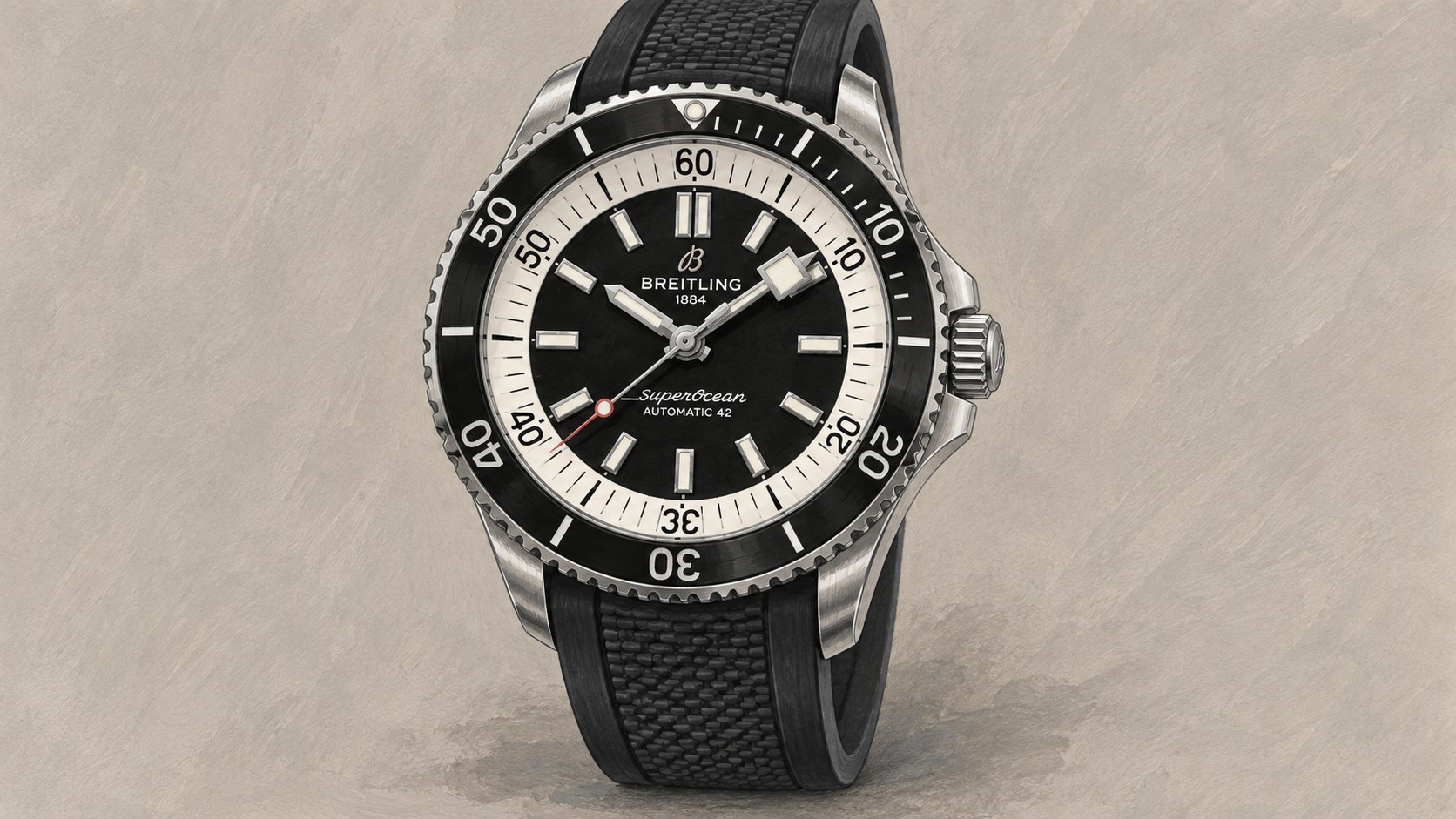
The Superocean Automatic 42 offers a deliberately limited set of jobs: show the time and provide a rotating elapsed-time scale. The black rubber reference A17375211B1S1 does not add a date or chronograph simply because there is room for one. That concentration is the point of the design.
Its main specification trade-off is the approximately thirty-eight-hour reserve. A buyer comparing modern divers will encounter longer figures, including in smaller cases. The Superocean therefore needs to win through its particular appearance and straightforward controls, rather than through the assumption that the most expensive-feeling brand always provides the longest-running movement.
The history behind the choice
Breitling’s Superocean story begins in 1957 with the reference 1004. The later Slow Motion branch, represented in the company’s archive by the 1960s reference 2005, approached underwater timing with an especially concentrated display. Today’s Automatic draws on that visual heritage without reproducing the historical watch’s unusual timing mechanism. That distinction matters: the current model is a conventional automatic three-hander with a rotating bezel. Its ancestry explains the emphasis on clear shapes and a limited display, rather than identifying it as a mechanical reissue. The family has also evolved into several distinct interpretations, so Superocean and Superocean Heritage should not be treated as interchangeable names. This reference pursues the more emphatic, pared-down branch of Breitling’s diving design.
The exact reference
| Specification | Published detail |
|---|---|
| Reference | A17375211B1S1 |
| Case | 42mm steel; 12.56mm thick |
| Lug width | 22mm |
| Movement | Automatic Breitling 17 |
| Frequency | 28,800 vibrations per hour |
| Stated reserve | Approximately 38 hours |
| Display | Hours, minutes and seconds; no date |
| Bezel | Unidirectional; ratcheted |
| Crown | Screw-locked; two gaskets |
| Crystal | Cambered sapphire; antireflective both sides |
| Water resistance | 300m |
| Strap | Black rubber; steel folding clasp |
The absence of a date is an active choice
Leaving out the calendar lets the time display remain the centre of the watch. It also removes a practical feature which some owners use more often than a timing bezel. That is the first decision to settle, because no movement comparison can supply a date to this particular reference.
The case makes sense when you enjoy a diver as a relatively direct object. The external bezel supplies the extra function, leaving the dial free from counters and apertures. A Navitimer fills its available space with calculations and chronograph information; this Superocean takes almost the opposite approach. The contrast within the same brand is useful, since it shows that the choice is about a design brief rather than a universal Breitling style.
The bezel does the additional work
The ratcheted bezel rotates in one direction and provides an external reference for elapsed time. It is a simpler interaction than starting and later reading a chronograph counter. Someone who enjoys setting a visible reference for ordinary short intervals can appreciate that function without needing the historical diving narrative to justify it.
The exact size matters when reading family descriptions. Breitling’s larger 46mm version uses a different locking arrangement, while this 42mm reference is specified with a unidirectional bezel. Copying one feature across the range would obscure a real difference. Begin with the reference you intend to buy, then judge whether its controls and display are the ones you want.
Calibre 17 supplies a modest reserve
The automatic Breitling 17 runs at 28,800 vibrations per hour and has a stated reserve of approximately thirty-eight hours. That is a straightforward everyday movement brief, but it becomes an obvious comparison point when a competing diver offers roughly seventy hours.
For continuous use, the shorter reserve may have little influence on the decision. For regular rotation, it increases the likelihood of restarting the watch after time away from the wrist. The absence of a calendar keeps restarting relatively uncomplicated. The useful conclusion is not that one reserve number settles the purchase, but that the Superocean’s strongest reasons lie elsewhere: its display, bezel and complete material-and-strap arrangement.
Rubber reinforces the character
The black rubber strap uses a steel folding clasp. It gives this reference a different identity from a diver on a broad metal bracelet, keeping the visual emphasis on the steel case and its surrounding scale. The 22mm opening contributes to that relatively substantial case-to-strap relationship.
The watch is 42mm across and 12.56mm thick, with a screwed caseback and screw-locked crown. During a fitting, compare the clasp position and case profile once; a diameter number cannot settle how you will respond to the complete rubber-mounted object. If a metal bracelet is the part of a diver you most enjoy, assess the appropriate bracelet reference rather than mentally replacing the supplied strap before you have chosen the watch.
The alternatives and the verdict
The Avenger Automatic 42 gives you the same named calibre and similar reserve with a calendar and a different sporting design. The titanium Pelagos 39 offers a smaller case and approximately seventy hours, along with its own very specific Tudor display. Neither is simply a higher grade of this Superocean.
Choose A17375211B1S1 when the no-date face, black rubber and direct timing-bezel brief are what you want. Consider another model when longer reserve or a calendar is a recurring priority. This Superocean is most persuasive when its restraint is a positive attraction, rather than a set of missing features you hope to stop noticing.
Specifications and sources checked on 8 September 2026. Superocean Automatic 42 specifications; Breitling Superocean history; Avenger Automatic 42 comparison; Tudor Pelagos 39 comparison.
Image: AI-generated editorial illustration of the Breitling A17375211B1S1. Fine dial details and finishing may differ from the production watch.


