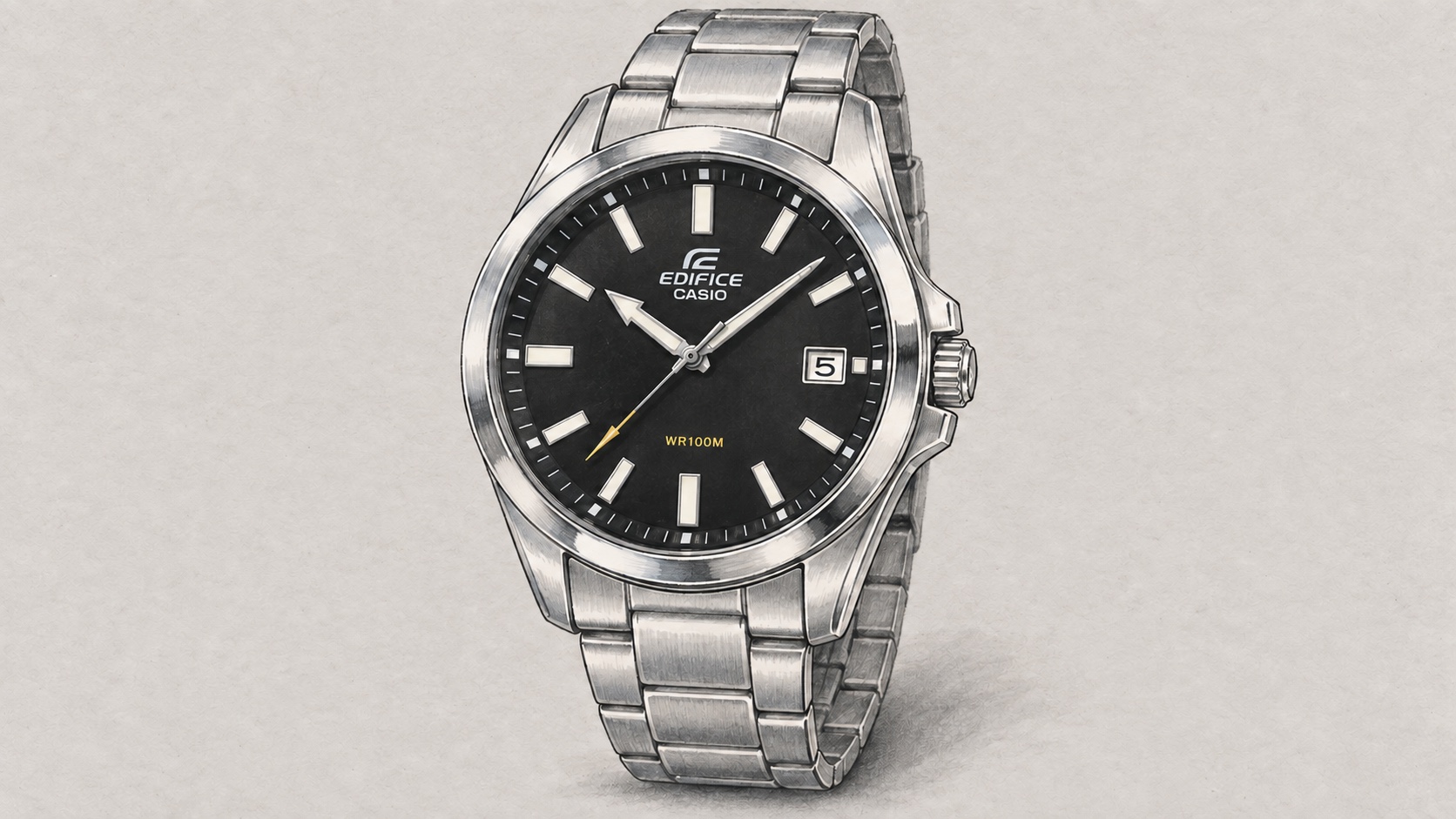
The simplest question in this pairing is also the most useful: do you want a chronograph? The Casio Edifice EFV-100D tells the time and date. The Seiko Speedtimer SSC813 adds a solar-powered stopwatch and the dial architecture that comes with it.
Both are quartz-based steel watches on bracelets, but the Seiko is not simply the smaller version of the Casio. It is shorter across the wrist, considerably thicker and heavier. Those changes need to earn their place through functions and design you actually enjoy.
The references compared
| Feature | Edifice EFV-100D-1AV | Speedtimer SSC813P1 |
|---|---|---|
| Display | Three hands and date | Solar chronograph with date |
| Case width / diameter | 42 mm | 39 mm |
| Case length / lug-to-lug | 48 mm | 45.5 mm |
| Thickness | 10.9 mm | 13.3 mm |
| Published weight | 125 g | 161 g |
| Movement power | Battery quartz; nominal 3 years | V192 solar; about 6 months fully charged |
| Crystal | Mineral | Curved sapphire; inner coating |
| Water resistance | 100 m | 10 bar |
| Availability note | Official page labels old model | UK boutique showed out of stock at check |
Specifications: Casio Edifice EFV-100D-1AV; Seiko UK boutique SSC813P1.
From Edifice and Speedtimer history to modern quartz
Casio introduced Edifice in 2000, adding a distinct analogue-watch family to a company already closely associated with electronic timekeeping. This older EFV-100D reference expresses that idea through a straightforward steel case and an uncomplicated display.
The Speedtimer name connects with Seiko’s 1969 chronograph development. The modern solar collection uses that history as design context while employing the V192 quartz mechanism. It therefore offers a different route into the chronograph story from a vintage mechanical example. These backgrounds explain the products without obliging you to prefer either: the Casio makes an everyday analogue watch simpler, while the Seiko gives a contemporary solar watch a recognisable timing identity.
The smaller Seiko is thicker and heavier
The Speedtimer’s 39 mm diameter and 45.5 mm lug-to-lug span make it the more compact face and footprint on paper. The Casio measures 42 mm wide and 48 mm long. If broad cases have been a problem, the Seiko deserves a try.
Height and mass go the other way. The Casio is 10.9 mm thick and weighs 125 g; the Seiko is 13.3 mm thick and weighs 161 g. The Speedtimer adds 2.4 mm of height and 36 g despite the smaller diameter.
That makes a side-by-side fitting useful. Decide whether you want a smaller, denser chronograph or a broader, slimmer three-hand watch. Neither conclusion can be reached by looking at the diameter alone.
Solar is a power choice, not an automatic movement
The Seiko’s V192 converts light into energy and offers about six months of running time when fully charged. It remains a quartz movement. Its appeal is combining that readiness with a rechargeable power system and chronograph functions.
The Casio uses a conventional SR927SW battery, with approximately three years of nominal life. Its maintenance rhythm includes periodic battery replacement rather than ensuring that a solar cell receives sufficient light.
If you keep a watch in a closed drawer for long periods, consider how that routine suits solar charging. If you wear it regularly in daylight, the Seiko’s power system may be a natural fit. The better technology is the one that suits how you store and use the watch.
The Speedtimer’s dial should be part of the attraction
The white-and-dark-counter arrangement gives the SSC813 its immediate identity. Separate timing displays, pushers and a tachymeter bezel make it look busier and more instrument-like than the Edifice.
The EFV-100D has a black dial and a simple three-hand layout. If you rarely time events and value an uncluttered glance at the hour and date, that reduction has a purpose. Extra counters are not an improvement when you would rather they were absent.
For the Seiko, ask to see the stopwatch start, stop and reset, and locate the elapsed-time counter. Owning a chronograph is more rewarding when you understand the display instead of using only its appearance.
Construction favours different priorities
The Speedtimer supplies curved sapphire with an inner anti-reflective coating, while the Edifice uses mineral glass. Both publish a 100 m equivalent water-resistance rating, so the Seiko’s added complication does not bring a higher stated rating here.
The Casio’s thinner case may still be the practical advantage you notice most often. The Seiko’s sapphire and solar chronograph may justify the bulk if those features matter to you.
Availability also needs attention. Casio labels this EFV-100D an old model, and the official UK Seiko boutique showed the SSC813P1 out of stock when checked. Compare the exact reference and the seller’s supply conditions rather than assuming every search result represents current manufacturer stock.
Where each makes sense
Choose the Edifice if you want a straightforward steel quartz watch and its wider but flatter proportions suit you. Its value is in doing a smaller set of jobs with less dial clutter.
Choose the Speedtimer if the solar system, compact footprint and chronograph layout are all part of the attraction. The thicker, heavier case is a clear trade-off, so let the stopwatch and design earn it rather than assuming a more complicated watch is automatically the better purchase.
Based on manufacturer information. Specifications checked on 8 September 2026.
Image: AI-generated editorial illustration of the Casio EFV-100D-1AV. Design details are approximate; this is not a product photograph.


