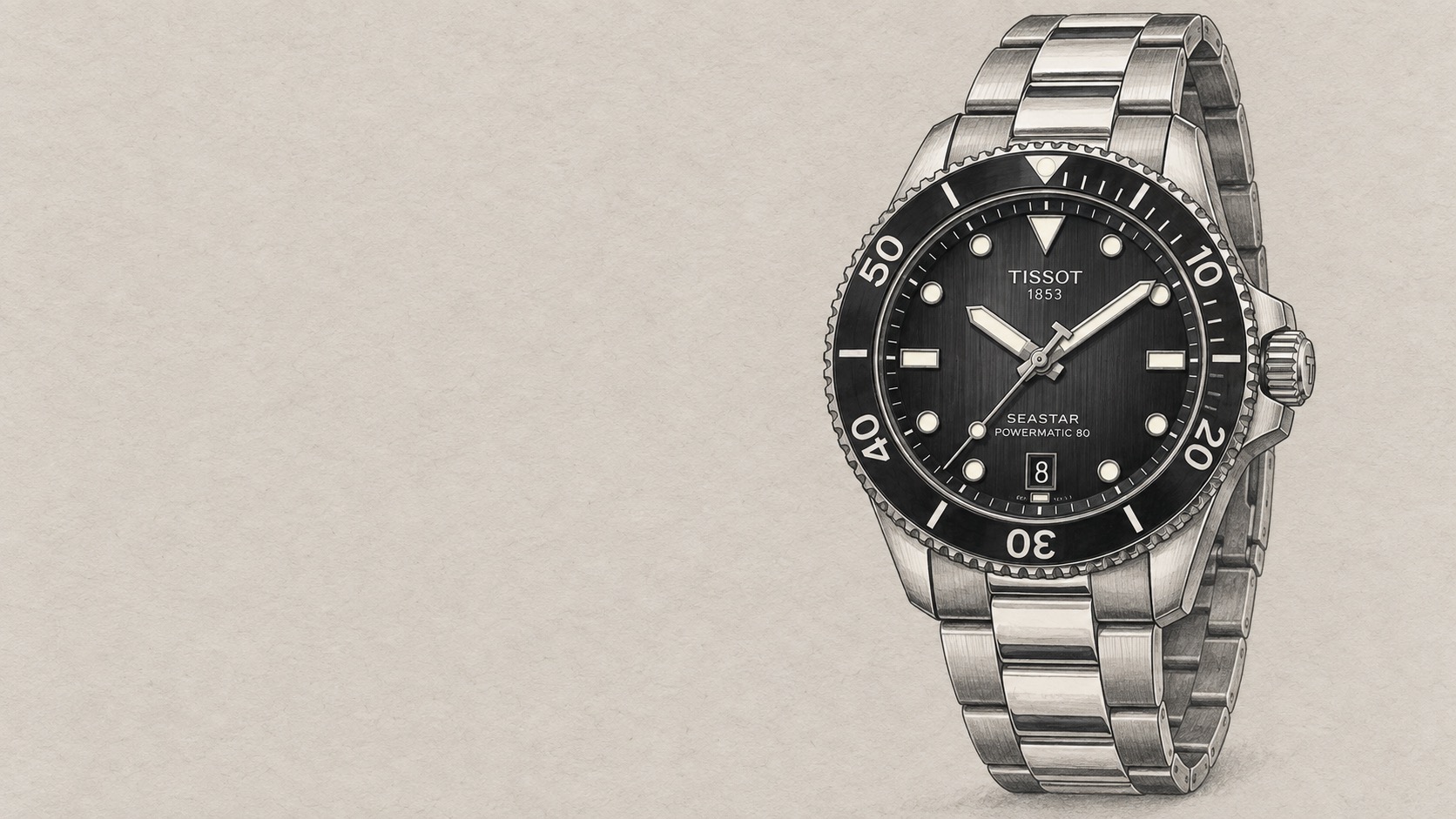
The quartz Seastar has a strong argument before you even discuss timekeeping: it is thinner, lighter and £260 less expensive at the checked UK list prices. The automatic answers with a visible mechanical movement and up to 80 hours of reserve. Neither is a free upgrade over the other.
This comparison uses the black-dial T120.807.11.051.00 automatic and blue-dial T120.410.11.041.00 quartz, both on steel bracelets. The colours differ, but the main decision is whether mechanical ownership is something you actively want.
The references compared
| Feature | Automatic T120.807.11.051.00 | Quartz T120.410.11.041.00 |
|---|---|---|
| Dial in this comparison | Black | Blue |
| Diameter | 40 mm | 40 mm |
| Thickness | 12.48 mm | 9.97 mm |
| Weight | 148 g | 134 g |
| Power | Automatic; up to 80 hours | Battery quartz; end-of-life indicator |
| Water resistance | 30 bar / 300 m | 30 bar / 300 m |
| Bezel | Unidirectional; mineral ring | Unidirectional; mineral ring |
| Crystal coating | Sapphire; underneath | Sapphire; both sides |
| UK price, 8 Sept 2026 | £685 | £425 |
Specifications: Tissot UK Seastar 1000 40 mm; Tissot Seastar quartz specifications.
A shared Seastar history, two power systems
Tissot’s Seastar history traces the name to its 1952 trademark, following earlier work on water-resistant watches. The Camping and Aquasport families of the late 1930s and a Canadian Five Star series formed part of that background. The present diving-watch silhouette came through later development.
That shared history is useful here because neither power source has an exclusive claim to the Seastar idea. Both current watches turn a water-oriented collection into an everyday steel sports watch. One uses a self-winding movement to provide mechanical interest; the other makes readiness and a slimmer case central to its appeal. Choosing quartz does not remove the collection’s historical connection, and choosing automatic does not recreate the first Seastar.
The thinner quartz changes everyday fit
The quartz case is 9.97 mm thick, compared with 12.48 mm for the automatic. That 2.51 mm difference is more significant than the matching diameters initially suggest. It is a clear reason to try the quartz first if you want the diver format to sit quietly beneath a sleeve.
The published weights also favour quartz, at 134 g against 148 g. Neither is an especially light resin watch, but the slimmer model removes some mass as well as height. Those are benefits you can appreciate without knowing anything about the movement inside.
The automatic’s greater substance may still be attractive. Some buyers enjoy a sports watch with a more pronounced profile and a view through the back. The point is to choose that experience deliberately, rather than assuming it is universally preferable because the mechanism is more interesting.
What 80 hours does and does not solve
The automatic’s reserve gives more than three days of potential running time from full wind. It can cover a weekend change of watch and reduce the frequency of restarting. It still relies on energy supplied through winding and regular use.
The quartz continues running between outings without that routine. Its battery end-of-life indicator provides a prompt when replacement approaches. For a watch kept as an occasional holiday companion, that readiness may be the most useful feature in the comparison.
Choose automatic if winding, seeing the mechanism and setting it occasionally are part of the pleasure. Choose quartz if you mainly want to put the watch on and leave. A mechanical movement does not become better value simply because its owner tolerates work they would rather avoid.
The water specification is shared
Both references publish 30 bar or 300 m water resistance and use screw-down crowns. Both also have unidirectional timing bezels. The automatic premium therefore does not buy a higher stated depth rating.
Both bezel rings are mineral, another detail worth checking when browsing photographs of the wider Seastar family. The crystals are sapphire, with Tissot specifying coating underneath on the automatic and on both sides for this quartz reference.
Those differences make the comparison more interesting than a simple expensive-versus-basic split. The lower-priced watch has useful construction and proportion advantages, while the automatic offers a different mechanism and rear view.
Price, colour and the complete watch
The official UK list prices were £685 for the automatic and £425 for the quartz on 8 September 2026. The £260 gap should be weighed against what you gain in enjoyment from the mechanism, not against an invented promise of superior longevity or resale.
The blue quartz dial may also be the design you prefer. If black is essential, investigate the exact alternative rather than assuming every current listing has identical measurements and details. A comparison reference is a starting point for shopping, not a reason to ignore the version you actually want.
The sensible choice for your routine
Buy the automatic if you want an accessible mechanical diver, appreciate the transparent back and will use its long reserve in a rotation. Its price premium makes sense when those details add enjoyment.
Buy the quartz if fit, readiness and cost matter more. It retains the main practical features of the Seastar format in a noticeably thinner package. That is a positive choice of the right technology for your use, rather than a temporary substitute for the automatic.
Based on manufacturer information. Specifications checked on 8 September 2026.
Image: AI-generated editorial illustration of Tissot T120.807.11.051.00. Design details are approximate; this is not a product photograph.


