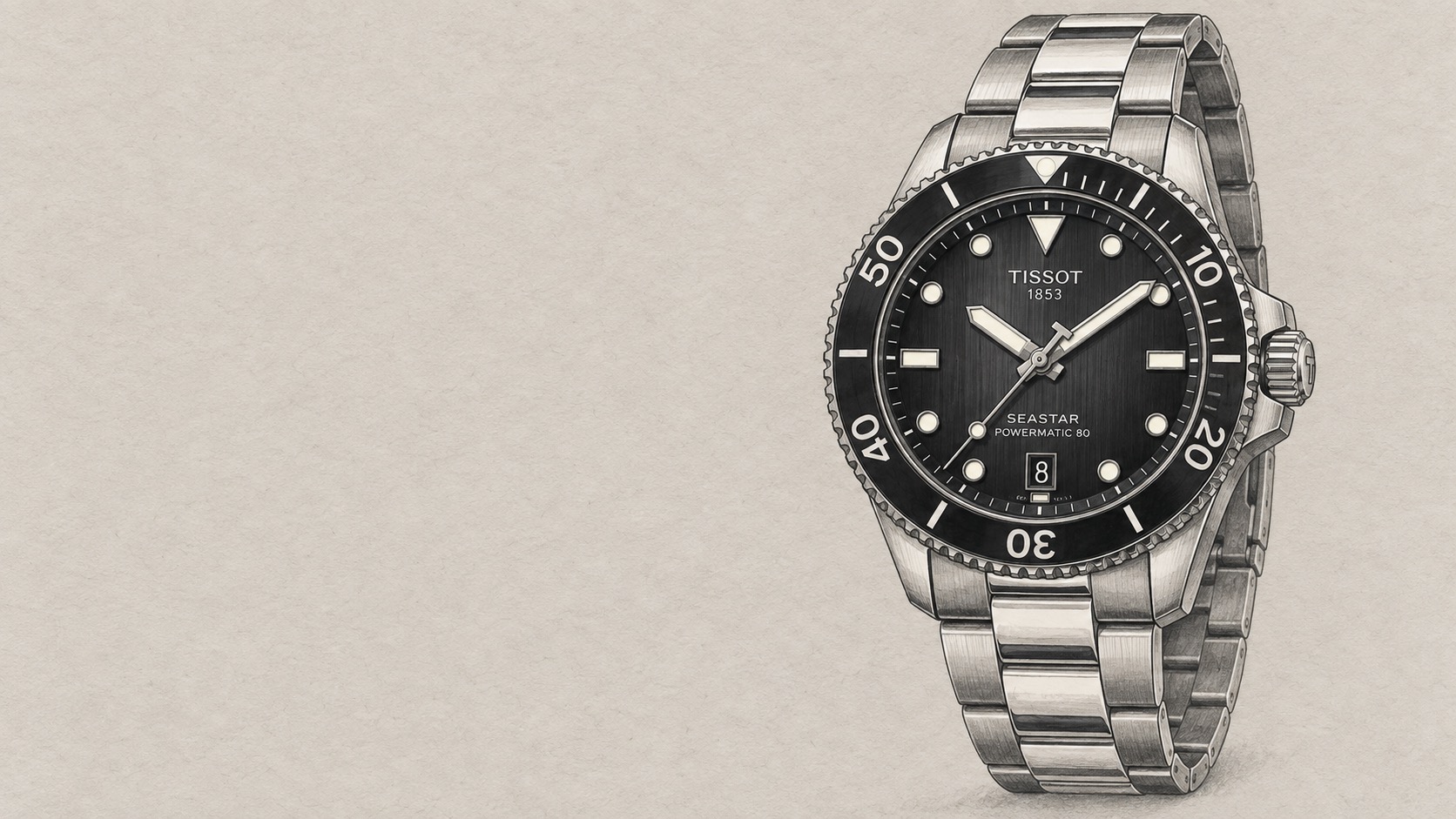
Most people shopping for a first automatic diver need it to work on a train, at a desk and on holiday. The Tissot Seastar 1000 in 40 mm makes sense in that order. It offers a familiar black dial, a useful timing bezel and enough movement reserve to tolerate a weekend change of watch.
The headline is not an exotic material or an unusual complication. It is the combination of a manageable case size and a £685 UK list price, checked on 8 September 2026. Reference T120.807.11.051.00 is worth considering if you want the diver format to become your ordinary watch, with its water capability available when needed.
Based on Tissot’s published information. Specifications checked on 8 September 2026.
The exact reference
| Case | 316L steel; 40 mm diameter; 12.48 mm thick |
|---|---|
| Movement | Automatic Powermatic 80; Nivachron balance spring |
| Power reserve | Up to 80 hours |
| Water resistance | 30 bar / 300 m; screw-down crown and caseback |
| Bezel | Unidirectional; mineral ring |
| Crystal | Sapphire; anti-reflective coating underneath |
| Lug width / weight | 20 mm / 148 g |
| Bracelet | Steel; safety folding clasp; quick-release attachment |
| UK listed price | £685, checked 8 September 2026 |
Specification source: Tissot UK Seastar 1000 40 mm.
The Seastar name began with everyday water resistance
Tissot’s history of the Seastar traces the name to a trademark registered in 1952. It followed earlier water-resistant Camping and Aquasport watches from 1938 and 1939, and a Five Star range sold in Canada during the following decade. The name therefore grew out of efforts to make watches more useful around water, rather than beginning with the appearance of this modern diving bezel. That is a helpful way to understand the current model. The 40 mm automatic continues a practical idea while adopting a much more explicitly sporting form. Its interest is the adaptation of a familiar water-oriented collection to everyday proportions, not a claim that the present case is an exact reconstruction of a 1952 watch.
The proportions make the case
A 40 mm diameter sounds conventional, but 12.48 mm of thickness and a stated 148 g give the Seastar some substance. It should be approached as a steel sports watch, rather than a dress watch with a rotating ring added. The bezel takes up part of the face, leaving the dial more concentrated than on a plain 40 mm three-hander.
That can be attractive if you want a watch with presence without a particularly large expanse of dial. The black-and-steel colour scheme is easy to combine with different clothes. It also leaves the luminous markers and broad hands to do the visual work, rather than relying on a bright colour to create interest.
The 20 mm attachment and quick-release bracelet make a strap change part of the proposition. A black rubber option would reinforce the sporting character; a softer-looking strap could make it less metallic for everyday use. Decide whether you like the watch on its supplied bracelet first, since that is the version this reference and price describe.
The useful specification, and the easy mistake
Tissot specifies a mineral bezel ring for this 40 mm reference. It is easy to see a glossy black insert and assume ceramic, particularly when comparing several Seastars in the same search. The distinction is worth making, but it need not decide the purchase. Ask whether you like the appearance and accept the material at this price.
The sapphire crystal has anti-reflective treatment underneath. The caseback is transparent, providing a view of the automatic movement without adding another display to the dial. For a first mechanical watch, that little window can be more enjoyable than another line of technical text on the front.
An 80-hour reserve you can actually use
Starting from full wind, the rated reserve spans more than three days. That suits someone who switches to a lighter watch for the weekend and wants to return to the Tissot on Monday. Regular wear remains important: the maximum reserve is a capacity, rather than energy that appears merely because a watch has an automatic rotor.
The Nivachron balance spring is another practical ingredient, addressing magnetic sensitivity within the movement. Neither that feature nor the long reserve makes the Seastar quartz-accurate. Buy a mechanical watch because its mechanism interests you, while judging its convenience against your own habit of changing watches.
Is it a credible watch for water use?
The published 300 m rating, screw-down crown and unidirectional bezel are substantial water-oriented features. They make this a much more focused choice than a dressy watch carrying a modest water-resistance number. Its timing ring is also useful away from water, for an elapsed-time reminder without opening an app.
For actual diving, suitability depends on the watch’s condition and the owner’s equipment requirements as well as the model specification. Keep the crown secured and follow Tissot’s care instructions. There is no need to invent an ISO certification or a completed dive test to recognise what the manufacturer has equipped it to do.
The alternative that sharpens the choice
The 40 mm C60 Trident Pro 300 pairs the same published depth rating with a ceramic bezel and an 11.3 mm case. Its 38-hour reserve is shorter. That comparison makes the priorities clear: the Tissot’s strength is the long-running movement in a straightforward package, while the Ward puts more emphasis on a slimmer profile and bracelet adjustment.
Choose the Seastar if its fit works for you and the ordinary usefulness is the attraction. Move on if you specifically want ceramic, unusually fine bracelet adjustment or a much lighter watch. This reference earns its place by meeting familiar needs well on paper, rather than trying to make every familiar feature extraordinary.
Image: AI-generated editorial illustration of Tissot T120.807.11.051.00. Design details are approximate; this is not a product photograph.


