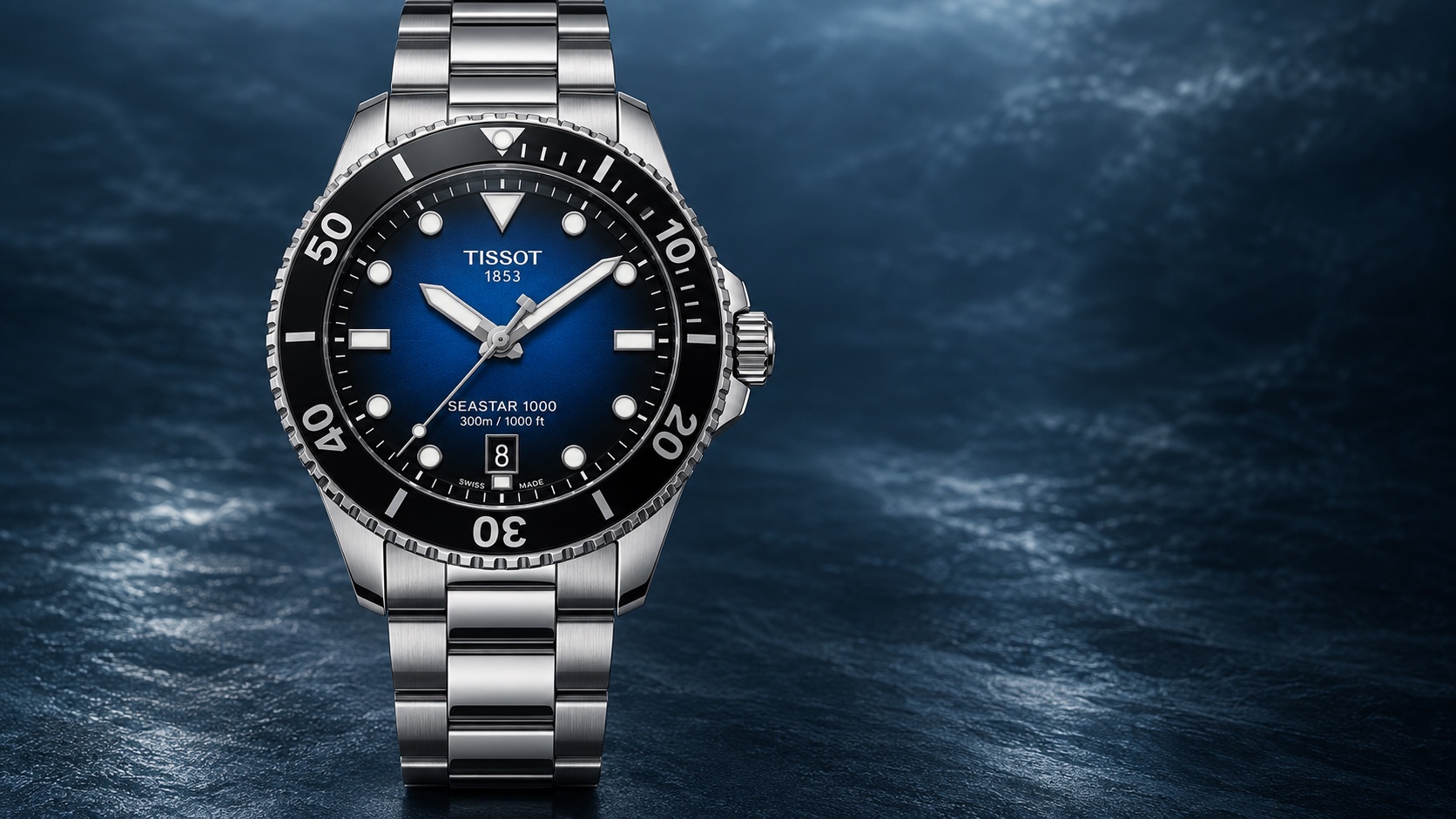
There is a particular satisfaction in picking up a watch and finding that it is already doing its job. The 40mm quartz Tissot Seastar 1000 is built around that sort of ownership. At £425, it offers the familiar diver layout without asking you to make a mechanical movement part of your routine.
That is the decision to settle first. If you want the experience of a spring-driven watch, no amount of practicality will substitute for it. If you mainly want a blue steel watch that is ready when you are, this reference deserves to be considered on its own merits.
The history behind the choice
The Seastar name predates today’s familiar dive-watch appearance. Tissot’s archive account traces its water-resistance work through experiments in the 1930s and the Camping and Aquasport collections of 1938 and 1939. A Five Star series followed in Canada during the 1940s. When an improved sealed watch arrived, the maritime variation on that name became a natural fit, and Seastar was registered as a trademark in 1952. That lineage is interesting because it begins with the practical business of protecting a watch, rather than a modern lifestyle image. The current quartz model continues the usefulness of the name with different technology and a contemporary case. It should not be mistaken for a direct reproduction of the first Seastar.
The exact reference
| Specification | Published detail |
|---|---|
| Reference | T120.410.11.041.00 |
| UK price checked | £425 |
| Diameter / thickness | 40mm / 9.97mm |
| Published weight | 134g |
| Case / bracelet | 316L stainless steel / steel |
| Movement | Quartz; battery end-of-life indicator |
| Functions | Hours, minutes, seconds, date |
| Water resistance | 30 bar / 300m |
| Crystal | Sapphire; antireflective coating on both sides |
| Bezel | Unidirectional; mineral bezel ring |
| Strap attachment | 20mm; quick-release bracelet |
Why quartz belongs on this shortlist
Consider how long your watches spend unworn. Someone who changes watches according to work, exercise or weather may appreciate not having to restart an automatic after a break. The Seastar removes that particular interaction. It still needs care and a battery service when required, but its routine is different rather than inferior.
The useful question is whether you would miss winding and setting a mechanical watch. If you would, be honest about that emotional preference. If you would not, buying an automatic because it is considered more serious can add an ownership task without adding enjoyment. An everyday tool is allowed to be interesting because it solves a small problem consistently, not because its mechanism needs explaining.
Read the case height alongside the diameter
A diver’s outline can look bulky in an enlarged photograph. This reference’s published thickness gives a more useful starting point for trying it with a sleeve. Check the entire experience, including where the bracelet sits and whether the crown area meets your hand when you bend your wrist. A sensible diameter alone cannot settle those questions.
For someone moving from a digital or very light watch, the steel bracelet may be a greater adjustment than the case size. Ask for a realistic fit before drawing conclusions. Several surplus links hanging beneath the wrist can distort the impression. Conversely, tightening a bracelet excessively to stop movement is not evidence that the case shape is right for you.
Use the bezel as a practical feature
A rotating timing scale can be useful well away from water. You might prefer it for keeping track of a short break or another ordinary elapsed interval. Try operating it and reading the result in person. The appeal should be that the arrangement makes sense to you, not merely that it looks like equipment associated with adventure.
The product sheet distinguishes the mineral bezel ring from the sapphire crystal over the dial. Keep those descriptions separate when comparing listings; sapphire on the front does not mean every visible insert uses the same material. If a seller describes this exact reference differently, resolve that detail before treating the comparison as like for like.
Practicality includes the next service
The battery end-of-life feature is worth having explained at purchase. Knowing what the indication means makes it easier to arrange attention promptly rather than assuming a changed display behaviour is random. Ask how the retailer handles battery replacement and the associated water-resistance checks for this model.
Follow the exact operating instructions around the crown and water use. If actual diving is central to the purchase, make the watch part of an appropriate equipment and maintenance plan. Do not use a buying guide or the number printed on a dial as a substitute for that process.
Try an automatic before paying for one
The Mido Ocean Star offers a useful contrasting brief: an automatic dive-style watch in steel. Try an example if the mechanical idea still appeals after considering the quartz Seastar. Compare the daily routines as well as the appearance, and check the precise reference rather than relying on a shared family name.
Choose this Seastar if you like its proportions and want its straightforward readiness. Spend more on an automatic when the movement itself will make ownership more enjoyable. Look elsewhere if the bracelet fit or design leaves you indifferent. A practical watch should still be one you want to put on. Convenience is a strong reason to choose it, but not a reason to ignore your own taste.
Based on manufacturer information. Specifications and sources checked on 8 September 2026. Sources: Tissot Seastar quartz specifications; Seastar history; Automatic Ocean Star alternative. Prices, where included, are dated UK manufacturer listings and may change.
Image: AI-generated editorial illustration of the Tissot Seastar 1000 40mm Quartz, reference T120.410.11.041.00. Fine design details may differ from the production watch.