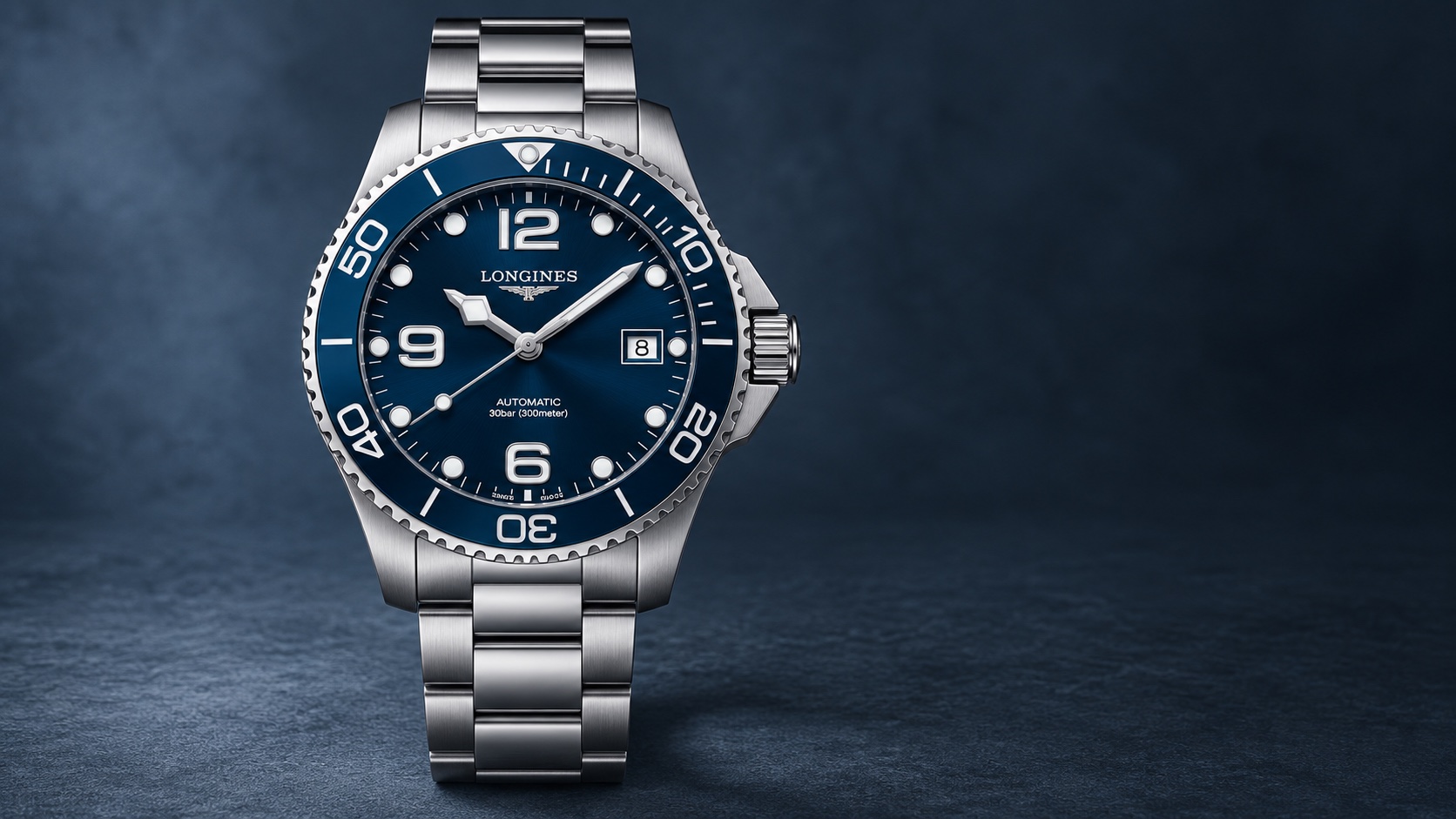
The 39mm Longines HydroConquest answers one question neatly: you can want the familiar visual language of a dive watch without automatically choosing the largest case in the cabinet. It does not answer the next question for you. A smaller diameter still leaves the rotating bezel, blue dial and steel bracelet at the centre of the design.
Choose this L3.780.4.96.6 because you like that sporting identity, not simply because the size sounds sensible. At the checked £1,700 UK price, a good purchase should bring a watch you actively prefer rather than a compromise you can defend on paper.
The history behind the choice
Longines’ October 2018 HydroConquest announcement offers a useful snapshot of the family’s development. It described an all-black ceramic watch joining a line that had recently gained coloured ceramic bezel inserts. That distinction is still important when reading listings: ceramic can refer to a particular component rather than an entire case. The steel 39mm reference covered here belongs to the familiar material combination stated in its own specification, not to the all-black model in that historical release. The history shows a sports collection being developed through materials and different executions rather than simply repeating one vintage design. For a buyer, the lesson is practical: establish the exact version before applying information from a review of the wider HydroConquest family.
The exact reference
| Specification | Published detail |
|---|---|
| Reference | L3.780.4.96.6 |
| UK price checked | £1,700 |
| Diameter | 39mm |
| Case / bezel | Stainless steel / ceramic bezel |
| Bracelet | Stainless steel |
| Movement | Automatic; 25,200 vibrations per hour |
| Stated reserve | Up to 72 hours |
| Functions | Time and date |
| Water resistance | 30 bar / 300m; screw-in crown |
| Crystal | Sapphire; antireflective layers on both sides |
| Bezel operation | Unidirectional rotation |
| Clasp | Double safety folding |
A diver should be a preference, not a default
Many buyers begin with a dive-style watch because it seems to cover the broadest range of situations. That can be sensible, but the decision still has an aesthetic cost. The timing bezel occupies visual space that another watch might leave to a quieter dial. If you enjoy that element, it can be a reason to choose the HydroConquest every day.
If you keep imagining how it would look without the scale around the face, try the ordinary Conquest as well. You do not have to buy a diver to demonstrate that your watch is practical. The right everyday design is the one you want to see repeatedly, with capabilities appropriate to your routine rather than to someone else’s checklist.
Try the smaller size as a whole watch
Do not translate the diameter directly into a recommendation for a particular wrist circumference. The bracelet, case shape and wearing position all contribute to the result. Ask for a realistic fitting and check the clasp under your wrist as carefully as the watch above it. Removed links should be included with the purchase and kept safely.
Try bending your hand and slipping the watch beneath a familiar sleeve. Then look at your arm in a mirror rather than relying on a close phone photograph. You are checking whether the complete arrangement feels proportionate for you, not whether a number falls inside an online rule. A larger or smaller alternative may still be the better personal fit.
Understand what the bezel adds
The unidirectional scale provides an elapsed-time function without a separate chronograph display. Ask to try it and judge whether the action and markings make sense to you. It may be something you use for ordinary tasks on land, or simply a design feature you enjoy. Either is a valid preference if you recognise which one is driving the choice.
The manufacturer identifies ceramic in this reference’s bezel specification. That description should not be expanded into a promise that the watch is immune to damage. When comparing a used example, inspect the visible components and ask about repairs instead of letting the material name stand in for a condition report.
The movement supports a routine, not a fantasy
A stated reserve of this length gives some freedom to leave the watch off briefly, provided the movement began adequately wound. It still stops after a sufficiently long break and then needs the time and calendar restored. If you rotate several watches, ask for the correct setting demonstration and consider whether you enjoy that ownership pattern.
The manufacturer specification is useful for comparing the intended design, while actual condition and after-sales support matter when buying a particular example. For water use, follow Longines’ instructions and appropriate maintenance. The depth rating should remain part of that practical plan rather than a replacement for it.
What to compare before committing
The Conquest offers a useful alternative if you like Longines but want a quieter bezel and a less explicitly diving-led appearance. A compact Certina DS Action may be worth investigating if you are open to a different brand and, for the older reference, the extra checks involved in remaining stock. Compare actual offers and complete watches, not remembered launch prices.
Choose the HydroConquest when its blue steel diver identity is what you wanted from the outset and the 39mm fitting confirms it. Choose something simpler if the sporting appearance repeatedly feels like a concession. Its dimensions can make the format more approachable, but they cannot turn it into an entirely different kind of watch. That is a reason to be precise about your preference, not a criticism of the design.
Based on manufacturer information. Specifications and sources checked on 8 September 2026. Sources: HydroConquest exact-reference specifications; Longines’ 2018 ceramic HydroConquest announcement; Conquest 38mm alternative; Certina compact-diver alternative. Prices, where included, are dated UK manufacturer listings and may change.
Image: AI-generated editorial illustration of the Longines HydroConquest 39, L3.780.4.96.6. Fine details may differ from the production watch.