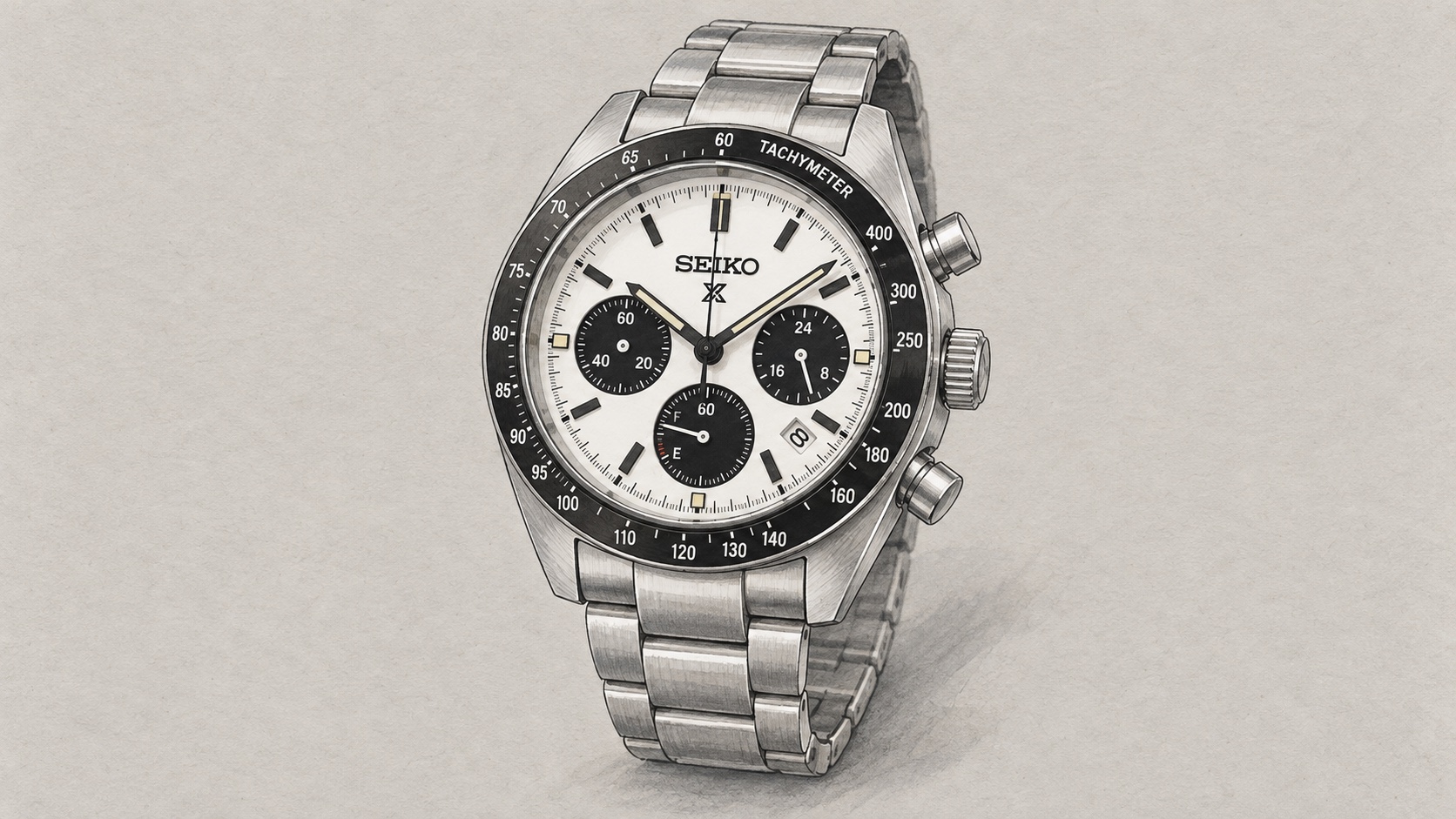
The Seiko 5 GMT and Speedtimer are an unusually useful pair to compare because they answer different everyday questions. The SSK001 helps show the time in another place. The SSC813 measures an elapsed interval. Their extra hands and scales should be chosen for those functions, not simply because both make a dial look more technical.
The movement choice is equally clear. The GMT is an automatic which stores energy in a mainspring; the Speedtimer is a solar quartz chronograph. Choose the SSK001 if the additional time-zone display and mechanical movement are the appeal. Choose the SSC813 if a ready chronograph and its contrasting-register design are more relevant.
The references compared
| Feature | Seiko 5 GMT | Speedtimer Solar |
|---|---|---|
| Reference | SSK001K1 | SSC813P1 |
| Case diameter / thickness | 42.5mm / 13.6mm | 39mm / 13.3mm |
| Lug-to-lug | 46.0mm | 45.5mm |
| Movement | Automatic 4R34 GMT | Solar quartz V192 chronograph |
| Reserve | Approximately 41 hours | Approximately 6 months fully charged |
| Crystal | Hardlex; date magnifier | Curved sapphire |
| Water resistance | 10 bar | 10 bar |
| Main added function | Twenty-four-hour GMT hand | Chronograph up to 60 minutes |
| Published weight | 161g | 161g |
Two histories behind the decision
Seiko introduced the 5 Sports GMT series in 2022, adding the 4R34 movement to a shape and bracelet vocabulary associated with its established sports watches. The Speedtimer’s design story reaches back to Seiko’s 1969 chronograph chapter, although the current SSC813 uses solar quartz rather than reproducing the original automatic mechanism. Those are different uses of heritage. The GMT extends an everyday automatic platform with a new display, while the modern Speedtimer translates historical chronograph styling into a different power system. Neither needs its current mechanism to be identical to an earlier watch to make sense. What matters is how the design history supports the function and movement actually supplied today.
A GMT hand is not an elapsed-time counter
The SSK001’s additional hand follows a twenty-four-hour scale, allowing another time to be read alongside the ordinary hands. Its GMT hand is independently adjustable; the watch should not be mistaken for a travel GMT with a separately jumping local hour. That distinction matters if quick local-time changes are the main reason you want the complication.
The Speedtimer uses its pushers and chronograph hands to start, stop and read a measured interval. Its twenty-four-hour subdial is an indication tied to the main time, not an independently adjustable second time zone. A dial can contain a twenty-four-hour scale without providing the same function as a GMT watch.
Solar and automatic reward different habits
The Speedtimer’s solar system charges its rechargeable cell through exposure to light. Its stated six-month duration assumes a full charge, so the benefit depends on keeping the watch adequately illuminated rather than leaving it permanently in a dark drawer. It offers a useful kind of readiness when that simple requirement is met.
The SSK001 winds as it is worn and also permits manual winding. Its roughly forty-one-hour reserve means more frequent attention if it spends extended periods off the wrist. That is not a disadvantage for someone who wants an accessible mechanical GMT specifically to enjoy its movement. It is a meaningful difference for someone who wants to pick up an occasional chronograph and begin timing with minimal preparation.
The compact Speedtimer is not dramatically shorter
The Speedtimer is substantially narrower in diameter, but the published lug-to-lug figures are much closer. The SSK001’s rounded case and crown placement create a different outline from the SSC813’s chronograph case and pushers. Compare the complete shapes rather than extrapolating from the diameter difference.
The two listed weights are also the same, which is a useful reminder that a smaller diameter does not guarantee a lighter complete bracelet watch. The Speedtimer brings curved sapphire, while the GMT uses Hardlex with a date magnifier. These are tangible configuration differences worth including alongside the more obvious movement and display choices.
Choose the complication you want to read
The black GMT face has a prominent additional hand and a surrounding time-zone scale. The white Speedtimer dial has contrasting registers and an external tachymeter, giving it a busier chronograph identity. Their similar pressure ratings do not erase those different purposes.
Choose the SSK001 when knowing another place’s time, watching a mechanical movement run and enjoying the rounded Seiko sports case are the attractions. Choose the SSC813 when interval timing, solar charging and the compact contrasting-register design make a more useful package. If you will rarely use either complication, let that admission simplify the choice: buy the dial you prefer, or consider a simpler three-hand Seiko instead of paying for a function that only decorates the decision.
Specifications and sources checked on 8 September 2026. SSK001 specifications; Seiko 5 GMT introduction; 4R34 GMT operation; SSC813 specifications; Speedtimer design history.
Image: AI-generated editorial illustration of the Seiko SSC813P1. Design details are approximate; this is not a product photograph.


