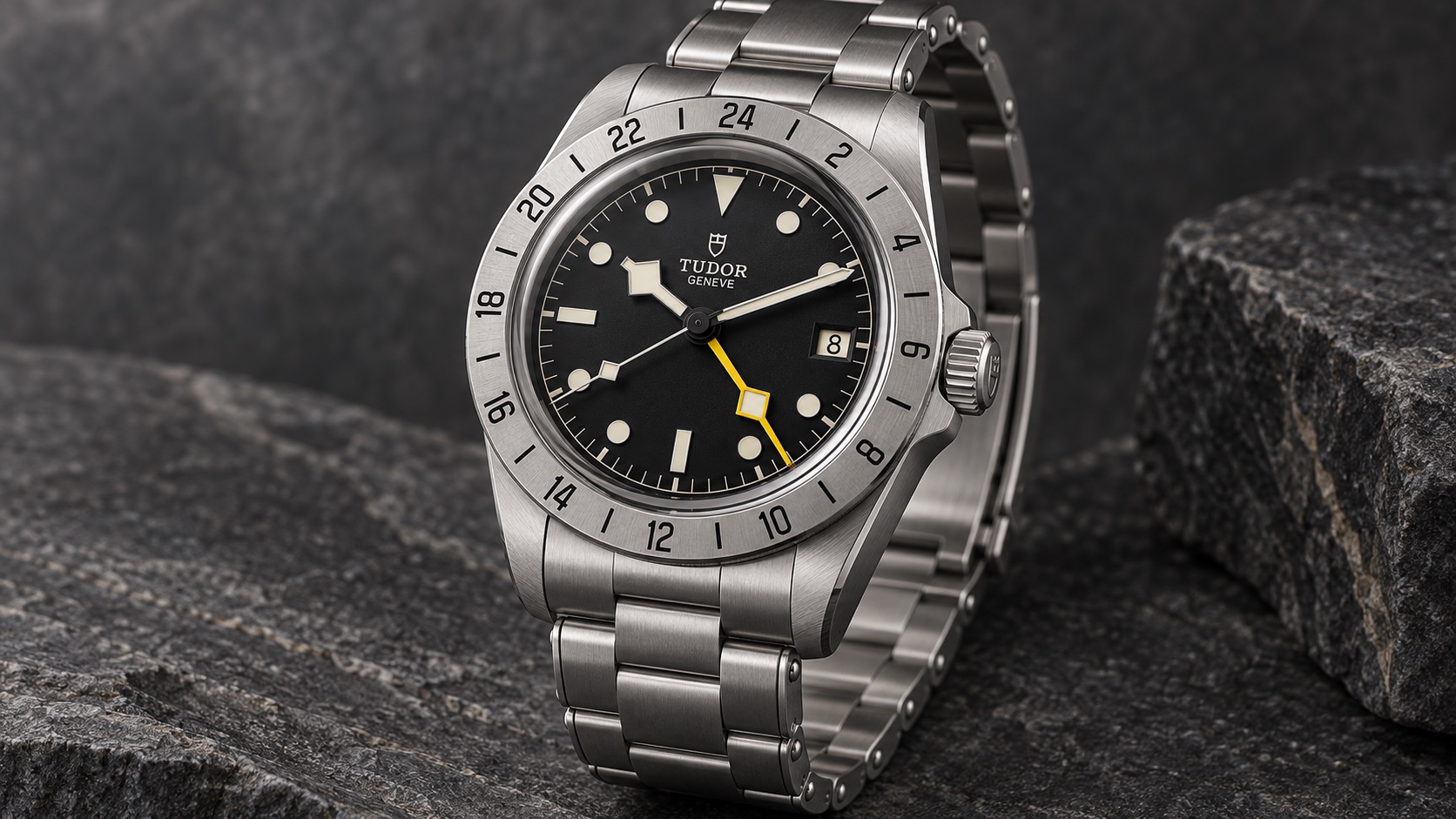
The Zulu Time and Black Bay Pro solve the main travel adjustment in a similar way: the local hour can be changed independently. That leaves the more interesting choice around the movement. Longines gives you a rotating ceramic-insert bezel and an anthracite dial with Arabic numerals. Tudor supplies a fixed steel scale, black dial and a different bracelet adjustment system.
Both selected cases are thirty-nine millimetres across, but their heights differ. Start with the Longines if the rotating scale and its more decorated pilot-style face appeal. Start with the Tudor if you prefer a fixed frame and the Black Bay hand-and-marker vocabulary.
The references compared
| Feature | Spirit Zulu Time 39 | Black Bay Pro |
|---|---|---|
| Reference | L3.802.4.63.6 | M79470-0001 |
| Case diameter / thickness | 39mm / 13.5mm | 39mm / 14.6mm |
| Movement | Automatic L844.4; COSC | Automatic MT5652; COSC |
| Reserve | Up to 72 hours | Approximately 70 hours |
| Local hour | Independently adjustable | Independently adjustable |
| Bezel | Bidirectional; ceramic insert | Fixed steel; 24-hour scale |
| Water resistance | 10 bar | 200m |
| Bracelet detail | Steel; folding safety clasp | Rivet-style steel; T-fit |
Two histories behind the decision
Longines traces the Zulu Time name to a dual-time wristwatch of 1925, whose dial carried the Zulu flag. That aviation connection helps explain the present Spirit model’s numerals and emphasis on keeping another place’s time in view. Tudor places the Black Bay Pro within an expedition-oriented design story, using familiar Snowflake hands and a fixed twenty-four-hour bezel rather than copying the rotating-bezel layout of every travel watch. The historical comparison is most useful as an explanation of their different personalities. Longines makes its aviation reference more visible in the dial; Tudor presents a compact steel instrument with an austere surrounding scale. Their current GMT mechanisms turn those identities into practical modern watches.
Both have the useful local-hour adjustment
An independently adjustable local hour is convenient when arriving somewhere with a different whole-hour offset. It lets the main display move to local time while the reference hand continues its separate twenty-four-hour role. That shared capability means the decision does not hinge on one watch having a fundamentally different kind of GMT adjustment.
The Longines and Tudor manuals remain the correct guides to crown positions and calendar behaviour. For the buying comparison, the important point is that both support the traveller-oriented interaction many buyers are seeking. The two-hour difference between their stated reserves is much less revealing than the larger differences in case and bezel design.
The rotating bezel adds flexibility and visual activity
The Zulu Time’s bidirectional ceramic-insert bezel can move its twenty-four-hour scale relative to the hand. That offers another way to read an offset once the display is understood. It also places a contrasting, movable ring around the dial.
The Pro’s fixed engraved steel bezel keeps that frame stable. It is simpler to treat as a permanent reference scale, and its plain metal finish contributes strongly to the watch’s identity. If you want a rotating GMT bezel, the Longines is offering a feature the Tudor does not have. If you prefer the appearance and fixed relationship of the Pro’s scale, the extra moving part is not automatically a benefit.
The dials carry their detail differently
Longines combines Arabic hour numerals, an anthracite face and a ceramic bezel in this configuration. The resulting design puts more printed and applied information around the hands. Tudor’s black face uses its familiar geometric markers and a contrasting GMT hand beneath the engraved steel ring.
The Tudor is visually plainer around the dial, but that does not make every part of it smaller. Its published case height is greater. A side view is therefore useful alongside the usual front photograph: the Longines and Tudor share a diameter without sharing the same proportions. Let the preferred display and the actual case profile influence the decision together.
The clasp provides a concrete Tudor attraction
The selected Black Bay Pro bracelet includes T-fit adjustment. Longines lists a folding safety clasp for this Zulu Time reference. Those are specific package details, and the Tudor provision may be valuable if easy changes to bracelet fit matter to you.
Choose the Zulu Time when the rotating ceramic scale, numeral dial and slimmer published profile form the GMT you want. Choose the Black Bay Pro when the fixed steel bezel, Tudor display and T-fit bracelet are the main attractions. Both offer a capable local-hour mechanism, so neither needs to win by being called the true travel watch. The stronger choice is the complete case, face and bracelet you prefer after the shared GMT capability has been recognised.
Specifications and sources checked on 8 September 2026. Zulu Time specifications and history; Longines GMT instructions; Black Bay Pro specifications; Tudor GMT operation and design.
Image: AI-generated editorial illustration of the Tudor Black Bay Pro M79470-0001. Fine dial details, hand shapes and finishing may differ from the production watch.


