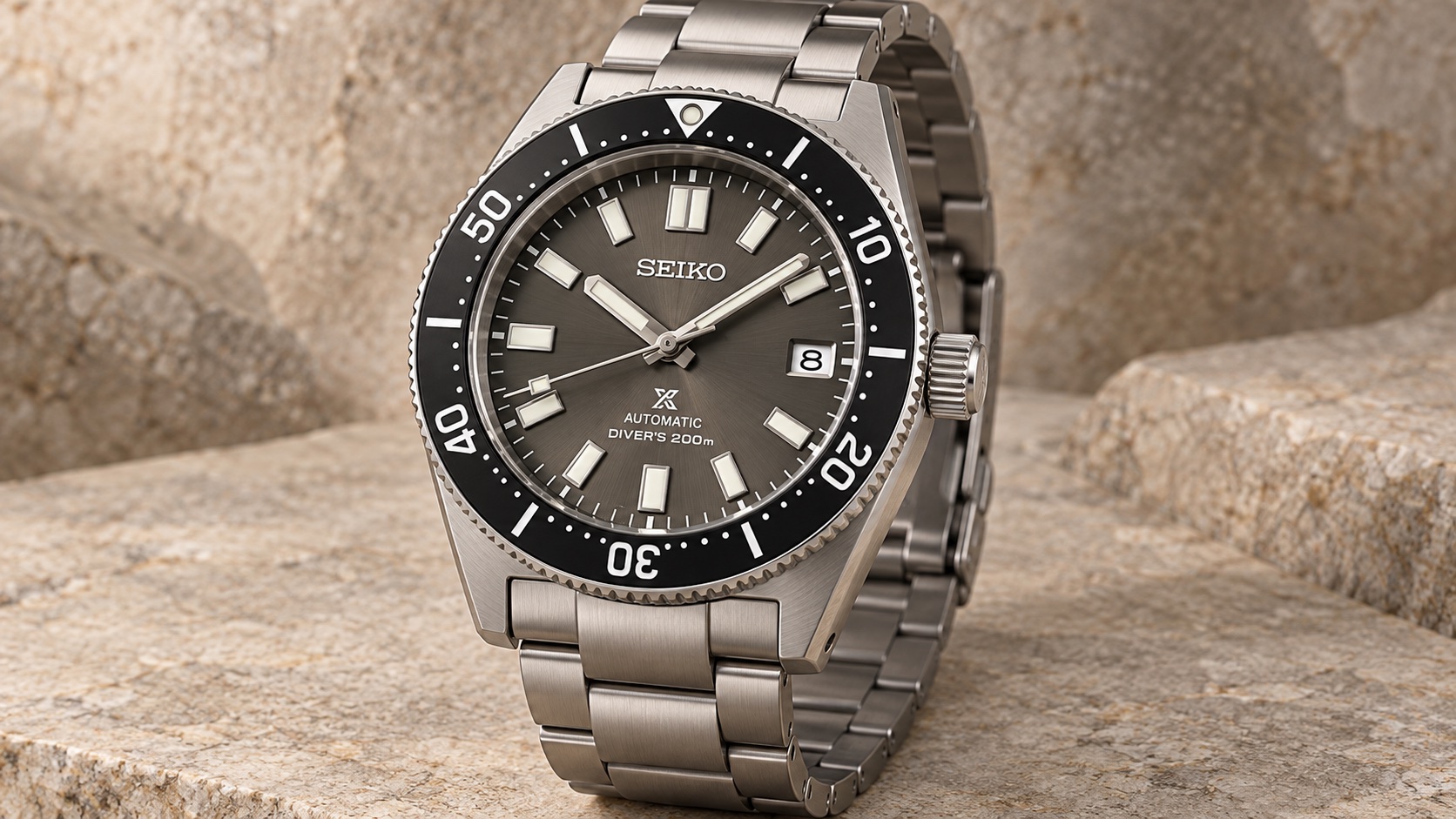
The SPB143 and green Alpinist demonstrate how much a watch can change around the same movement. Both use Seiko’s 6R35 automatic, offer roughly seventy hours of reserve and measure 13.2mm thick. Yet the grey bracelet diver and green leather-strapped Alpinist make very different visual and functional arguments.
Choose the SPB143 if a clear elapsed-time bezel and conventional diving layout are what you want. Choose the SPB121 if the green dial, decorative hands and internal compass scale are the attraction. The movement does not decide this comparison; it gives the two designs a shared mechanical foundation from which to do different things.
The references compared
| Feature | SPB143 diver | SPB121 Alpinist |
|---|---|---|
| Reference | SPB143J1 | SPB121J1 |
| Diameter / thickness | 40.5mm /13.2mm | 39.5mm /13.2mm |
| Lug-to-lug | 47.6mm | 46.4mm |
| Movement | Automatic 6R35 | Automatic 6R35 |
| Reserve | Approximately 70 hours | Approximately 70 hours |
| Maker accuracy | −15 to+25 seconds/day | −15 to+25 seconds/day |
| External / internal scale | Rotating elapsed-time bezel | Rotating compass inner ring |
| Rating | Diver’s 200m | 20 bar |
| Attachment | Steel bracelet | Brown leather; folding clasp |
Two histories behind the decision
Seiko identifies the SPB143 with its 1965 diving-watch heritage. The Alpinist’s family story begins earlier, in 1959, with a watch intended for climbers and other outdoor users. Today’s references are later developments rather than identical recreations of those first watches. The contrast in their displays explains the different inheritances: the diver puts elapsed minutes around a legible face, while the Alpinist includes a direction-related scale inside a more decorative dial composition. Both now sit within Prospex and share a modern automatic calibre. Their histories remain useful because they explain why the surrounding hardware and markings differ, rather than because either present watch must be used in the setting which originally inspired its family.
A minute scale and a compass scale are different tools
The SPB143’s unidirectional bezel can mark the start of an interval, letting the minute hand show elapsed time against the scale. It remains a simple visual reference even for activities far removed from diving. Its scale is part of why the watch has the familiar diver silhouette.
The Alpinist’s rotating inner ring is marked for compass use. It is not a magnetic compass sensor and does not independently find north. It adds character and a different sort of scale, but it should not be confused with the diver’s straightforward minute timer. If the extra function you will actually use is elapsed minutes, the SPB143 has the clearer case.
The Alpinist spends more of its design on decoration
The green face and warm-coloured details give the Alpinist a richer palette than the SPB143’s restrained grey composition. Its hands and numeral treatment also create a different character, while the date magnifier makes the calendar more conspicuous.
The diver relies more on the contrast between its hands, block-like markers and surrounding timing ring. These are not simply two dial colours applied to the same layout. Someone who enjoys the Alpinist’s distinctive mixture of outdoor cues and decorative details may find the diver comparatively plain. Someone who wants the simplest visual hierarchy may find that plainness exactly the reason to choose it.
The smaller Alpinist is not thinner
The SPB121 is one millimetre narrower and has a shorter published lug-to-lug length. It is the same thickness as the SPB143. That distinction matters if the aim is specifically to find a thinner watch rather than a smaller footprint.
The supplied attachments also change the complete objects. The SPB143’s steel bracelet continues the metal case, while brown leather frames the Alpinist differently. Both use twenty-millimetre lug spacing, allowing other compatible attachments, but an imagined strap change should not hide a dislike of the underlying case. Compare the supplied packages and their profiles before deciding which would benefit from a different strap.
The common movement removes an easy distraction
Both watches have the same published 6R35 accuracy range and reserve. There is no basis here for claiming one reference necessarily keeps better time simply because its design appears more professional or more refined. The shared movement leaves the other characteristics to justify the choice.
The SPB143 is specifically listed with a diver’s 200-metre rating, whereas the Alpinist is rated 20bar. Keep those descriptions distinct rather than turning equal-looking depth numbers into a claim of identical purpose. Choose the diver for its elapsed-time bezel, bracelet and restrained face. Choose the Alpinist for the green dial and unusual internal scale, accepting that the movement and thickness are broadly shared rather than extra reasons to prefer it.
Specifications and sources checked on 8 September 2026. SPB143 specifications and 1965 design; Alpinist SPB121 specifications; Alpinist 1959 history.
Image: AI-generated editorial illustration of the Seiko Prospex SPB143J1. Fine dial typography and finishing may differ from the production watch.


