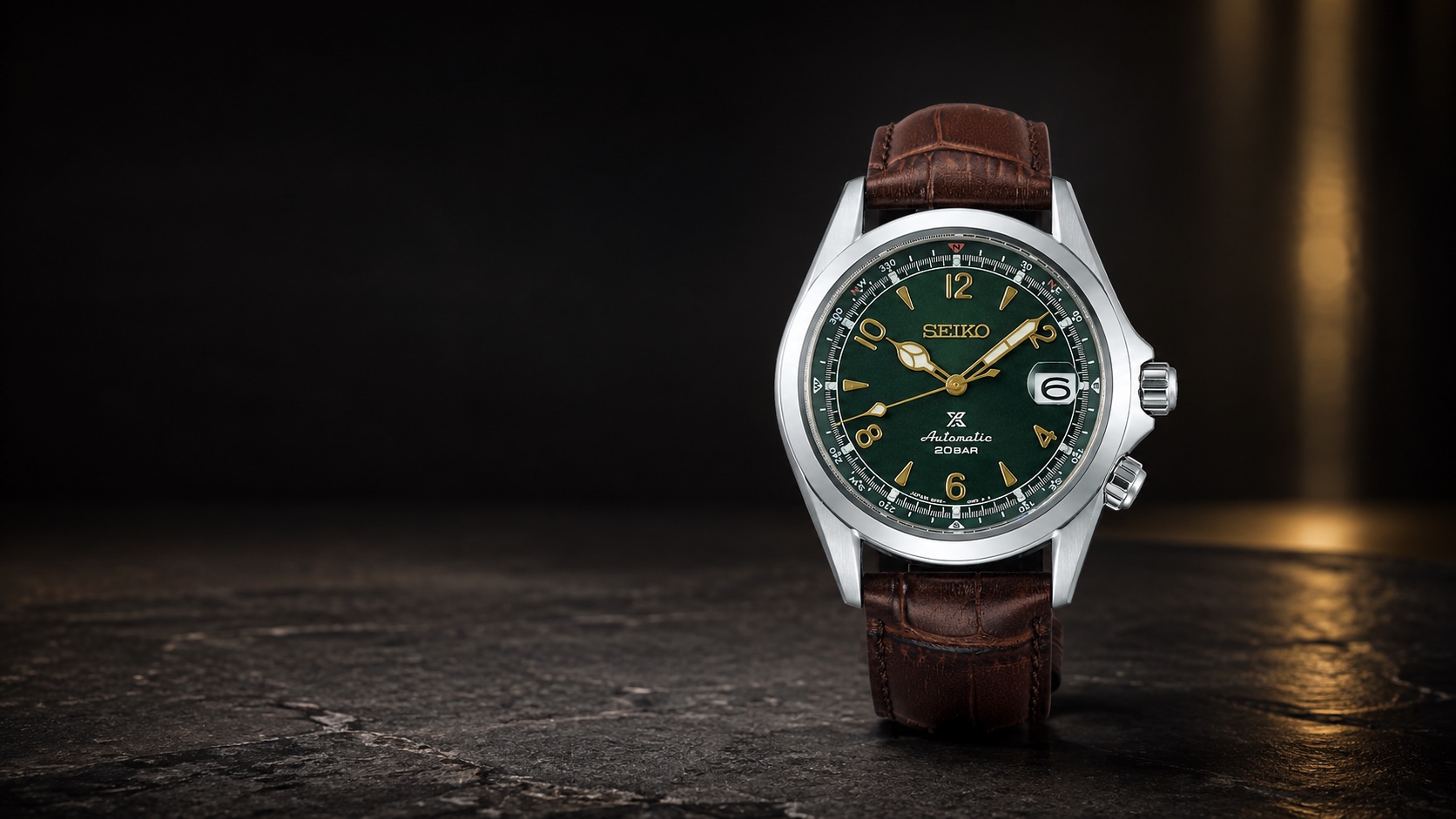
Research-based guide by The Wrist Guide Editorial, using manufacturer specifications and instructions checked on 7 September 2026. This is not a hands-on test. The featured image is an AI composition based on the manufacturer’s product photograph, not a photograph taken during hands-on testing.
The green Seiko Alpinist makes most sense when you want an everyday mechanical watch with a recognisable design, and can accept that accuracy is not its strongest specification. Its combination of a compact case footprint, date display and long running time is useful. The compass scale adds character, but should not be the main reason to buy it.
This guide concerns the SPB121J1 on its supplied brown leather strap. Seiko’s official UK store listed it at £690 on 7 September 2026. That is a dated retail price, not a guarantee of the amount a retailer will charge when you buy. The store identifies the green dial and the Alpinist collection’s origins in 1959. See Seiko’s official UK listing.
The specifications that matter
| Movement | 6R35 automatic, with manual winding and stop seconds |
|---|---|
| Rated accuracy | −15 to +25 seconds per day |
| Power reserve | Approximately 70 hours |
| Steel case | 39.5 mm diameter; 13.2 mm thick; 46.4 mm lug to lug |
| Crystal | Sapphire with date magnifier; internal anti-reflective coating |
| Water resistance | 20 bar |
| Strap fitting | 20 mm between lugs; leather strap with folding clasp |
These figures come from Seiko’s SPB121J1 technical page. They describe the manufacturer’s specification, not measurements or timing results taken by this publication.
Small enough to consider, thick enough to try on
The diameter alone suggests an easy everyday size. The more useful pairing is its 46.4 mm length and 13.2 mm thickness. A watch can sit within the edges of your wrist yet still stand noticeably above it; both measurements deserve attention. On paper, this Alpinist is a better candidate for someone seeking a modest footprint than for someone seeking a thin dress watch.
Try it with the sleeve you normally wear. Check whether the case stays centred when your arm hangs down and whether the clasp sits comfortably underneath. A strap hole that is almost right can make a larger difference to comfort than half a millimetre of case diameter. No wrist-circumference rule can settle that in advance.
The dial is another personal decision. The compass ring and date magnifier occupy visual space that a simpler three-hand watch leaves empty. Look at the time and date from your normal reading distance, not just in a close-up photograph. If the extra detail feels distracting there, familiarity with the Alpinist name will not solve it.
A long reserve does not mean quartz-like accuracy
Seventy hours is useful if you alternate watches: a fully wound example can theoretically bridge a two-day break. It is a capacity figure, however, so a lightly worn watch may not begin that break fully charged. Manual winding gives you another way to prepare it.
The published accuracy range deserves equal weight in the buying decision. Someone who wants to set a watch and leave it alone for months may find the need for corrections frustrating. Someone who enjoys checking and setting a mechanical watch may consider the same compromise entirely reasonable. We have no timing results for an individual SPB121J1 and would not promise performance better than Seiko’s stated range.
What the compass ring can and cannot do
This is a scale used with the sun and the watch hands, not a magnetic compass. Seiko’s instructions describe different procedures for the Northern and Southern Hemispheres, require the sun’s position to be known, and call for an adjustment when daylight saving time applies. Seiko also says the result is approximate and unsuitable where accurate direction is critical. Read the 6R35 instructions, including compass use and care.
That makes it an interesting feature to learn, rather than a replacement for navigation equipment. If you never use it, judge whether you still enjoy the dial enough to justify the space it takes.
Plan for the leather strap
The case’s water-resistance rating does not make the supplied leather immune to wear. Seiko’s manual explains that moisture and perspiration affect leather and recommends wiping them away. For regular wet activities, ask the retailer about a suitable alternative strap and the watch’s intended use. Include replacement straps in your ownership budget rather than assuming the original will last indefinitely.
Verdict
Buy the SPB121J1 for its green dial, manageable length and practical mechanical features if you are comfortable with its thickness and rated accuracy. Before paying, try the clasp, read the date at arm’s length and decide how you will use the leather strap. If slimness or minimal time-setting is your priority, those requirements point elsewhere. Check current availability with Seiko; this is a direct, non-affiliate link.


