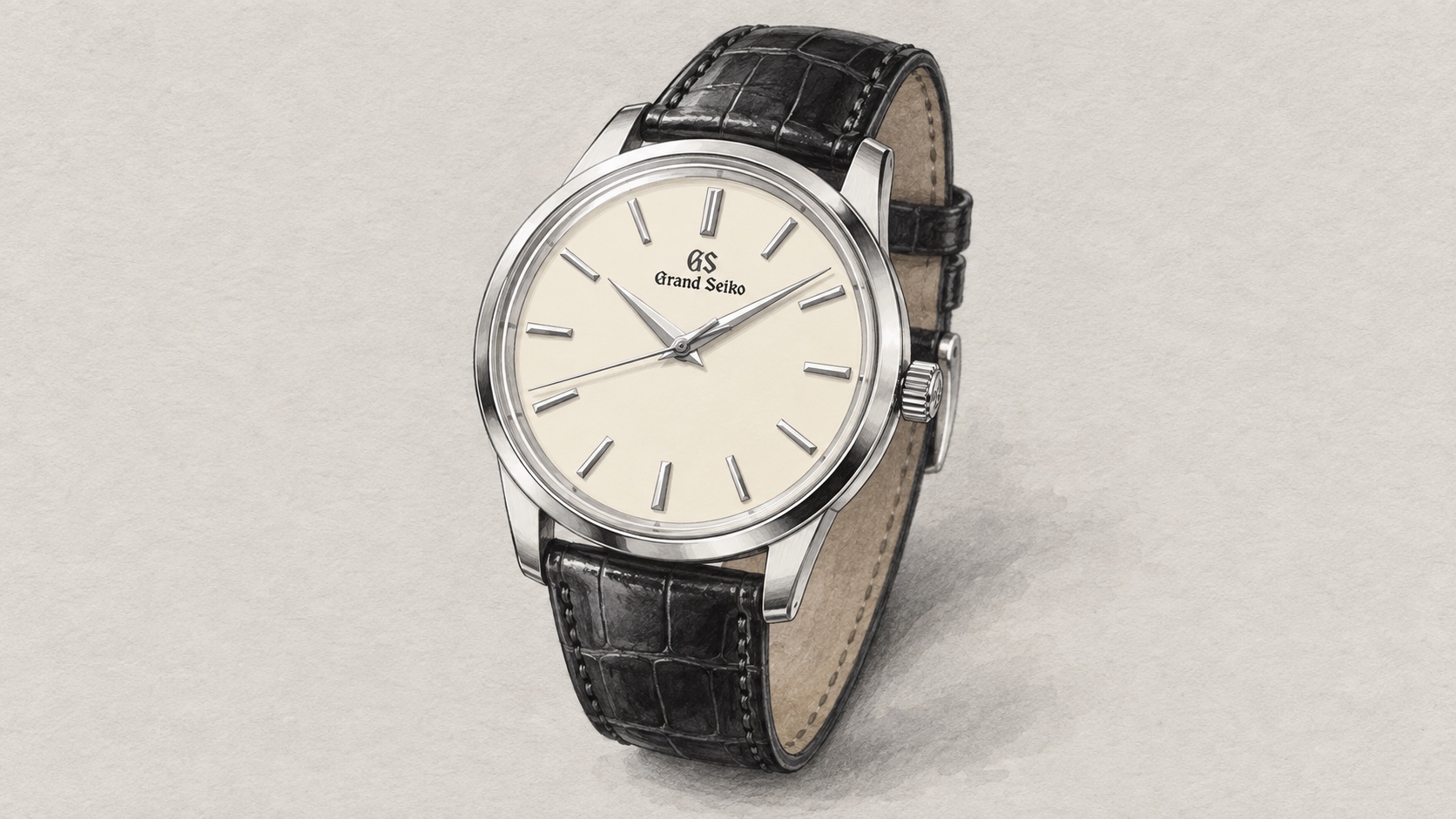
A hand-wound watch makes a small request: give it energy yourself. For some buyers, turning the crown is the part that makes the watch feel worth owning. For others, it is a chore that an automatic or quartz movement would remove. Decide which response sounds like you before paying for a beautifully finished mechanism.
The Grand Seiko SBGW231, Nomos Tangente 139 and Hamilton Khaki Field Mechanical H69439931 demonstrate three different reasons to choose manual winding. One puts a restrained Japanese dress-watch design first, one pairs typography with a thin German case, and one uses a field-watch layout that feels purposeful and direct.
Grand Seiko SBGW231: a traditional face and a long reserve
The SBGW231 has a 37.3 mm steel case, a pale dial and central seconds. Its 9S64 movement offers approximately 72 hours of running time from a full wind. The 11.6 mm thickness is worth noticing: manual winding does not automatically mean an exceptionally thin watch, particularly when a box-shaped crystal contributes to the silhouette.
Seiko introduced the 9S64 in 2011, continuing the company’s development of hand-wound mechanical movements. The SBGW231 places that technology behind a deliberately composed dial rather than a complicated display. It suits someone who enjoys the contrast between a quiet face and an involved mechanism. The official UK boutique showed this reference sold out at the source check, so availability should be confirmed before planning a purchase around it.
Nomos Tangente: winding as part of a spare design
Current reference 139 uses the DUW 4001 with a 53-hour reserve. Its 35 mm case is only 6.6 mm thick, but the lug-to-lug length is 45 mm. Those long, straight lugs make it a useful reminder that diameter and wrist span are separate questions. The small-seconds dial and blue hands give the white silver-plated face structure without filling it.
The Tangente reached the market in 1992 after Roland Schwertner and designer Susanne Günther revisited historical German dial typography. Nomos describes a specific connection to a 1937 dial design, rather than claiming that the Bauhaus school itself produced this watch. Choose it when that graphic character appeals as much as the movement visible through the back.
Hamilton Khaki Field Mechanical: a different reason to wind
H69439931 combines a 38 mm steel case with a black dial, clear Arabic hours and an inner 24-hour scale. The H-50 has an approximately 80-hour reserve. Its textile-and-leather strap and matte-looking field-watch vocabulary create a very different effect from a polished dress watch, even though winding the crown remains the basic ownership task.
Hamilton connects the modern Khaki Field Mechanical to its twentieth-century military supply history, including the functional layouts of its 1960s watches. The current model uses modern materials and a contemporary movement. Buy the layout and routine you enjoy, without treating it as an unchanged issued military instrument.
| Watch and reference | Case | Movement and reserve |
|---|---|---|
| Grand Seiko SBGW231 | 37.3 mm × 11.6 mm; 44.3 mm lug-to-lug | 9S64; approximately 72 hours |
| Nomos Tangente 139 | 35 mm × 6.6 mm; 45 mm lug-to-lug | DUW 4001; 53 hours |
| Hamilton H69439931 | 38 mm × 9.5 mm steel | H-50; approximately 80 hours |
The routine matters more than a large number
A long reserve gives flexibility, but it does not require you to wait until the watch is almost empty. A consistent winding routine can be easier to remember. Follow the maker’s instructions and stop at the appropriate resistance on a manually wound movement; do not force the crown in pursuit of an arbitrary number of turns.
Leaving the watch for longer than its reserve means resetting it. These three references avoid a date window, which makes that reset simpler than on a watch with several calendar indications. That can be a real advantage in a collection where different watches spend time off the wrist.
Which would make the ritual worthwhile?
Choose the Grand Seiko for its restrained traditional face, the Nomos for its thin profile and distinctive typography, or the Hamilton for a practical field-watch appearance. Try the crown as well as the case during a fitting. A watch bought partly for the pleasure of winding should have a control that you enjoy handling, not simply a movement specification you admire on paper.
Based on manufacturer information. Specifications and sources checked on 8 September 2026.
Sources: Grand Seiko UK boutique SBGW231; Seiko 2011 introduction of calibre 9S64; Grand Seiko US boutique SBGW231; Nomos UK Tangente reference 139; Nomos Tangente origins, Susanne Günther and 1937 dial ancestry; Nomos DUW 4001 technical information; Nomos winding, water-resistance and servicing guidance; Hamilton UK: Khaki Field Mechanical H69439931; Hamilton general instruction manual including H-50.
Image: AI-generated editorial illustration of the Grand Seiko SBGW231. Design details are approximate; this is not a product photograph.


