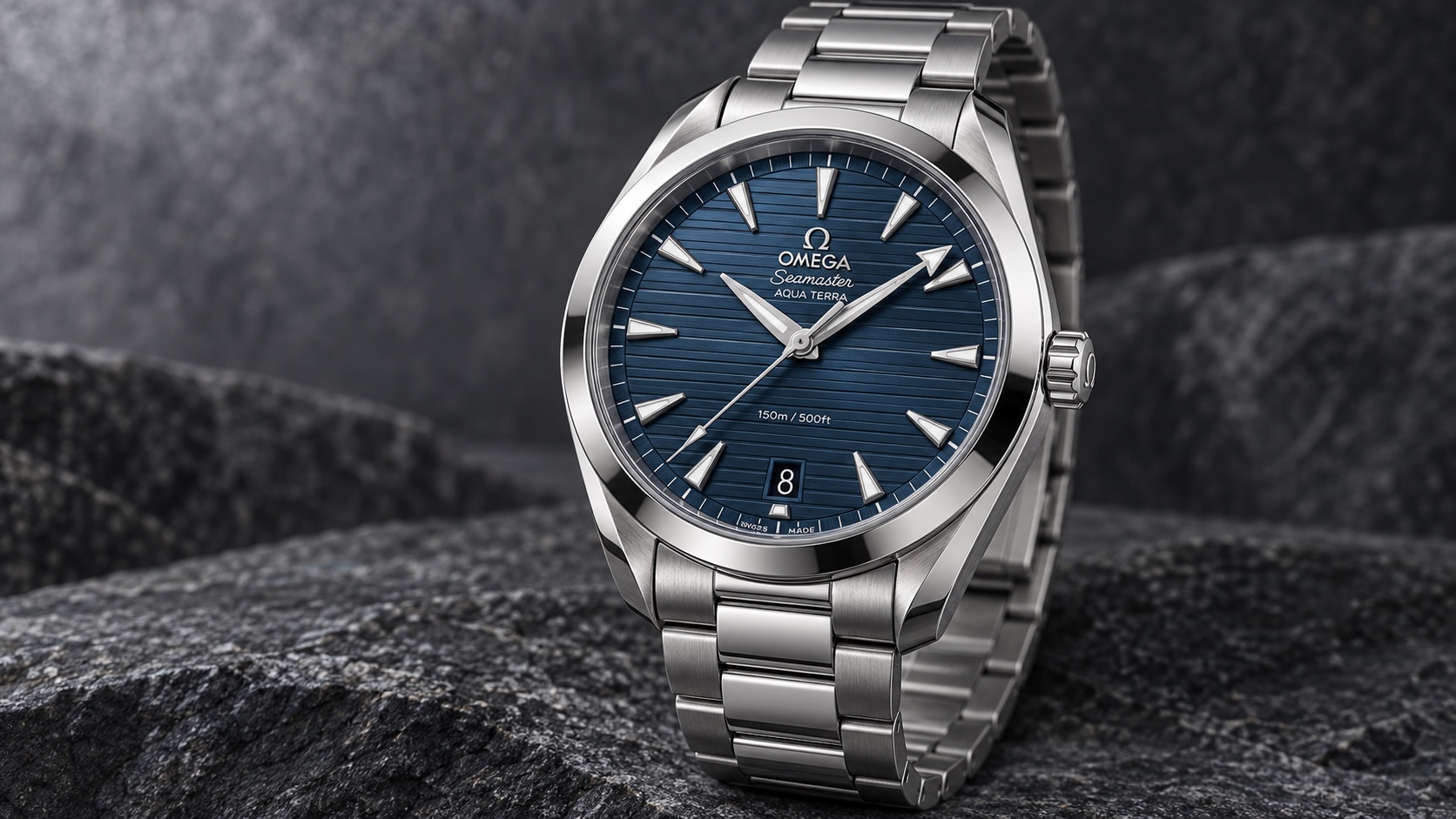
A watch that works with jeans and a suit does not need to disappear into both outfits. It needs a shape and finish you enjoy seeing every day. Blue dials and steel bracelets provide a flexible starting point, but the Omega Aqua Terra, Tissot PRX and Christopher Ward Twelve create very different outlines.
The Aqua Terra is the compact round-case option. The PRX and Twelve make the bracelet’s continuation into the case much more of the design. If you find yourself looking at the bracelet before the dial, that distinction should guide the shortlist before movement specifications do.
Similar colours, different proportions
| Exact reference | Diameter and height | Complete published weight | Reserve | Bracelet detail |
|---|---|---|---|---|
| Omega 220.10.38.20.03.001 | 38 × 12.24mm | About 131g | 55h | Steel; butterfly clasp; 19mm attachment |
| Christopher Ward C12-40ADA1-S00B0-B0 | 40 × 9.95mm | 160g | 38h | Integrated; current 3mm total micro-adjustment |
| Tissot T137.407.11.041.00 | 40 × 10.93mm | 138g | Up to 80h | Integrated; quick release; butterfly clasp |
These are the blue automatic references on their supplied steel bracelets. All use sapphire crystals. The Omega has a 150m rating; the Ward and Tissot specify 100m. None of those details promises that polished surfaces will remain free from normal wear.
Two design traditions share the desk
Omega introduced the Aqua Terra in 2002 as a broader expression of the Seamaster’s sporting identity. Its teak-pattern dial carries a nautical reference without adding a diving bezel. Tissot explicitly connects the PRX case to a 1978 design. Christopher Ward places the Twelve within the 1970s integrated-bracelet tradition while also acknowledging its own earlier C20 Lido. These histories explain why all three can feel established, yet differ so clearly in outline. The round everyday watch and the continuous steel sports watch solve the wardrobe question through different visual relationships.
The Aqua Terra begins with a smaller face
The Omega’s 38mm case and 45mm lug-to-lug measurement make it worth trying when you want a relatively compact watch with an open dial. At 12.24mm thick, it is the tallest case in this comparison, even though it has the smallest diameter. That distinction is particularly relevant under a close cuff.
The horizontal dial texture and date at six give the face interest without a strongly faceted bezel. If you want the watch to accompany different clothes through a familiar round shape, this may be the easiest visual starting point. Its 19mm attachment matters if you expect to add leather later; check an actual compatible strap rather than assuming an existing one will fit.
The Twelve puts surface and bracelet first
The Ward is thinner at 9.95mm and uses a twelve-sided bezel around a densely patterned Nordic Blue dial. It asks you to enjoy texture and small surfaces, rather than providing extra dial functions. The integrated bracelet tapers from 25mm to 17mm.
The current clasp offers up to 3mm of total micro-adjustment, split between its two sides. That is a useful feature to check on the actual bracelet, particularly when comparing a new listing with an older review or used example. At a published 160g, the watch also demonstrates why a thin case does not necessarily mean a particularly light complete watch.
The PRX makes a strong case for a familiar routine
The blue Powermatic 80 PRX offers a 40mm case, 10.93mm thickness and 138g published weight. Its quick-release bracelet and butterfly clasp complete the continuous steel outline. The textured dial supplies enough detail for a deliberately chosen accessory without requiring a complicated display.
The 80-hour reserve is the longest here. If you regularly switch watches for a weekend, a sufficiently wound PRX offers more time before stopping than the Aqua Terra’s 55 hours or the Twelve’s 38. That is a concrete ownership advantage, although it cannot decide whether you prefer the design.
Bracelet fit matters more than a versatility label
Have each bracelet adjusted to a plausible length and check where the clasp sits while typing. Watch how the first links bend around the wrist. A broad attachment can look beautifully continuous while occupying more horizontal space than the case diameter suggests.
Then examine the watch with your usual clothes. A steel bracelet can feel relaxed with knitwear and more deliberate beside a shirt, but there is no guarantee that the same design will suit every person’s idea of formal. Choose the finish you are happy to wear repeatedly, including after it acquires ordinary marks.
Choose the part you will keep appreciating
Pick the Aqua Terra for its smaller round face and nautical dial treatment. Pick the Twelve for its thin case, expressive texture and current clasp adjustment. Pick the PRX when its integrated shape already appeals and the longer reserve suits your rotation. An everyday watch earns its place through repeated enjoyment of those details, rather than a promise to be the objectively correct watch for every outfit.
Based on manufacturer information. Specifications checked on 8 September 2026.
Sources: Omega Aqua Terra specifications; Omega Seamaster and Aqua Terra history; Omega on nautical dial details; Christopher Ward The Twelve 40 Nordic Blue; The Twelve owner’s handbook; Tissot UK: PRX Powermatic 80 40mm T1374071104100.
Image: AI-generated editorial illustration of the Omega Seamaster Aqua Terra 150M 38 reference 220.10.38.20.03.001. Fine dial details, bezel contours and finishing may differ from the production watch.


