A wrist under six inches narrows the search, but it does not nominate a winning watch. Two wrists with the same circumference can have different shapes, and a narrow dial can sit above surprisingly long lugs. The useful question is which complete outline rests comfortably on your wrist.
The Rolex Explorer 36, Tudor Black Bay 54 and Nomos Tangente 139 are good examples to compare because they make different use of compact dimensions. One is a plain-bezel sports watch, one a small diver, and one a thin manually wound design on leather. Choosing among them begins with the kind of presence you want.
The measurements we can actually compare
| Watch and reference | Diameter | Published height | Power reserve | Fit-related detail |
|---|---|---|---|---|
| Rolex Explorer 124270-0001 | 36mm | Not quoted here | About 70h | Oyster bracelet; 5mm Easylink |
| Tudor Black Bay 54 M79000N-0001 | 37mm | 11.2mm | About 70h | Three-link bracelet; T-fit clasp |
| Nomos Tangente 139 | 35mm | 6.6mm | Up to 53h | 45mm lug-to-lug; 18mm leather strap |
The Tangente’s 45mm lug span is a documented manufacturer figure. The selected Rolex and Tudor sources do not supply comparable lug spans, so no guessed measurements are inserted. A missing figure is a reason to request a measurement or try the watch, not to assume the shortest case.
Compactness has more than one history
Rolex returned the Explorer to 36mm in 2021, after a period at 39mm, making the smaller case a deliberate current option. Tudor’s Black Bay 54 refers to its 1954 diving reference 7922 and carries specific early design cues into a modern 37mm watch. The Tangente arrived in 1992 after research into historical Glashütte dial design. Its economy of line follows a different tradition from either sports watch. All three have reasons for their proportions; none requires the wearer to follow a universal rule about what size is correct.
Try the Explorer for a compact everyday face
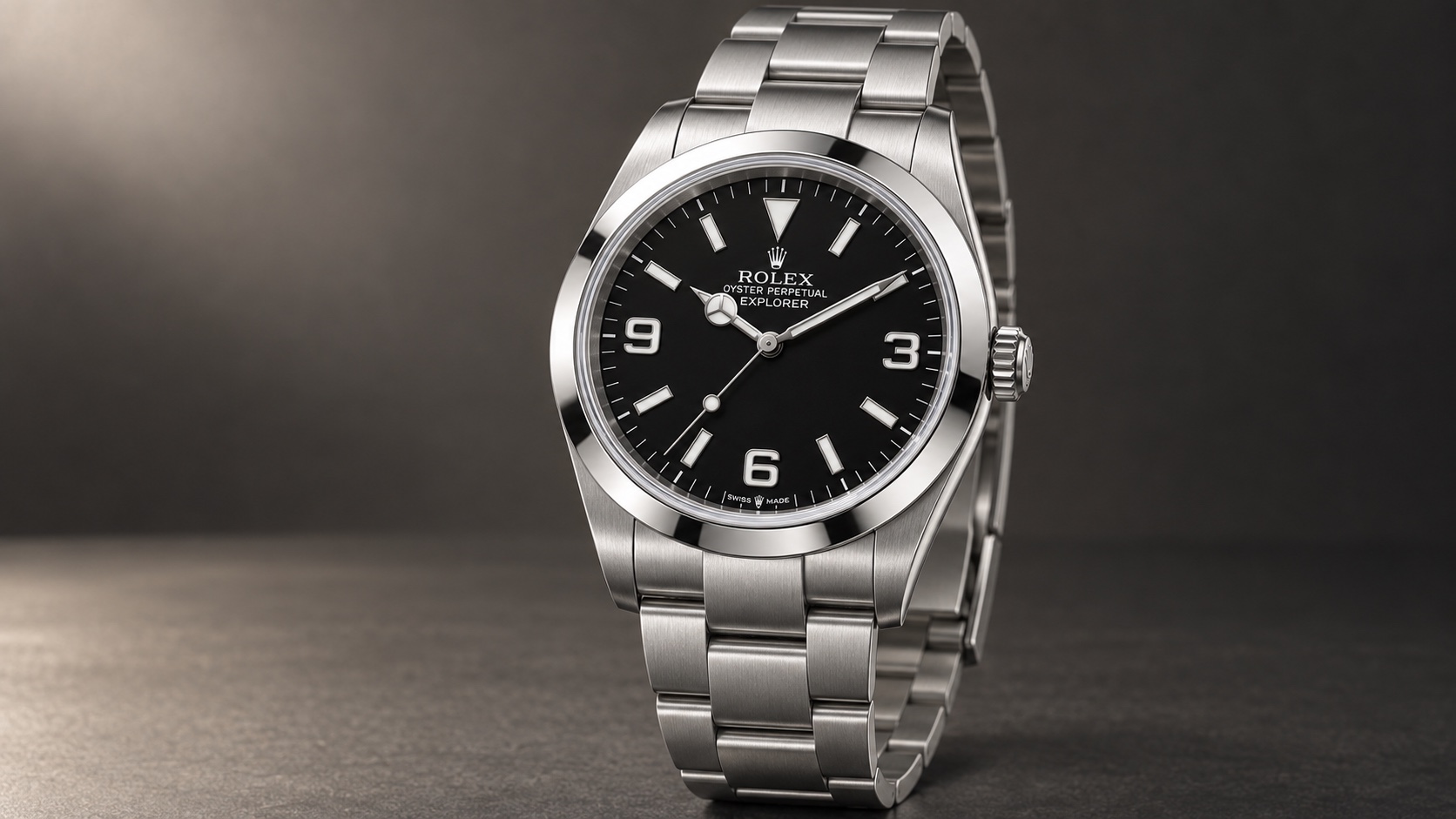
The 36mm Explorer uses a black dial with prominent 3, 6 and 9 numerals and a smooth bezel. Without a diving ring, a greater share of the visible face belongs to the time display. That can make it feel visually open despite the small diameter.
Its Oyster bracelet has an Oysterlock clasp and a 5mm Easylink extension. Have the basic bracelet length set appropriately before trying that adjustment. A watch that can be tightened to your wrist still needs its clasp to sit comfortably underneath it. Keep the removed links if you buy; they are part of the complete watch.
Try the Tudor when you want a small diver
The Black Bay 54 adds a black aluminium timing bezel, domed sapphire crystal and 200m water rating. Its 11.2mm thickness is useful for judging cuff clearance, while the bezel concentrates the dial within the 37mm case. Someone who finds plain dials visually expansive may prefer that arrangement.
The T-fit clasp gives the bracelet an adjustment mechanism aimed at everyday changes in fit. Test the actual combination of links and clasp, not an oversized display bracelet held together with a finger. The small case is valuable only if the whole bracelet can sit where you want it.
Try the Nomos when low height matters most
The Tangente is thinner than the Tudor at 6.6mm, with a 35mm diameter and a 45mm lug-to-lug measurement. Those long, straight lugs explain why it should not automatically be treated as the smallest-wearing watch in this group. Look at the side profile and where the leather begins to curve.
Reference 139 currently uses the manually wound DUW 4001, offering up to 53 hours. Its leather strap lets you select an appropriate length, but a strap cannot shorten the steel case. NOMOS describes the 5atm rating as splash-proof; it is a different water-use choice from the two bracelet sports watches.
A fitting sequence that reveals more
First set the bracelet or strap to a plausible everyday length. Then let your arm hang normally and look in a mirror, rather than relying only on a close photograph taken from above. Finally, rest your hand on a desk and bend your wrist as you do while typing. Notice contact from the crown, case ends or clasp.
Include your usual sleeve in the assessment. A thin watch can suit a fitted cuff even when its dial appears broad; a short case may be comfortable yet remain visibly tall. There is no need to reduce these separate impressions to one diameter limit.
Let the role settle the decision
Choose the Explorer when you want the clean sports-watch face and compact bracelet package. Choose the Black Bay 54 when the timing bezel and diving specification are part of the attraction. Choose the Tangente when its thin case and restrained dial suit your clothes and you welcome manual winding. The right small-wrist watch is the one that fits both your wrist and the job you expect it to do.
Based on manufacturer information. Specifications checked on 8 September 2026.
Sources: Rolex Explorer 36 specifications; Rolex Explorer origins; Rolex Explorer size evolution; Black Bay 54 specifications; Black Bay 54 origins and design; Nomos UK Tangente reference 139; Nomos Tangente origins, Susanne Günther and 1937 dial ancestry; Nomos DUW 4001 technical information; Nomos winding, water-resistance and servicing guidance.
Image: AI-generated editorial illustration of the Rolex Explorer 36 reference 124270-0001. Fine dial details and finishing may differ from the production watch.


