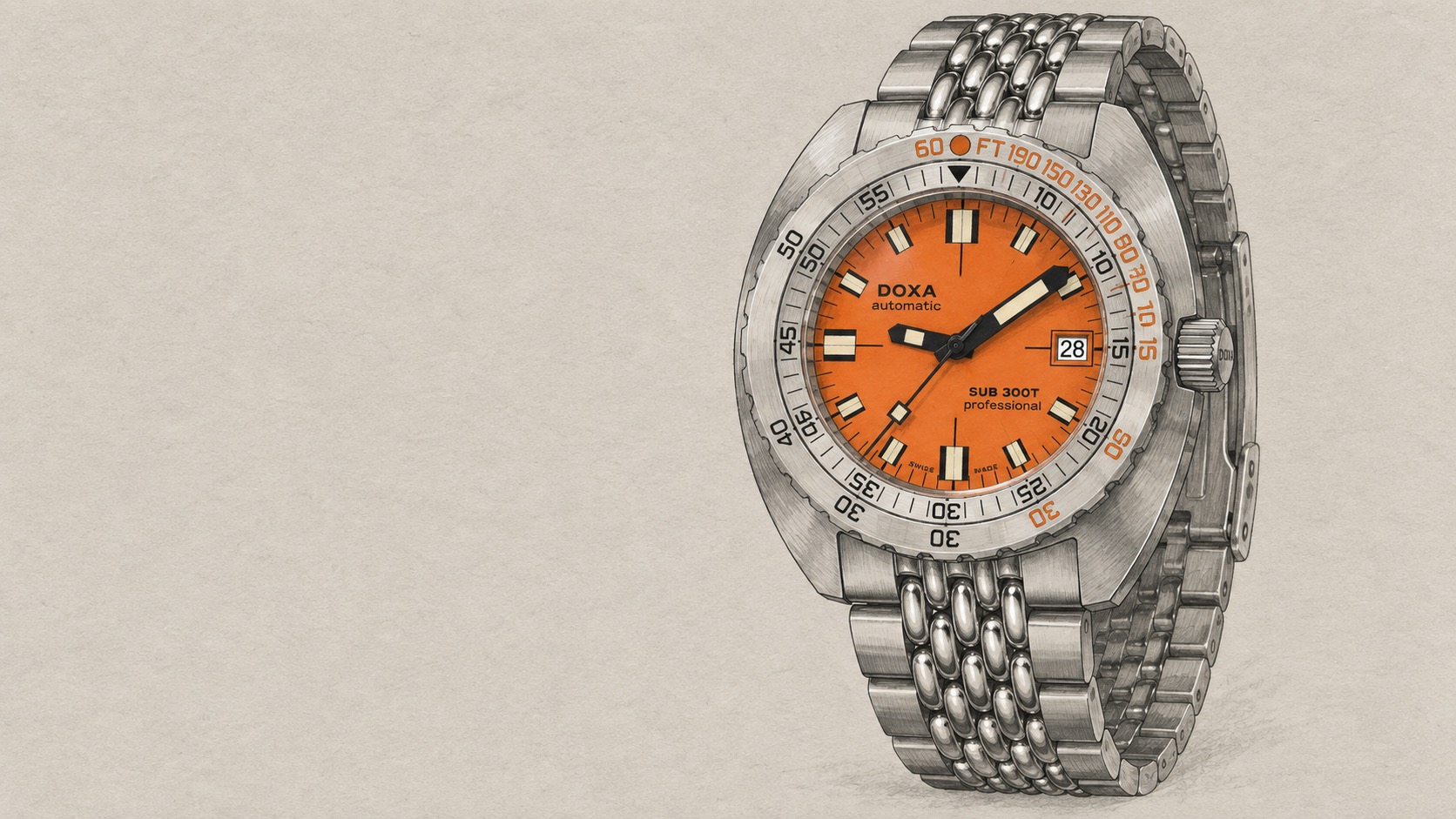
An orange DOXA is an unusually honest purchase. It does not pretend that a diving watch must disappear under every outfit. The SUB 300T Professional makes its colour, broad cushion case and elaborate bezel part of the reason to own it.
That does not prevent reference 840.10.351.10 from being an everyday watch. It simply changes the question. Rather than asking whether you need its 1,200 m rating, ask whether you want this very particular object on your wrist most days. The answer depends much more on its proportions, display and bracelet than on the greatest number printed in the specification.
Based on DOXA’s published information. Specifications checked on 8 September 2026.
The exact reference
| Case | Steel; 42.5 mm wide × 44.5 mm long; 13.65 mm thick |
|---|---|
| Movement | Swiss automatic; 28,800 vibrations per hour |
| Power reserve | 38 hours |
| Functions | Hours, minutes, seconds; date |
| Water resistance | 120 ATM / 1,200 m |
| Crystal | Sapphire with anti-reflective coating |
| Hardware | Unidirectional bezel with feet scale; helium-release valve |
| Bracelet | Steel beads of rice; folding clasp and ratcheting wetsuit extension |
| Lug width | 20 mm |
| UK listed price | £1,890, checked 8 September 2026 |
Specification source: DOXA UK SUB 300T Professional 840.10.351.10.
Orange, a valve and a distinctive diving lineage
DOXA’s history places the original SUB 300 in 1967 and the helium-valve-equipped SUB 300T Conquistador in the late 1960s. The brand connects the orange dial to its earlier underwater visibility research, giving the colour a functional origin within the collection. The current SUB 300T was introduced in September 2019 as a tribute to that earlier family. The continuity is visible in the cushion-like case, strongly differentiated hands and specialised bezel. It explains why this watch looks different from a generic round diver even before the colour is considered. For an everyday buyer, the history supplies context for the design, while the current reference’s dimensions and movement still need to earn the purchase on their own.
Broad across, relatively short along the wrist
DOXA publishes a 42.5 mm width and 44.5 mm case length, with 13.65 mm of height. That is an unusual combination: a generous horizontal presence without a correspondingly long case. It makes the SUB 300T worth trying even if some longer watches with smaller diameters have proved awkward.
The shape remains substantial. A short span does not erase the broad steel shoulders or turn the watch into a thin object. View it from the side and with your normal sleeves before deciding that the compact length solves every fitting question.
The dial occupies a smaller area within that wide case and bezel. It gives the watch an instrument-like concentration, with the orange face framed by a great deal of metal. Someone who likes expansive, open dials may find that relationship less appealing than the diameter initially suggests.
The orange face is an everyday decision
Professional is the orange-dial identity within the range. Its colour gives the watch an immediate point of recognition, while the dark hands and markers organise the time display. It is a strong choice if the rest of your wardrobe is relatively restrained and you want the watch to contribute the visual interest.
The same feature makes it less suitable as a purchase intended to match absolutely everything without comment. That is not a failing. It is simply a reason to be honest about your taste: if you usually return to black or silver after a brief experiment with colour, the orange may work better as a second watch.
The date supplies a normal daily function amid the diving details. This remains a three-hand watch to operate, rather than a complication that requires a separate skill just to read the time.
What the specialist hardware contributes
The bezel combines elapsed-time markings with a no-decompression scale, listed in feet on this reference. Its arrangement is part of the DOXA identity. For ordinary ownership, the useful action is the familiar one of turning a ring to mark a start time.
The helium-release valve belongs to the watch’s saturation-diving heritage. It is not a feature most everyday owners will use, and it does not make an orange dial more legible at a desk. You can appreciate why it is there without making it the purchase justification.
Likewise, the exceptional published depth rating is a statement about the design’s pressure capability. It does not establish the condition of an older example or replace appropriate diving procedures. The stronger argument for a daily buyer is that the watch retains a distinct form developed around a specialist purpose.
The bracelet and movement set the routine
The steel beads-of-rice bracelet adds fine texture against the broad case. Its folding clasp includes a ratcheting wetsuit extension. That equipment reinforces the diving identity while giving the bracelet more functionality than a plain fixed closure.
The stated 38-hour reserve is less generous than the depth rating might lead a specification enthusiast to expect. If you take the watch off on Friday evening, plan on setting it again for Monday. The exact product page does not name the calibre, so the buying case here rests on DOXA’s published automatic specification rather than an assumed movement supplier.
The quieter alternative
The 40 mm C60 Trident Pro 300 offers a more conventional blue diver appearance, an 11.3 mm case and a 300 m rating. It is an alternative for someone who wants the timing bezel and steel bracelet without the DOXA’s orange face and broad cushion shape.
At DOXA’s £1,890 UK listed price on 8 September 2026, choose the SUB 300T because those distinctive features are the attraction. It makes an engaging daily watch when you welcome its personality. If you are already trying to explain away the colour or case shape, a less specialised-looking diver is likely to suit you better.
Image: AI-generated editorial illustration of DOXA 840.10.351.10. Design details are approximate; this is not a product photograph.


