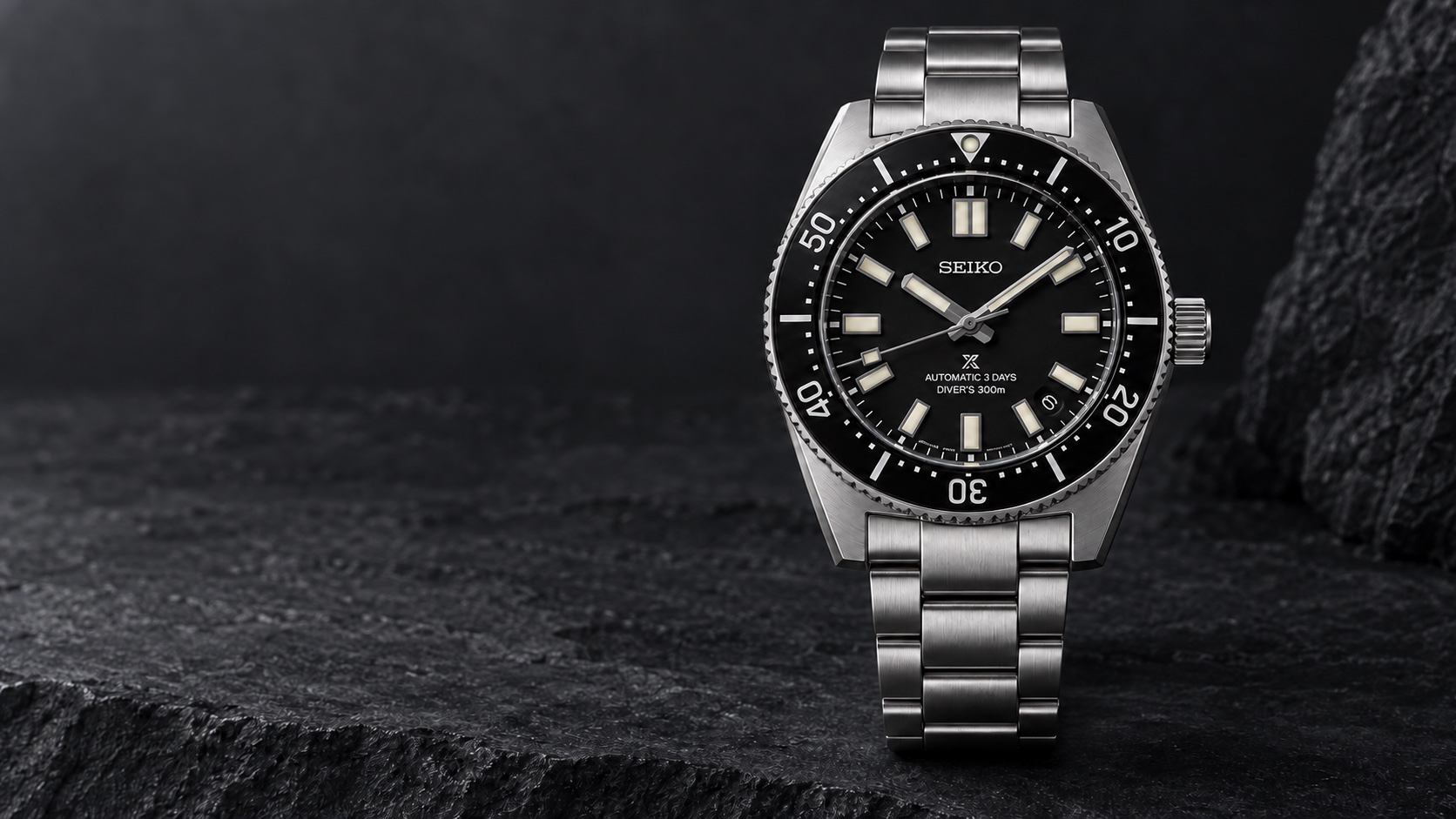
A longer power reserve is easy to appreciate on Monday morning. Extra water resistance is harder to notice on the train. The Seiko SPB453 offers both, which makes it worth separating the improvements you will use from the ones you simply like knowing are there.
This black-dial Prospex is a 40 mm automatic diver with a deliberately restrained appearance. It sits well beyond the simplest entry-level mechanical watch in price. The buying decision is therefore less about collecting a familiar Seiko silhouette and more about whether this particular combination of proportions, movement and dive-watch specification fits your needs.
Based on Seiko’s published information. Specifications checked on 8 September 2026.
The reference at a glance
| Movement | 6R55 automatic with manual winding and stop seconds |
|---|---|
| Reserve | Approximately 72 hours |
| Published accuracy | −15 to +25 seconds per day |
| Case | Stainless steel; 40.0 mm diameter; 13.0 mm thick |
| Lug-to-lug | 46.4 mm |
| Lug width | 20 mm |
| Crystal | Curved sapphire; internal anti-reflective coating |
| Water resistance | 300 m diver’s |
| Weight | 168 g |
| UK listed price | £1,250, checked 8 September 2026 |
Specification source: Seiko UK SPB453 specifications.
From 1965 to a thoroughly modern specification
Seiko introduced its first diver’s watch in 1965. The original combined automatic winding with 150-metre water resistance, as recorded in Seiko’s historical account, establishing a line that the modern Heritage Diver collection revisits. The SPB453 generation arrived in 2024 as a reinterpretation, with contemporary dimensions, a new movement and a relocated date display. It is connected to that first watch through design, not through identical engineering.
Seiko’s account of the 2024 development highlights the 72-hour calibre 6R55, increased 300-metre rating and revised bracelet with shorter links and a smaller clasp. Moving the date between four and five also allowed a full luminous marker at three. That history is useful because it explains why a watch that looks familiar has changed. See Seiko’s 1965 Heritage development story.
The upgrade you may notice most is the shape
The diameter is only one part of the case. Its documented 46.4 mm lug-to-lug length describes the reach along the wrist, while the 13.0 mm height is relevant to cuffs and how substantial the watch appears from the side. Those figures are a better starting point than declaring it suitable for a particular wrist circumference.
Seiko says the revised bracelet uses shorter links and a smaller clasp. That is a design change to investigate during a fitting, not a substitute for one. Ask whether the bracelet bends around your wrist without leaving a pronounced gap, and check the clasp’s position underneath. The supplied clasp includes an extender, but an extender alone does not guarantee the perfect everyday adjustment.
At a listed 168 g, the complete watch is still a substantial steel object. Someone seeking the least noticeable watch should compare a lightweight alternative before deciding that a moderate diameter solves everything. Size and mass answer different questions, and neither predicts whether you will enjoy the watch.
Three days of reserve, with an important condition
The approximately 72-hour reserve can cover a normal weekend away from the wrist when the watch begins fully wound. That qualification matters. An automatic movement stores energy through use, and a partially wound watch does not acquire its maximum reserve simply because the dial says three days.
For a rotation of two watches, the extra reserve can reduce how often you reset the time and date. For someone who wears the same watch every day, it may change very little. Think about the gaps in your actual routine rather than treating a bigger number as an automatic reason to upgrade.
Accuracy is a separate specification. Seiko publishes a range of −15 to +25 seconds per day for the 6R55. That is not a promise of the rate of an individual example, and it should not be confused with a chronometer certificate. If precise timekeeping with very little correction is your overriding priority, a mechanical reserve extension does not address that requirement.
A better-lit dial can mean a less obvious date
The small date aperture between four and five changes the visual balance. It preserves the main hour-marker sequence, which Seiko links to increased luminous material and legibility. For buyers who dislike a large date window at three, that can be a meaningful design improvement. For someone who consults the date constantly, its smaller and less conventional position deserves a careful look.
The sapphire crystal has an anti-reflective coating on its inner surface, and LumiBrite appears on the hands, indexes and bezel. Those are the specified components. They do not establish how many hours the dial will remain readable in your own conditions, so avoid turning the feature list into an assumed lume test.
The screw-down crown, unidirectional bezel and 300 m diver designation form a coherent dive-watch specification. Even if your watch mostly sees a desk, there is nothing unreasonable about liking that capability. Just recognise whether you are buying for an activity, for reassurance or for the design itself.
Put the £1,250 decision in context
Seiko lists £1,250 in the UK, checked on 8 September 2026. At that level, arrange a fitting and inspect the actual watch before making the specification sheet your verdict. Check the crown operation, date visibility and bracelet fit, then consider whether those details justify the total purchase for you.
The Orient Kamasu RA-AA0001B is an alternative worth investigating if you primarily want an automatic sports watch with sapphire and a rotating bezel. Its published 41.8 mm width and day-date layout make it a different proposition, and its 200 m rating should not be treated as the same certification claim as Seiko’s explicit diver designation. Compare the exact retail offers rather than an old overseas headline price.
Choose the SPB453 if you want Seiko’s modern 1965-inspired diver, can use the longer reserve and find the revised case and bracelet convincing on your wrist. Pass if you mainly want the least expensive route to a mechanical bezel watch, or if accuracy matters more than the mechanical format. The strongest reason to buy it is that several practical improvements matter together, not that any one specification wins alone.
Image: AI-generated illustration. Fine details may differ from the watch.


