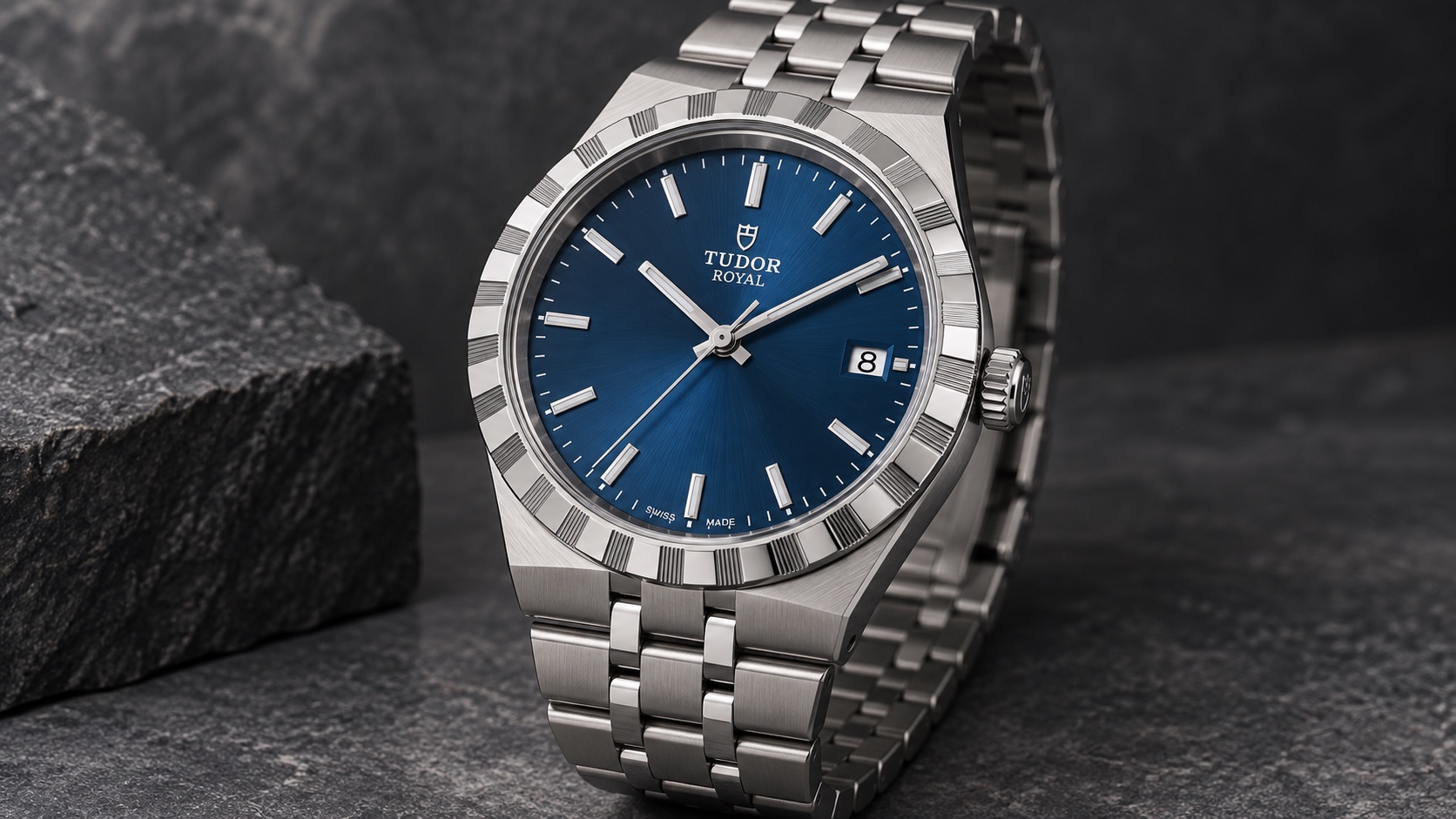
The 2026 Royal needs to be judged as a new proposition. If you remember the older 38mm model, its movement and bracelet specification are the wrong starting point for this 36mm blue reference. Tudor now combines a manufacture calibre with T-fit adjustment and a reworked exterior.
Those changes strengthen the everyday case for the Royal, but its identity still rests on the integrated bracelet and notched bezel. Buy it because that combination appeals, rather than treating it as a placeholder for a Datejust. The useful comparison is between two distinctive bracelet watches and the features each actually gives you.
The history behind the choice
Tudor first used the Royal name in the 1950s, associating it with the quality and design of its watches. That long-lived name does not mean today’s integrated-bracelet model is an unchanged mid-century design. The current range reinterprets it through three new case sizes: 30, 36 and 40mm. The 2026 revision also brings redesigned bezel notches, altered end-link and lug geometry, and manufacture movements. This is a useful example of heritage supplying a name rather than dictating every line of a modern case. The blue 36mm version makes that evolution especially clear. Its stick markers and linked steel surfaces put the emphasis on a contemporary bracelet watch, while the Royal name provides continuity with a much older part of Tudor’s catalogue.
The exact reference
| Specification | Published detail |
|---|---|
| Reference | M2836C1A0-0102 |
| Case | 36mm steel; 9.7mm thick |
| Dial | Blue; applied stick markers; date at 3 |
| Bezel | Steel; polished notches |
| Movement | Automatic manufacture MT5412; COSC |
| Stated reserve | Approximately 70 hours |
| Maker timing standard | −2/+4 seconds per day; assembled watch |
| Water resistance | 100m |
| Crystal | Sapphire |
| Bracelet | Integrated five-link steel; T-fit clasp |
The bracelet is the shape of the watch
The Royal’s five-link bracelet is integrated into the case outline. Three broad satin-brushed elements alternate with two slimmer polished ones. That arrangement continues the contrast of finishes around the wrist, making the bracelet part of the composition rather than merely a way to fasten the watch.
T-fit is a meaningful addition because a visually continuous design still needs practical adjustment. Tudor has also revised the relationship between the end links and lugs to keep the links from touching the case. Together, those changes suggest attention to the complete object. The main limitation remains the design’s commitment to its bracelet. If switching among ordinary straps is central to your enjoyment of a watch, a conventional case deserves consideration instead.
Sharper notches, quieter markers
The bezel has polished notches with a more sharply defined form. It creates repeating points of reflection around the dial, but it is not the same pattern as a Datejust’s fluted bezel. Calling both simply dressy misses the visual difference. The Royal’s interrupted notches connect naturally with its broad bracelet elements.
This exact blue reference uses applied stick hour markers. Other Royals use different dial treatments, including Roman numerals, so photographs should match the full reference when you compare them. The baton layout makes the blue surface a stronger part of the design and leaves the date aperture as its main asymmetrical feature. Someone who found earlier Royal configurations too busy may see this version differently.
A movement upgrade with an everyday purpose
The MT5412 brings approximately seventy hours of reserve to this model. It is COSC certified, while Tudor also states a tighter assembled-watch timing range of minus two to plus four seconds per day. The company describes a silicon hairspring and a balance supported by a bridge anchored at two points.
The important distinction is that these are the details of the present 36mm reference. They should not be copied from or assigned to an older Royal listing just because the family name matches. The current 30mm model also uses a different calibre and stated reserve. A buyer comparing discounted older stock with a new Royal should identify the two references first, then decide how much the movement and clasp changes matter.
What a Datejust comparison should include
The steel-and-white-gold Datejust 36 considered here has a fluted white-gold bezel, a Jubilee bracelet and the 3235 movement. Its date is magnified by the Cyclops lens. The Royal’s steel notched bezel and unmagnified date produce a different face, even before the integrated case-to-bracelet transition enters the comparison.
Both selected watches publish a 100-metre water-resistance rating and approximately seventy hours of reserve. Those common figures make the exterior and bracelet differences more significant, rather than proving the watches equivalent. Compare complete retailer quotations for the exact configurations. Neither a shared group connection nor a similar diameter establishes how much one watch should be worth to you.
Who the revised Royal suits
At 9.7mm thick, the Royal 36 has a different structural brief from Tudor’s taller sports models. It gives up a diver’s rotating bezel and the stronger visual separation between case and strap in favour of a continuous bracelet silhouette. During a fitting, check how that integrated transition follows your wrist; one diameter number cannot describe it.
Choose the new Royal if its polished notches, blue stick-marker dial and linked steel architecture are the attraction. The MT5412 and T-fit make that choice easier to justify on practical grounds. Choose the Datejust when its fluted bezel, Cyclops and separate bracelet identity are what you wanted all along. The revised Royal is most persuasive when allowed to be itself.
Specifications and sources checked on 8 September 2026. Royal 36 blue specifications; Royal design and history; 2026 Royal technical press dossier; Rolex Datejust 36 comparison.
Image: AI-generated editorial illustration of the Tudor Royal 36 reference M2836C1A0-0102 current 2026 generation. Fine dial details, hand shapes and finishing may differ from the production watch.


