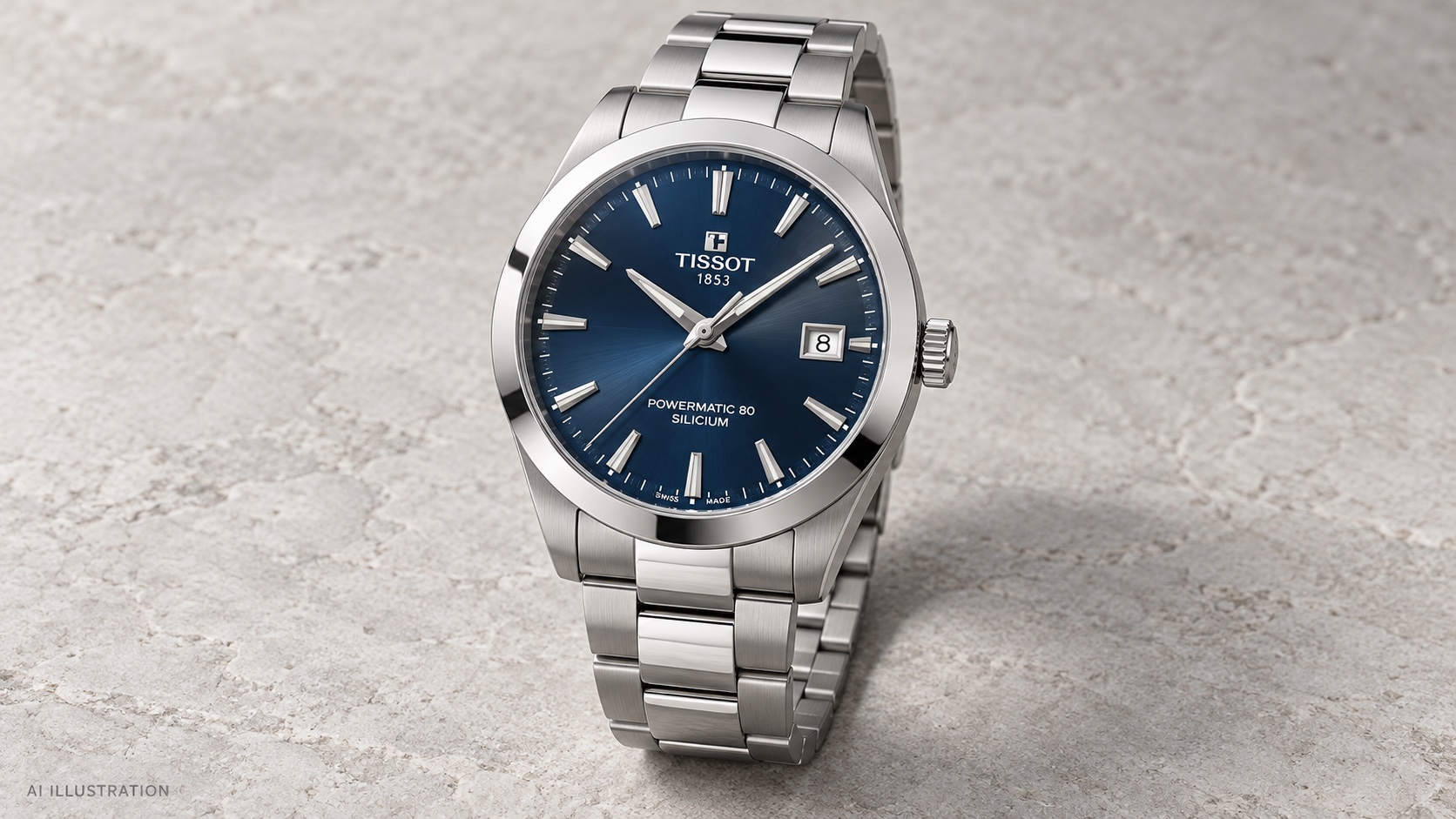
The Tissot Gentleman and Longines Conquest 38 arrive at a similar destination by different routes. Both offer a blue dial, a steel bracelet, automatic winding and enough restraint to work with most everyday clothes. Yet the checked UK prices are £800 and £2,000. The interesting question is what the extra £1,200 changes.
Start with the Gentleman if you want this type of watch and value matters most. Start with the Conquest if its smaller case and particular dial-and-bracelet design are already what you want. The Longines needs to win on those details, because the specification table does not give it a sweeping practical advantage.
The two blue bracelet references
| Feature | Tissot T127.407.11.041.00 | Longines L3.720.4.92.6 |
|---|---|---|
| UK listed price | £800 | £2,000 |
| Case diameter | 40mm | 38mm |
| Movement | Powermatic 80 automatic; silicon spring | Automatic; silicon spring |
| Power reserve | Up to 80 hours | Up to 72 hours |
| Case and bracelet | Stainless steel | Stainless steel |
| Crystal | Sapphire; antireflective coating underneath | Sapphire; antireflective layers on both sides |
| Water resistance | 10 bar / 100m | 10 bar / 100m |
| Clasp | Butterfly with push-buttons | Triple safety folding; push-piece release |
This comparison uses the Gentleman T127.407.11.041.00 and Conquest L3.720.4.92.6. Other sizes, dial colours and movement versions can change the decision. Prices above are the manufacturers’ UK listings checked on 8 September 2026.
Two different ways of carrying history
Tissot began in Le Locle in 1853, but the Gentleman’s historical connection is more specific than a founding date. The maker describes a design inspired by the 1960s, using a round case, clean dial and polished details to create a familiar everyday shape. It draws on a period rather than copying one named vintage reference. That gives the design freedom to use contemporary dimensions and a modern automatic movement.
The Conquest has a named lineage. Longines registered the collection name in 1954, and later anniversary editions revisited early designs directly. The present collection has developed into a contemporary sports watch, with the 2024 expansion bringing a wider selection of sizes. A Conquest buyer is choosing continuity of a collection as well as a current design. Neither approach makes one watch inherently better, but they offer different kinds of historical appeal.
The smaller Longines is the clearest physical difference
The Conquest measures 38mm across against the Gentleman’s 40mm. Two millimetres sounds modest until you compare the outline of a plain-bezel watch, where the dial occupies so much of the visible face. A buyer drawn to compact proportions has a concrete reason to begin with the Longines. Someone who wants more dial presence may prefer the Tissot.
This is a preference between these two watches, not a rule that maps a wrist circumference to a diameter. Bracelet shape and how the case sits still matter. The useful shop comparison is to try both with a realistic bracelet adjustment, look at the proportions from a normal distance, and decide which outline you prefer. A close-up phone photograph can make either look larger than expected.
The Gentleman’s published weight is 164g. The comparison should not turn that into a claim that the Conquest is lighter, because a comparable weight is not supplied in this brief. What can be compared is their character: the Tissot’s relatively broad, straightforward face and the Longines’ more compact interpretation of the same everyday role.
The movements explain less of the price gap than you might expect
Both watches use automatic movements with silicon balance springs. The Gentleman offers up to 80 hours of reserve, while the Conquest offers up to 72. That is an eight-hour difference, with the lower-priced watch ahead on the published figure.
In a two-watch rotation, either reserve can cover a weekend if the watch starts sufficiently wound. The Tissot provides a little more margin. If you wear one watch every day, that distinction is unlikely to be the main reason to choose. If you leave it untouched for a week, neither advertised reserve removes the need to restart it.
The point is not that reserve settles the contest. It is that spending more does not move every specification upward. The Conquest’s appeal has to include its proportions, design and the pleasure of owning that particular watch. Those are perfectly reasonable reasons to spend more, provided they are the reasons you actually have.
Shared water resistance, different crystal treatment
Both have a 10-bar rating and sapphire crystals. The Tissot specifies antireflective coating on the underside, while Longines specifies multiple antireflective layers on both sides. The Longines also lists a screw-in crown. These are useful construction differences to notice when comparing the watches closely.
A coating specification alone does not describe every reflection you will see. Dial finish, lighting and viewing angle all contribute to the appearance of a blue watch. The practical question is which display you find easier and more attractive to read in the places you spend time. The Conquest’s sunray dial is a substantial part of its visual appeal, so it deserves more attention than a reserve figure you may rarely notice.
The bracelet should settle a close decision
Tissot uses a butterfly clasp with push-buttons. Longines describes a triple safety folding clasp with a push-piece release. Both put a bracelet at the centre of the intended presentation, and neither should be treated as a watch head with an incidental band attached.
If leather is part of your plan, the Gentleman’s 21mm attachment deserves checking before buying replacement straps. That is a specific shopping detail which can matter more to an owner than the broad label of versatile sports watch. If you intend to stay on steel, concentrate on the clasp position and the fit that each bracelet can achieve.
Which one earns a place on your wrist?
Choose the Gentleman when you want a blue-dial Swiss automatic on a bracelet and its 40mm proportions suit you. At the checked prices, it leaves £1,200 for other priorities while retaining the central features of this comparison. It is an easy choice to defend without treating it as a temporary substitute for something more expensive.
Choose the Conquest 38 when its compact case, dial and bracelet are the combination you keep returning to. The premium buys the Longines interpretation of an everyday watch, not an extra £1,200 worth of calendar or reserve functionality. If you can name the design details that make you prefer it, the decision becomes much clearer. If you cannot, the Gentleman deserves to stay at the top of the shortlist.
Based on manufacturer information. Specifications and UK prices checked on 8 September 2026.
Sources: Gentleman alternative; Tissot history; Tissot on the Gentleman’s 1960s inspiration; Le Locle alternative; Longines Conquest 38mm specifications; Conquest’s 1954 origins; Longines’ 2024 Conquest expansion; HydroConquest alternative.
Image: AI-generated editorial illustration of the Tissot Gentleman Powermatic 80, reference T127.407.11.041.00. Fine design details may differ from the production watch.


