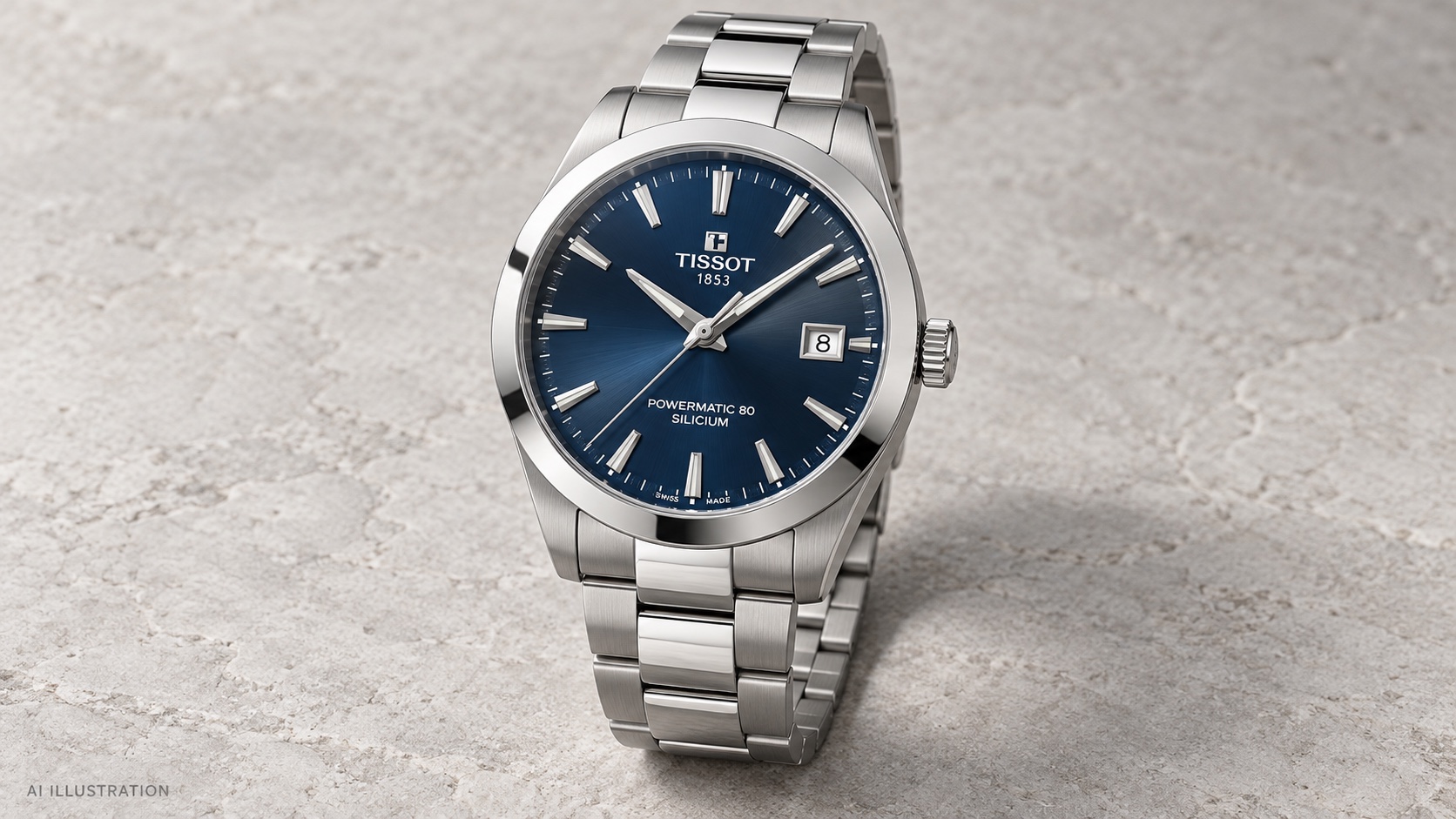
The Tissot Gentleman is easy to recommend from a photograph and harder to choose properly. Its blue dial and plain steel bezel do not demand a particular wardrobe. That is useful if you want one watch to cover a meeting, dinner and an unplanned Saturday. It also means the reasons to buy it are less obvious than a dramatic design feature.
Start with the bracelet and the weight. If those suit you, the Gentleman has a persuasive everyday brief. If you are hoping that a restrained appearance guarantees an equally unobtrusive feel, the published specifications deserve a closer look before you spend £800.
The history behind the choice
Tissot locates its story in Le Locle, Switzerland, beginning in 1853. The Gentleman draws on that background without presenting itself as a numbered recreation of one historic watch. Tissot’s Spanish product description specifically links its appearance to the 1960s: a round case, a clean dial and a mixture of polished surfaces. That is a useful distinction when deciding what kind of heritage you want. Here, the past supplies a familiar visual language rather than a replica’s obligation to preserve every old detail. The automatic movement and contemporary materials serve a present-day watch. Buy it because that balance appeals, rather than expecting a historical collector’s object simply because the design looks established.
The exact reference
| Specification | Published detail |
|---|---|
| Reference | T127.407.11.041.00 |
| UK price checked | £800 |
| Diameter / thickness | 40mm / 11.50mm |
| Published weight | 164g |
| Case / bracelet | 316L stainless steel / steel |
| Movement | Powermatic 80 automatic; silicon balance spring |
| Stated reserve | Up to 80 hours |
| Water resistance | 10 bar / 100m |
| Crystal | Sapphire; antireflective coating underneath |
| Strap attachment | 21mm |
| Clasp | Butterfly with push-buttons |
A versatile appearance still has a personality
Look at the Gentleman alongside the clothes you actually wear, not an imagined future collection of suits. A simple watch can work beautifully with a jumper and trainers, but it can also feel too conventional if your existing accessories are deliberately unusual. There is no advantage in buying versatility that makes you reluctant to reach for the watch.
The strongest case for this blue reference is consistency. It does not require you to enjoy a particular sporting story or a conspicuous dial display. That makes it a good candidate for someone whose daily routine changes more often than their preferences. For a collector who already owns a plain steel watch, the same quality can become overlap. Ask what job this would do that the existing watch cannot.
Judge the bracelet before the movement
The quoted weight puts substance behind that restrained design. Ask for a realistic bracelet adjustment during a fitting rather than leaving spare links folded beneath your wrist. Check where the clasp lands when your hand rests naturally on a desk. A bracelet that fits around your wrist is not necessarily one whose clasp sits comfortably in the right place.
The attachment width also deserves attention if you expect to wear leather regularly. Check the exact 21mm fit and the shape of the strap ends before ordering an alternative. Do not assume a strap already in your drawer will work because the case diameter looks familiar. Price the complete arrangement you want to wear, including any extra strap or professional fitting, rather than treating the bracelet model as a bare watch head.
What the automatic choice asks of you
The long stated reserve is helpful when this is part of a small rotation. It does not remove the need to set the watch after a sufficiently long break, and it assumes the movement began with enough stored energy. That routine can be satisfying if mechanical ownership is part of the appeal; it is merely another chore if you want instant readiness above everything else.
The silicon spring is a documented feature, not a reason to invent a daily accuracy result. If precision is your deciding criterion, discuss the manufacturer’s expectations and the retailer’s support before buying. Likewise, the water-resistance figure belongs alongside the maker’s care instructions, not in place of them. Everyday versatility is helped by suitable specifications, but it still depends on sensible maintenance.
When a different Tissot makes more sense
The Le Locle is the more deliberate choice when you want a watch to mark the occasions on which you dress up. Its Roman-numeral design offers a different mood, rather than simply a lower rung on the same ladder. Compare them for the occasions you would actually assign to each.
If you mainly want the Gentleman appearance, also ask to see the quartz branch of the collection. Do not buy the automatic version just because enthusiasts describe mechanical watches as the default upgrade. Spending more is worthwhile when it buys an experience you actively want. It is less persuasive if your only objection to quartz is that someone else might consider it insufficiently interesting.
Who should put it first
Choose the Gentleman if a familiar blue steel watch would simplify your mornings and you enjoy the small responsibilities of an automatic. Make the bracelet fitting the decisive part of the purchase. Look elsewhere if the watch feels heavy in the wrong way, or if your collection already performs this role well. Its best quality is that it can become an easy habit. That only matters if you want to form that particular habit.
Based on manufacturer information. Specifications and sources checked on 8 September 2026. Sources: Tissot Gentleman specifications; Tissot history; Tissot on the Gentleman’s 1960s inspiration; Le Locle alternative. Prices, where included, are dated UK manufacturer listings and may change.
Image: AI-generated editorial illustration of the Tissot Gentleman Powermatic 80, reference T127.407.11.041.00. Fine design details may differ from the production watch.


