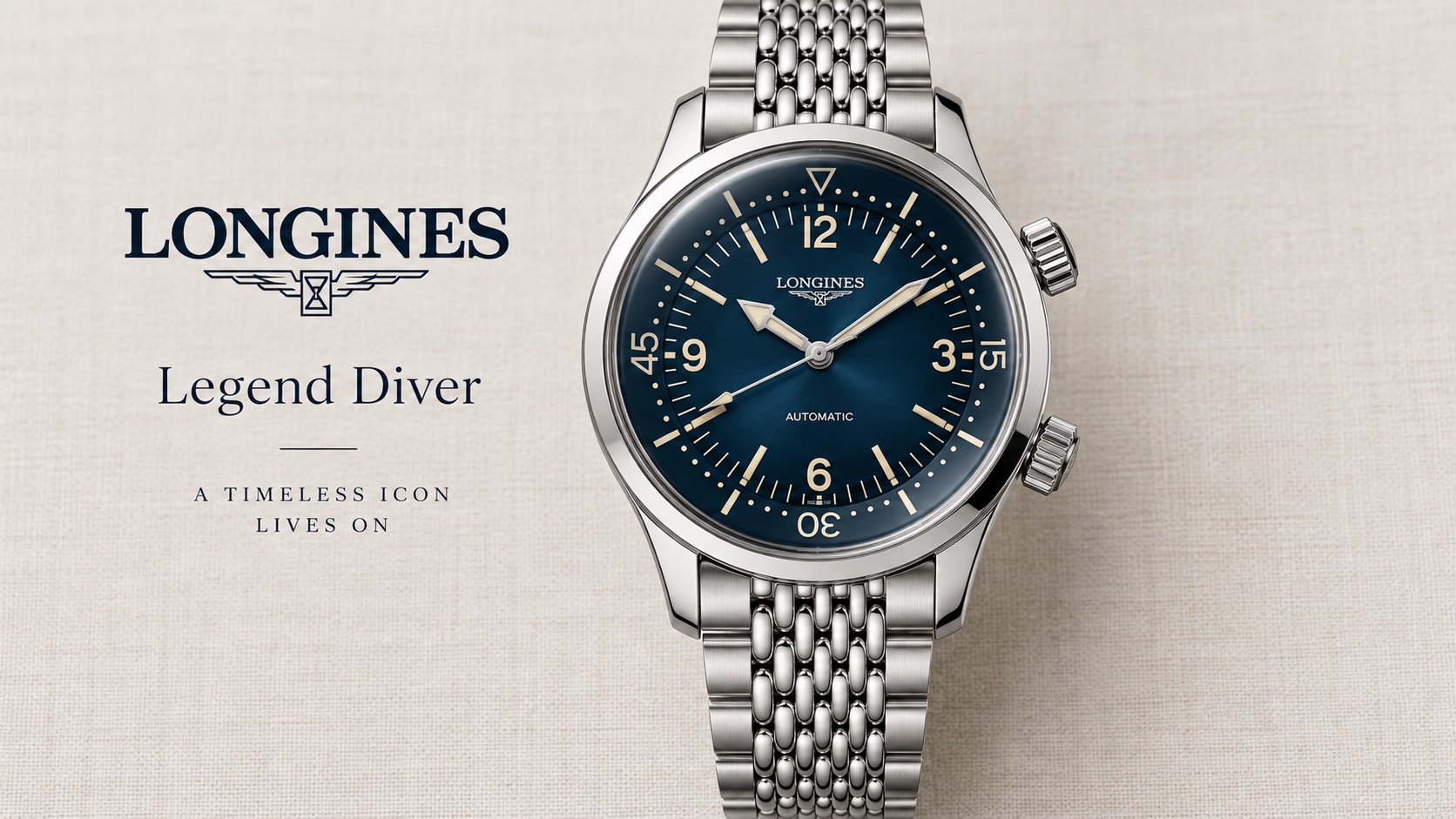
A vintage-inspired diver can remain bright steel or develop a changing bronze surface. That is the first important split between this Longines Legend Diver and the Oris Divers Sixty-Five Sepia. It will influence the watch’s appearance long after the first comparison photograph.
The controls differ too. The Longines places its timing scale inside the crystal, operated through a second crown. The Oris uses an external rotating bezel. These are two distinct approaches to a historic diver, not matching designs separated only by a logo.
The references compared
| Feature | Legend Diver L3.764.4.90.7 | Oris 01 733 7771 3154-07 8 19 15 |
|---|---|---|
| Diameter | 39 mm | 38 mm |
| Case / bracelet | Stainless steel | Bronze; steel caseback |
| Dial | Blue lacquered polished | Black |
| Timing bezel | Internal; operated by second crown | External rotating bezel |
| Movement | Automatic; silicon balance spring | 733-1 automatic |
| Reserve | Up to 72 hours | 41 hours |
| Water resistance | 300 m | 100 m |
| Front crystal | Sapphire; coating both sides | Domed sapphire; inner coating |
| UK price, 8 Sept 2026 | £3,100 | £2,500 |
Specifications: Current Legend Diver blue bracelet specifications; Oris UK Divers Sixty-Five bronze Sepia current specifications.
Two mid-century diver designs, revisited
The Legend Diver looks back to Longines’ 1959 diving watch, retaining the two-crown layout and internal timing flange. The 39 mm generation announced in November 2023 brought that recognisable format into a modern watch with a longer reserve and contemporary certification.
The Oris story begins with its first diver in 1965, followed by the Divers Sixty-Five revival in 2015. Subsequent versions expanded the materials and colours around the retro silhouette. This bronze Sepia uses that freedom to create a warmer, changing exterior. The historical relationship explains the shapes, but the current references should be chosen for their present specifications and materials rather than assumed to duplicate their mid-century predecessors.
Bronze is an ongoing appearance choice
The Oris uses bronze for both the case and bracelet, with a steel caseback. Its warm tone is not simply a coloured dial option. The material’s surface changes through patina, so its developing appearance is part of the ownership proposition.
Oris provides guidance on treating patina, which is useful reading before purchase. Decide whether you enjoy that change and the possibility of managing it, or whether you would spend ownership trying to keep the watch looking newly delivered.
The steel Longines offers a different visual expectation. Its blue polished dial and bright metal give the historical design a cooler character. Choose it if that combination is what you want consistently, rather than buying bronze and hoping it behaves like steel.
The timing controls feel different in principle
The Legend Diver’s internal flange is reached through its second crown. That protects the timing scale within the case and produces the distinctive twin-crown outline. It also creates a different setting action from turning an exposed bezel.
The Oris follows the external-bezel format. The scale is part of the outer shape of the watch, making the diver identity more immediately visible from the side and above.
Ask for a demonstration of both arrangements. Someone who enjoys the clean outer ring of the Longines may accept the additional crown operation readily. Someone who wants the familiar external timing control has a concrete reason to prefer the Oris.
Similar diameters, different packages
The Longines is 39 mm across and the Oris 38 mm. Neither should be treated as a large modern diver solely because it belongs to that category. Their bracelet shapes, crown arrangements and case details still need a proper fitting.
The selected Longines bracelet includes a micro-adjustment system. The Oris bracelet extends the bronze material around the wrist, making it central to the overall colour and patina story.
Compare the watches in the exact supplied configurations. A leather-strapped photograph of another reference may make the case appear more isolated and cannot establish how these bracelet versions will suit you.
Longines has the stronger specification for reserve and water
The Legend Diver offers up to 72 hours of reserve, against 41 for the Oris 733-1. That difference is meaningful if you regularly take the watch off for more than a day. The Longines has considerably more margin before restarting becomes necessary.
It also publishes 300 m water resistance, COSC chronometer certification and conformity with the ISO 6425 diver standard. This Oris is rated to 100 m. The figures give the Longines a stronger documented diving specification in this particular pairing.
That does not settle the aesthetic choice. A buyer mainly drawn to the bronze case and bracelet may willingly prefer the Oris despite the shorter reserve. The important point is to make that trade consciously.
Which version of vintage appeals?
At the checked UK prices on 8 September 2026, the Longines was £3,100 and the Oris £2,500. The additional £600 brings a different control layout, longer reserve and stronger stated water specification, alongside steel rather than bronze.
Choose the Longines when the twin crowns, blue dial and documented capabilities combine into the watch you want. Choose the Oris when a compact bronze diver that changes with use is the attraction. The material and bezel decisions are more revealing than asking which brand offers the better generic vintage watch.
Based on manufacturer information. Specifications checked on 8 September 2026.
Image: AI-generated editorial illustration of the Longines Legend Diver 39, L3.764.4.90.7. Fine details may differ from the production watch.


