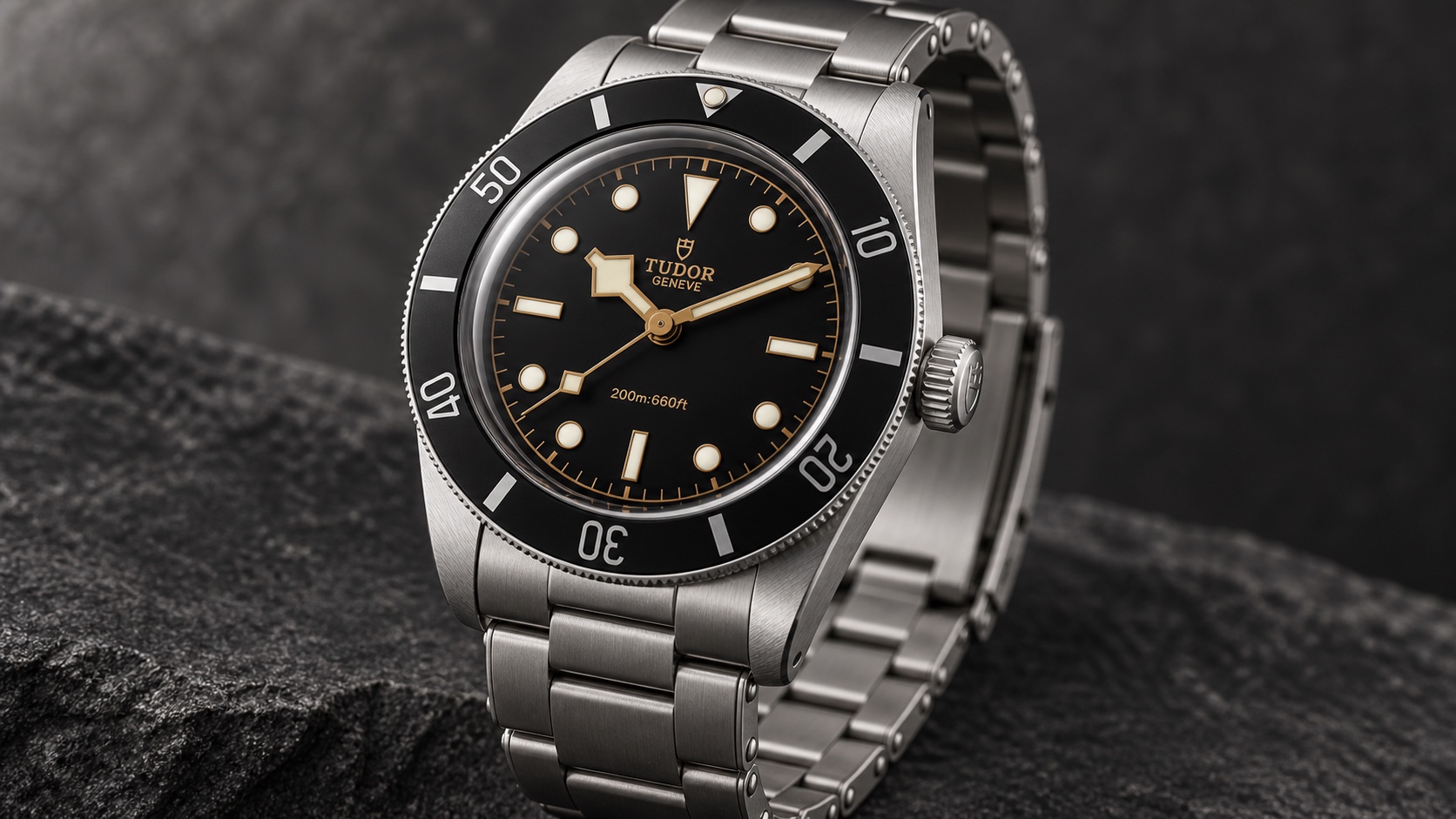
A watch can borrow the shape of an old diver without offering the same experience as another watch doing exactly that. The Tudor Black Bay 54 keeps the case compact and the dial straightforward. The bronze Oris Divers Sixty-Five adds a material that changes with ownership. Rado’s Captain Cook High-Tech Ceramic takes a historical name into a much larger, conspicuously modern construction.
Choose between those ideas before comparing bezel fonts. Their differences in size, surface treatment and bracelet design will affect daily use long after the initial appeal of a vintage-looking dial has settled.
Three histories, rather than one vintage recipe
Tudor links the Black Bay 54 to its first diving watch, reference 7922 from 1954. That makes its starting point earlier than the 1960s usually invoked by this category. The small crown and restrained timing bezel help carry that connection. Oris draws on its 1965 diver, revived as the Divers Sixty-Five in 2015, then developed through later versions including bronze watches. Rado’s original Captain Cook arrived in 1962, but the High-Tech Ceramic interpretation came in 2021. These are three different uses of heritage: close attention to proportions, an old design given an evolving surface, and an established shape recast in contemporary material. None needs to be mistaken for an original vintage watch to be interesting.
| Exact reference | Case diameter | Movement / reserve | Water resistance | Case and bracelet |
|---|---|---|---|---|
| Tudor M79000N-0001 | 37 mm | MT5400 automatic / about 70 hours | 200 m | Steel / steel with T-fit |
| Oris 01 733 7771 3154-07 8 19 15 | 38 mm | 733-1 automatic / 41 hours | 10 bar | Bronze / bronze; steel back |
| Rado R32127152 | 43 mm | R734 automatic / 80 hours | 300 m | Ceramic monobloc / ceramic; metal components |
Start with the case you actually want
The Tudor measures 37 mm across and 11.2 mm thick. Its steel bracelet has T-fit adjustment, useful when you want to change the fit during the day. The black dial has no date, and the domed sapphire crystal sits above a layout with relatively little competing information. This is the most compact case here, although the bracelet and your wrist shape still deserve a fitting.
At 38 mm, the Oris sounds very close. It is the colour and material that change the proposition. Bronze extends through the case, bezel and bracelet, with a stainless-steel case back. It will not remain the same fresh metallic shade indefinitely. Oris describes patina as a protective layer and recommends leaving it in place. Buy this reference because you welcome that change, rather than expecting it to behave visually like gold-coloured steel.
The Rado is 43 mm wide, 49.8 mm long and 14.6 mm thick, with a published weight of 157 g. That is a considerable step from the Tudor’s dimensions. Its black-tinted sapphire dial also exposes part of the movement, so this is not the choice for someone seeking an entirely opaque, spare black face. Try the actual ceramic bracelet on your wrist before deciding that the historical family name implies modest vintage proportions.
The material is a practical decision
All three selected references use sapphire crystals. There is no acrylic-versus-sapphire choice to make here. Their bezels and cases offer the more useful comparison: Tudor specifies an aluminium insert, Oris uses bronze, and Rado combines a ceramic insert with a steel bezel. The Rado’s monobloc middle case and bracelet are ceramic, but the watch also uses a titanium case back and clasp components. Calling it an entirely ceramic watch would hide those details.
Consider which type of visible ageing you are willing to accept. A bronze bracelet becoming darker is part of the Oris proposition. A brushed steel bracelet can acquire marks you may regard as ordinary wear. Ceramic offers a different surface, but it should not be treated as permission to subject the watch to impacts. A finish preference is more useful than a blanket claim that one material is indestructible.
What the modern specifications buy you
Tudor’s approximately 70-hour reserve and Rado’s 80 hours offer more time off the wrist than the Oris’s 41 hours. If you alternate watches over a weekend, that difference can reduce how often you start and set them. It does not establish a universal ranking of movement quality. The Tudor’s MT5400 also carries COSC chronometer certification, a separate specification from reserve length.
The water-resistance figures are 200 metres for Tudor, 10 bar for Oris and 300 metres for Rado. Use the exact model’s instructions when deciding on water activities and keep its seals maintained. The highest number is not the most important criterion for somebody mainly choosing a daily bracelet watch.
Choose the Black Bay 54 for compact steel proportions and convenient bracelet adjustment. Choose this Divers Sixty-Five when bronze patina is a positive part of ownership. Choose the Rado if its larger ceramic construction and partially visible movement are precisely the attraction. Buying the one whose modern character you like is more convincing than chasing a vague idea of the most authentic vintage style.
Based on manufacturer information. Specifications checked on 8 September 2026.
Sources: Black Bay 54 specifications; Black Bay 54 origins and design; Oris UK Divers Sixty-Five bronze Sepia current specifications; Oris first diver in 1965 and 2015 revival; Oris Cotton Candy development from bronze to steel; Oris guidance on bronze patina; Rado UK Captain Cook R32127152; Rado official history; Rado official care FAQ; Rado Captain Cook history, 1962 and 2021.
Image: AI-generated editorial illustration of the Tudor Black Bay 54 reference M79000N-0001. Fine dial details, hand shapes and finishing may differ from the production watch.


