Before choosing a GMT watch, imagine the moment you will adjust it. Are you stepping off a plane and changing the time shown by the ordinary hour hand? Or are you at home, adding a second zone so you know when to call someone abroad? The answer makes the movement’s setting system more important than the bezel colour.
The Rolex GMT-Master II 126710BLNR-0002 and Longines Spirit Zulu Time L3.802.4.63.6 allow the main hour hand to move independently. The Seiko SSK001K1 instead lets you adjust its 24-hour hand separately. All can show two time zones. They organise the act of changing them differently.
Read the setting system first
| Watch and reference | Diameter | What adjusts independently | Reserve | Water rating |
|---|---|---|---|---|
| Rolex GMT-Master II 126710BLNR-0002 | 40mm | Main local-hour hand | About 70h | 100m |
| Longines Zulu Time L3.802.4.63.6 | 39mm | Main local-hour hand | Up to 72h | 10 bar |
| Seiko SSK001K1 | 42.5mm | 24-hour hand | About 41h | 10 bar |
Collectors often call the first arrangement a traveller GMT and the second a caller or office GMT. These are useful descriptions of operation, rather than quality certificates. The best arrangement is the one that reduces the adjustments you make most frequently.
The extra hand has a travel history
Rolex introduced the GMT-Master in 1955, followed by the GMT-Master II in 1982. A 24-hour display became part of a familiar visual language for travel watches, but today’s options are not confined to that lineage. Seiko’s 2022 launch brought a GMT movement into the Seiko 5 Sports family. That gives a buyer a quite different entry point, retaining the everyday automatic-watch idea while adding a second zone. The history explains why a GMT can be an aviation-associated luxury watch or a practical sports model, without making one setting method the only legitimate version.
When the local-hour jump earns its place
Suppose your destination is three hours behind home. With the Rolex or Longines already set correctly, move the main hour hand back three steps while leaving the minutes and home-time hand undisturbed. The local display changes without requiring you to rebuild the entire time setting.
Longines’s L844 instructions confirm that the date follows the local hour across midnight in either direction. That is worth understanding before travelling: moving an hour hand through midnight can affect more than the visible time. Ask for a demonstration and repeat the sequence until the crown positions make sense.
The Rolex pairs this function with a 40mm case, blue-and-black ceramic bezel and Jubilee bracelet. The 39mm Longines offers a different appearance and a published 72-hour reserve. It was £3,000 on the official UK site when checked on 8 September 2026. Choose between them through their complete designs and actual offers, not simply the shared ability to jump an hour hand.
When the Seiko is the more relevant idea
If you remain in one place and track an overseas colleague, adjusting the 24-hour hand is a direct way to establish that second display. Once set, it keeps the other zone available without changing your ordinary local time. A watch can be useful for international life without its owner travelling every month.
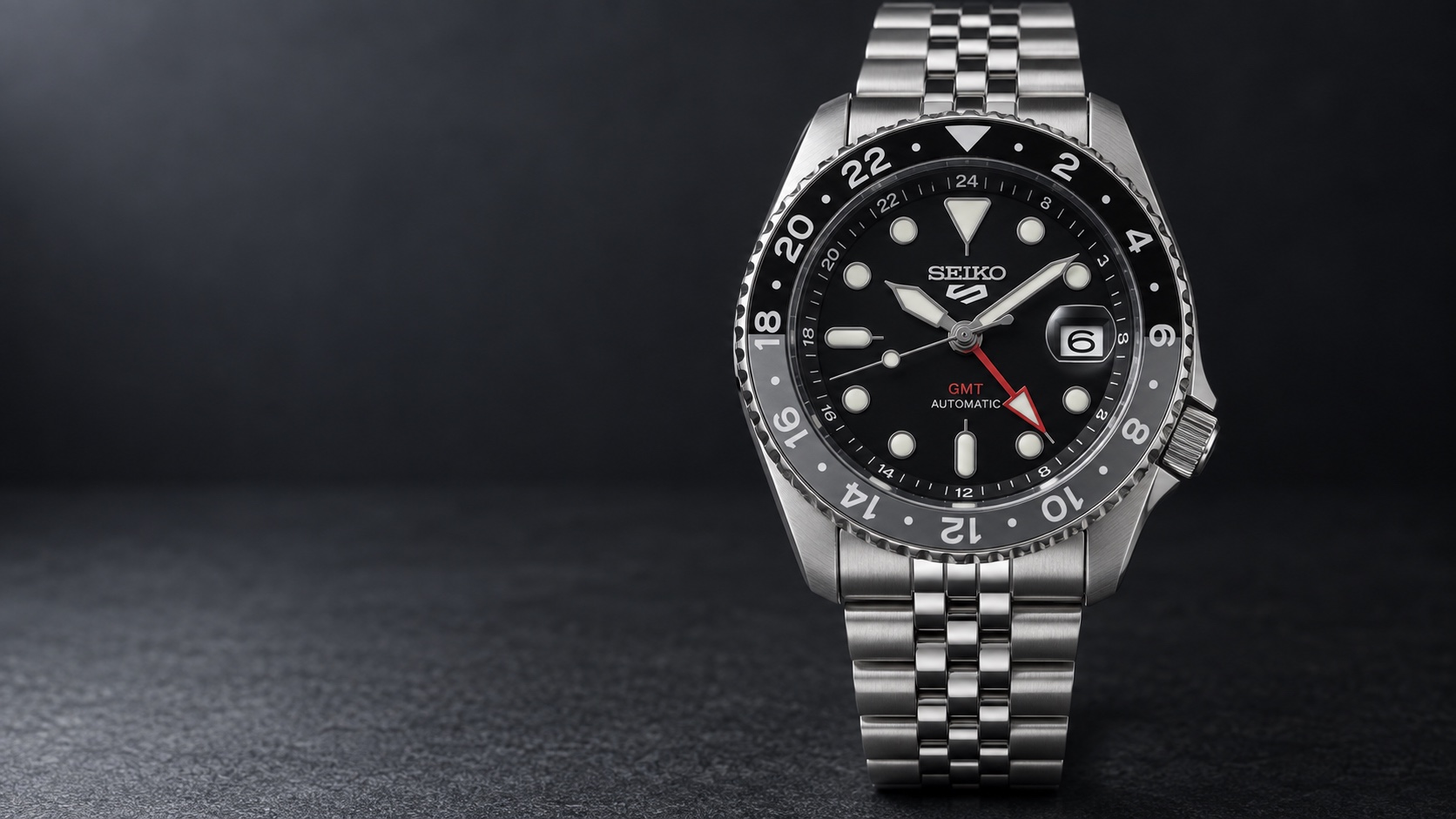
The SSK001 is a larger sports watch at 42.5mm, with a 46mm lug span and a conspicuous red GMT hand. Its Hardlex crystal, date magnifier and approximately 41-hour reserve are parts of the same proposition. The official UK price was £430 at the check. It should be considered positively for its function and design, rather than only as an interim purchase.
A 24-hour scale takes a little practice
The extra hand goes around once a day, so noon sits halfway around the scale rather than at the top. That is what lets it distinguish morning from evening. Learn to read it directly before introducing additional offsets with a rotating bezel.
These watches also do not automatically know that a country has changed its daylight-saving arrangements. You still need to check the relevant offset and make the appropriate adjustment. Their hour-step systems suit whole-hour changes; fractional offsets need particular attention rather than an assumption that every destination fits the same routine.
Fit and reserve still decide everyday usefulness
A GMT function does not shorten a case or make a bracelet more comfortable. Try the actual watch with its supplied bracelet sized sensibly, then assess the small 24-hour markings at your normal reading distance. Information that is technically present still needs to be useful to your eyes.
Choose the Rolex or Longines when changing local time while preserving home time is a regular need. Choose the Seiko when a separately adjustable home or colleague zone is enough and you like its sports-watch presentation. The right GMT is the one whose controls make your own routine simpler.
Based on manufacturer information. Specifications checked on 8 September 2026.
Sources: Rolex BLNR specifications; Rolex GMT-Master origins; Longines UK: Spirit Zulu Time L3.802.4.63.6; Longines: L3.802.4.63.6 dimensions and technical specifications; Longines L844 instruction manual; Seiko UK SSK001 specifications; Seiko 2022 GMT launch; Seiko 4R34 instruction manual.
Image: AI-generated illustration. Fine details may differ from the watch.


