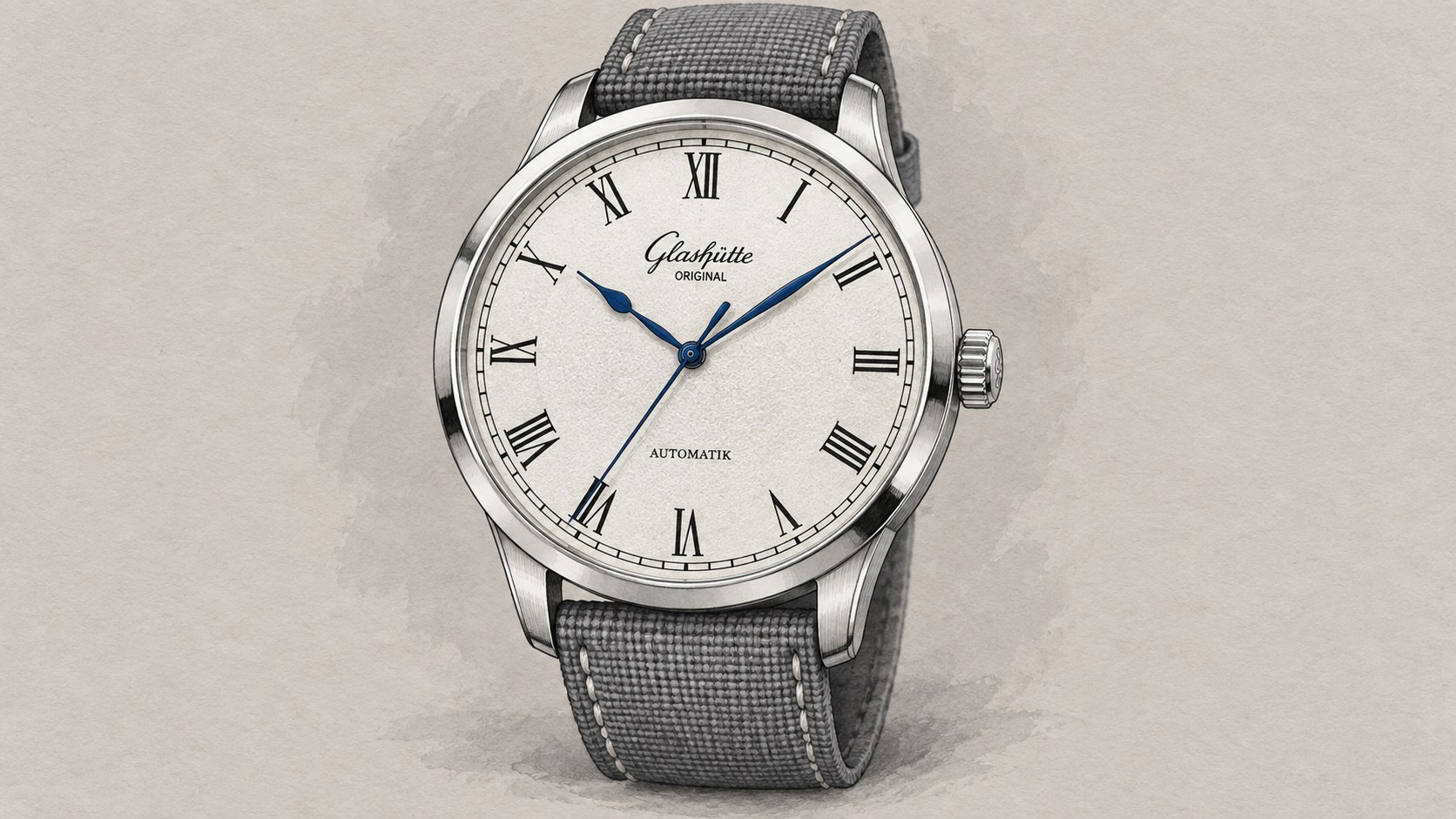
The Senator Excellence is an interesting watch to turn over before deciding whether its classical dial is too familiar. Beneath the Roman numerals and blued hands sits a hundred-hour automatic movement with distinctive German construction and finishing. The technical brief is more contemporary than the face initially suggests.
Reference 1-36-01-01-02-66 puts that combination on grey synthetic fabric, changing the surrounding mood without altering the dial. It is a strong option for someone who likes traditional time displays but wants more to investigate beneath them. Its appeal depends on enjoying both halves: the classical front and the modern long-reserve mechanism.
The history behind the choice
Glashütte Original introduced calibre 36 and the Senator Excellence line in 2016, beginning with a three-hand watch before adding calendar versions later that year. The movement was developed as a foundation for a new family rather than as a one-off complication. Extended autonomy, stable construction and a dedicated testing programme were central to the launch. The face drew on established watchmaking vocabulary, including railway-style divisions and hands with a pocket-watch character. That combination explains why the Senator can look older than its technical concept. It is not an untouched historical model with a modern name. It places a contemporary automatic architecture beneath a deliberately classical display, allowing the movement to provide much of the watch’s individual interest.
The exact reference
| Specification | Published detail |
|---|---|
| Reference | 1-36-01-01-02-66 |
| Case | Stainless steel; 40mm diameter; 10mm thick |
| Dial | Silver-grainé varnish; fine matt finish; Roman numerals |
| Hands | Blued; pear-shaped hour and minute hands |
| Movement | Automatic calibre 36-01 |
| Reserve / frequency | 100 hours / 4Hz |
| Balance spring | Silicon |
| Rotor | Skeletonised; 21-carat gold oscillating weight |
| Functions | Hours; minutes; seconds; stop seconds |
| Water resistance | 5 bar |
| Strap | Grey synthetic; 20mm attachment |
The hands establish the tone
The blued pear-shaped hands are more expressive than simple straight batons. Against the finely grained silver surface, they create a familiar classical contrast without relying on a dark dial. The surrounding railway-style track and numeral treatment reinforce that pocket-watch-derived character.
This is a clear stylistic commitment. Someone who prefers a severe modern dial may find the details too traditional, even if the movement is attractive. Someone who enjoys the vocabulary will find a face that gives ordinary timekeeping plenty to inspect. The absence of a date preserves the arrangement, keeping the main visual relationships focused on hands, markers and the open surface between them.
One barrel, a hundred hours
The original calibre 36 development used a larger barrel diameter and a smaller arbor to accommodate a longer mainspring. That is the mechanism behind the extended reserve, rather than a vague suggestion that a long-running watch must contain several barrels. The movement retains a four-hertz frequency.
This makes the Senator an especially interesting comparison with other long-reserve automatics. Different architectures can reach useful autonomy in different ways. The practical benefit is additional potential time away from the wrist before restarting an adequately wound watch. The enthusiast’s interest is how the manufacturer achieved it while making the calibre a foundation for other models in the family.
The back provides a recognisably German view
The three-quarter plate and skeletonised rotor give the movement a characteristic arrangement, with striped decoration, perlage and blued screws adding detail. The rotor’s gold weight provides another material contrast. The sapphire back allows those elements to become part of the ownership experience rather than remaining a list of hidden attributes.
This is a strong reason to consider the Senator if finishing and construction matter as much as dial design. The movement is not merely there to make a traditional face work. It supplies a second visual subject, with a different degree of complexity from the front. Someone who rarely wants to examine a movement may reasonably place less value on that aspect and choose chiefly by the dial instead.
The testing programme is specific
Glashütte Original subjects the Excellence family to a twenty-four-day programme. Its published description includes rate checks in six positions, temperature evaluation, running-time assessment and water-resistance checks. The process makes the Excellence name more than a decorative word on a product page.
It should also be understood as the manufacturer’s testing framework. The attraction is the detailed approach to the completed watch, rather than an invented prediction of what every example will do in every owner’s circumstances. For a buyer interested in the engineering behind a classical display, the programme provides another concrete reason to investigate this family alongside the movement’s reserve and construction.
The fabric strap changes the expectation
The grey synthetic strap on this exact reference gives the traditional dial a less formal surrounding material. It is not the black-alligator configuration, even though related product photographs may show that alternative. The difference makes the watch particularly worth considering for someone who likes classical hands and numerals without wanting the full formal-dress presentation.
The forty-millimetre case is ten millimetres thick, so its proportions sit apart from the very thinnest manual dress watches. Compare that complete form in a fitting. Choose the Senator Excellence when the old-fashioned dial vocabulary, visible calibre and extended autonomy are all positives. A Master Control Date offers a more conventional calendar-equipped alternative; a Saxonia Thin pursues greater reduction. The Senator’s individual case lies in making a richly considered three-hand automatic from two different eras of watchmaking priorities.
Specifications and sources checked on 8 September 2026. Senator Excellence exact reference; 2016 calibre 36 and Senator Excellence introduction; Glashütte Original 24-day testing programme; 2016 expansion of the Excellence family.
Image: AI-generated editorial illustration of the Glashütte Original 1-36-01-01-02-66. Fine dial details and finishing may differ from the production watch.


