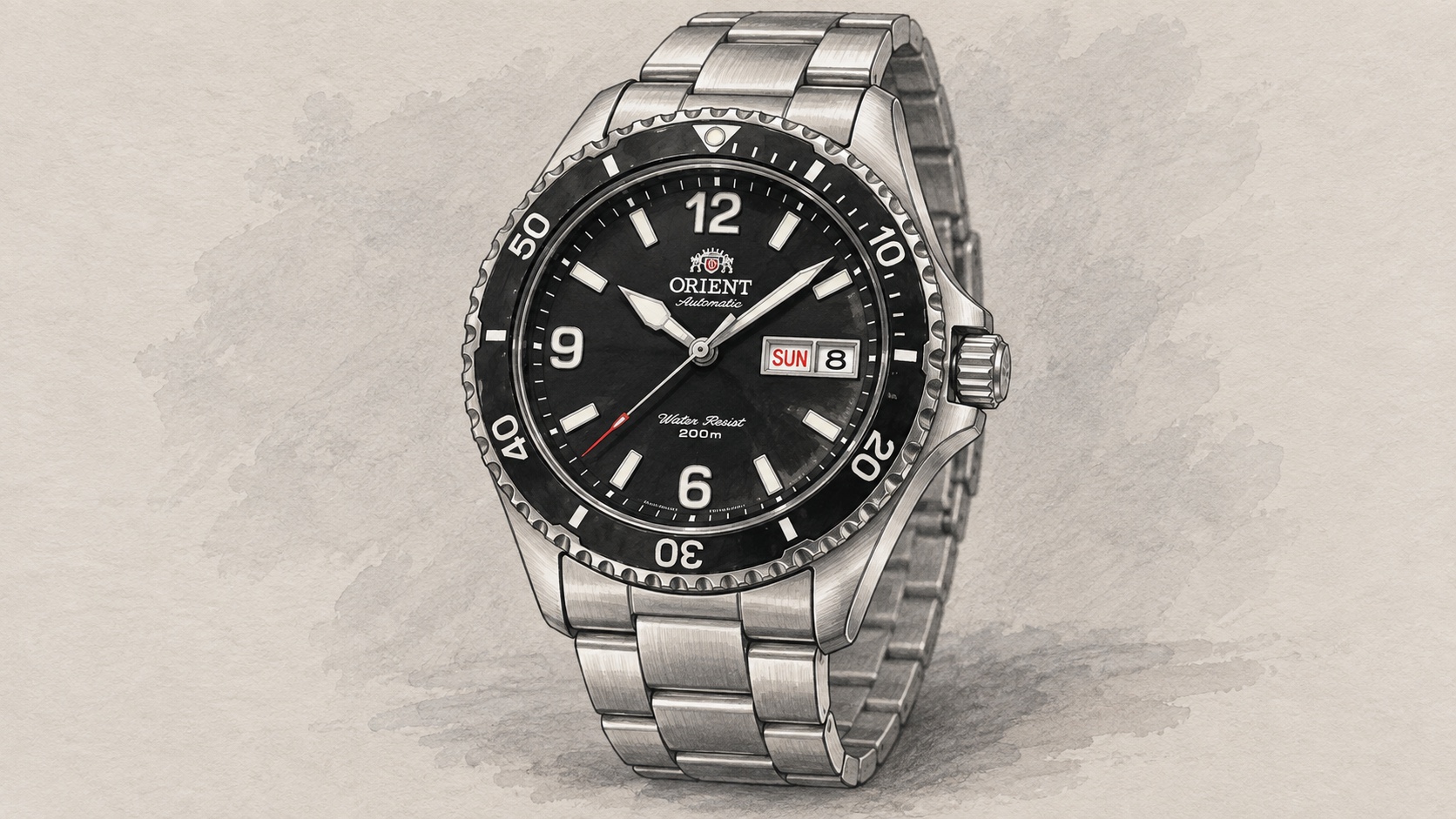
The Seiko SPB143 is narrower than the Orient Mako II, but slightly longer across the lugs. It has a much longer reserve, but one fewer calendar indication. These are the kinds of differences that make an upgrade discussion useful.
This comparison uses the black Mako II identified by Orient as AA02001B or TAA02001B9, and the grey SPB143J1. Both provide steel-bracelet automatic ownership with a rotating timing bezel. The decision depends on which improvements and design changes matter in your routine.
The references compared
| Feature | Orient AA02001B / TAA02001B9 | Seiko SPB143J1 |
|---|---|---|
| Diameter | 41.5 mm | 40.5 mm |
| Thickness | 13 mm | 13.2 mm |
| Lug-to-lug | 47 mm | 47.6 mm |
| Lug width | 22 mm | 20 mm |
| Movement | F6922 automatic | 6R35 automatic |
| Reserve | Approximately 40 hours | Approximately 70 hours |
| Calendar | Day and date | Date |
| Crystal | Mineral | Curved sapphire; inner coating |
| Water resistance | 200 m | Diver’s 200 m |
Specifications: Orient USA AA02 Mako II specifications; Seiko exact SPB143J1 specifications.
Mako continuity and the SPB143’s 1965 inspiration
Orient’s official milestones place the Mako family’s beginnings in 2004. The later F6922 generation added hand winding and stop-seconds to a familiar diver-style format. Its history is one of incremental accessibility rather than a literal recreation of an expedition watch.
Seiko identifies the SPB143 as a 2020 introduction, reinterpreting the appearance of its 1965 first diver. The squared-off markers, restrained dial and conventional case outline connect with that earlier design while using modern construction and a 6R35 movement. Both therefore have coherent histories, but they serve different explanations: the Mako develops a successful modern affordable-watch family, while the Seiko deliberately revisits an older professional-watch shape.
The reserve is the clearest mechanical difference
The Seiko offers approximately 70 hours against the Orient’s 40. That additional 30 hours is useful when the watch spends more than a day off the wrist, especially if you alternate with another watch during the weekend.
Both movements wind automatically, permit hand winding and stop the seconds hand for setting. The Mako II already includes those basic ownership conveniences. Choosing the Seiko does not introduce them for the first time.
Consider how often your watch actually stops. If it is worn almost every day, the reserve gap may matter less than the dial or fit. If it regularly rests for two days, the Seiko’s longer duration becomes a stronger reason to choose it.
Smaller diameter does not settle the fitting
The SPB143 is 40.5 mm across, 1 mm narrower than the Orient. It is also 13.2 mm thick, compared with 13 mm, and spans 47.6 mm lug to lug against 47 mm.
Those figures describe a change of proportion more than a clear reduction in every direction. Someone attracted by a smaller diameter should still check where the Seiko’s lugs and bracelet extend.
The attachment widths are 20 mm for Seiko and 22 mm for Orient. That changes the visual relationship between case and bracelet and matters if you plan to explore straps. Assess the complete supplied watch before making a strap collection part of the buying justification.
Sapphire and the dial create different kinds of value
The Seiko uses curved sapphire with an inner anti-reflective coating. The Orient uses mineral glass. For a buyer who specifically wants sapphire, that is a clear construction distinction rather than a vague claim of better quality.
The Mako’s black dial includes Arabic numerals and a day-date display. It provides a useful extra calendar indication and a more numeral-led character. The grey Seiko uses a quieter arrangement of substantial markers and a date window.
Decide which face you prefer before adding up the specifications. A calendar function you use every working day can outweigh an aesthetic preference for a cleaner dial; equally, you may welcome having one fewer indication to set and read.
Both retain the diver format
Each has a unidirectional timing bezel and screw-down crown, with 200 m stated water resistance. The Seiko is explicitly specified as a diver’s watch. Neither should be selected solely because a larger number is assumed to accompany the different price position.
When comparing older or used examples, condition becomes part of the decision. Ask about the state of the seals and bracelet, and whether the watch includes the links needed for your wrist. The original specification cannot describe every individual example now offered for sale.
No current GBP manufacturer price for this exact pairing is quoted here. Compare the actual delivered offers and their warranty and return terms, keeping the references fixed so a different Mako or later Seiko does not quietly enter the comparison.
What would justify choosing the Seiko?
Choose the SPB143 if its grey dial, sapphire crystal and much longer reserve are features you actively prefer. Those are concrete reasons to move towards it, provided its slightly longer footprint fits.
Choose the Mako II if the day-date display, numeral layout and existing mechanical conveniences already answer your needs. The better purchase is the watch whose differences improve your own use, rather than the one you expect to enjoy because another collector calls it the next step.
Based on manufacturer information. Specifications checked on 8 September 2026.
Image: AI-generated editorial illustration of the Orient AA02001B / TAA02001B9. Design details are approximate; this is not a product photograph.


