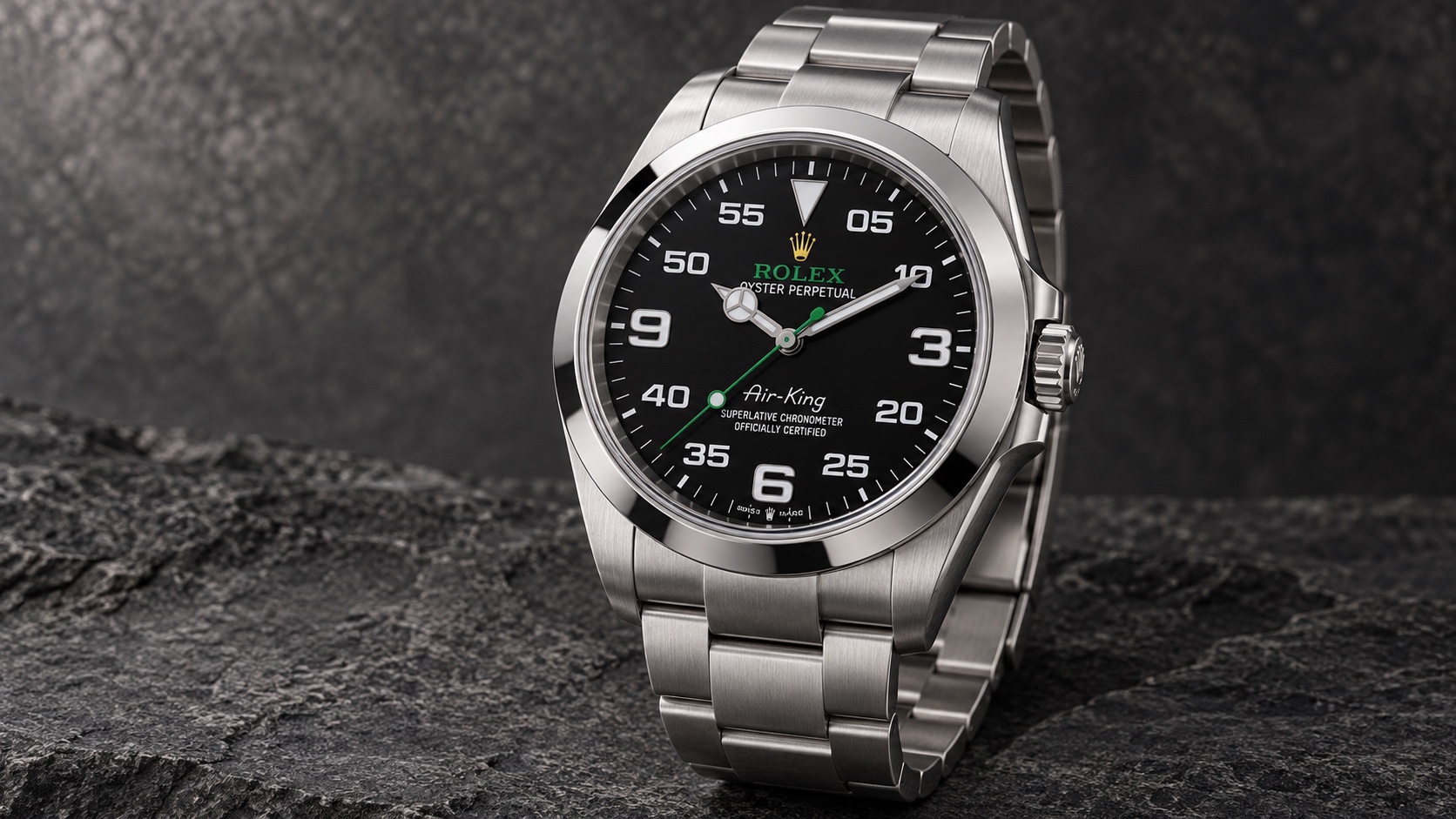
The Air-King fills its black dial with two ways of reading time: prominent hour numerals and a surrounding emphasis on minutes. The Ranger gives four large numerals much more space. That difference is more immediate than their shared family connections or similar reserves.
Both watches offer automatic timekeeping without a date, a steel bracelet and 100 m water resistance. If you want a straightforward daily watch, either can fit the brief. The better choice depends on whether you want visual activity or a quieter instrument layout.
The references compared
| Feature | Air-King 126900-0001 | Ranger M79950-0001 |
|---|---|---|
| Diameter | 40 mm | 39 mm |
| Case | Oystersteel; crown guards | Satin-finished steel |
| Movement | 3230 automatic | MT5402 automatic; COSC |
| Reserve | Approximately 70 hours | Approximately 70 hours |
| Calendar | No date | No date |
| Water resistance | 100 m | 100 m |
| Crystal | Sapphire | Domed sapphire |
| Bracelet adjustment | Oysterlock; 5 mm Easylink | Three-link steel; T-fit |
| Main dial numerals | 3, 6, 9 plus minute scale | 3, 6, 9 and 12 |
Specifications: Rolex Air-King specifications; Ranger 39 specifications.
The origins of two different numeral-led dials
The modern Air-King dial took shape in 2016, combining the familiar 3, 6 and 9 hour numerals with a prominent minute scale. The 2022 generation added crown guards and calibre 3230, making the current reference more than a dial variation on an earlier model.
Tudor’s Ranger name dates to 1929, while the familiar numeral-led design developed later. The present 39 mm model was introduced in 2022, marking the anniversary of the British North Greenland Expedition. The expedition watches were Oyster Prince models, not the current Ranger or an identical historic Ranger. The connection supplies context for the watch’s exploratory identity without making a misleading claim that this design itself crossed Greenland.
The dials ask for different attention
The Air-King’s minute numerals make the face unusually busy for a watch without additional complications. Green and yellow branding accents reinforce that individuality. If you enjoy an unconventional dial within the Rolex catalogue, those details can be its strongest attraction.
The Ranger uses a simpler set of 3, 6, 9 and 12 numerals. Its broad hands and open spaces create a more direct visual rhythm. Someone who wants to recognise the time quickly without a great deal of surrounding information may prefer that arrangement.
Look at both at an ordinary arm’s length, rather than only in magnified photographs. The relationship between hands, markers and empty space is what you will repeatedly encounter throughout a normal day.
A millimetre is only part of the size difference
The Air-King measures 40 mm and the Ranger 39 mm. Their outlines also differ: the Rolex includes crown guards, while the Tudor keeps its crown beside a simpler satin-finished case.
Tudor specifies a 12 mm thickness and 20 mm lug width for this Ranger. Those details provide useful fitting and attachment information. A matching set of case-height and lug-to-lug figures is not supplied by the Rolex source used here.
The smaller Tudor is the logical first try if you want less diameter, but do not let that single measurement settle the fitting. Bracelet articulation and the position of the clasp can make a modest dimensional difference feel more or less important.
The shared reserve makes the routine similar
Both movements offer approximately 70 hours of reserve. That gives a little under three days of potential running time from full wind, useful when alternating between two watches.
Neither has a calendar to correct after it stops. For someone who travels between occasional formal and casual watches, the simple restart can be an appealing part of the no-date brief. You set the time and return to wearing it.
The Air-King uses Rolex calibre 3230; the Ranger uses Tudor’s COSC-certified MT5402. The names identify distinct movements, but their similar headline reserve means this comparison is unlikely to be decided by running duration.
Bracelet adjustment deserves a demonstration
Rolex pairs its Oyster bracelet with an Oysterlock clasp and 5 mm Easylink extension. Tudor supplies its T-fit system on the three-link bracelet. Both give the owner a way to alter the fit beyond the basic initial sizing.
Try the controls and judge how the adjusted watch sits. A system’s name is less useful than understanding whether its available range and operation suit your wrist and routine.
The visual relationship also differs. The Ranger’s satin finish supports its restrained field-watch character, while the Air-King’s brighter branded details make the dial the more assertive part of the package.
Choose the character you actually want
Choose the Air-King if the minute-heavy face, colour accents and guarded case are precisely what you find appealing. Its individuality is a better reason to buy than treating it as a generic entry into another manufacturer’s catalogue.
Choose the Ranger if the quieter numeral layout, slightly smaller case and T-fit bracelet make a coherent everyday watch for you. The shared 100 m rating, long reserve and calendar-free routine already cover much of the practical brief. The remaining decision is about the watch you prefer to look at and operate.
Based on manufacturer information. Specifications checked on 8 September 2026.
Image: AI-generated editorial illustration of the Rolex Air-King 126900-0001. Fine dial details, bezel contours and finishing may differ from the production watch.


