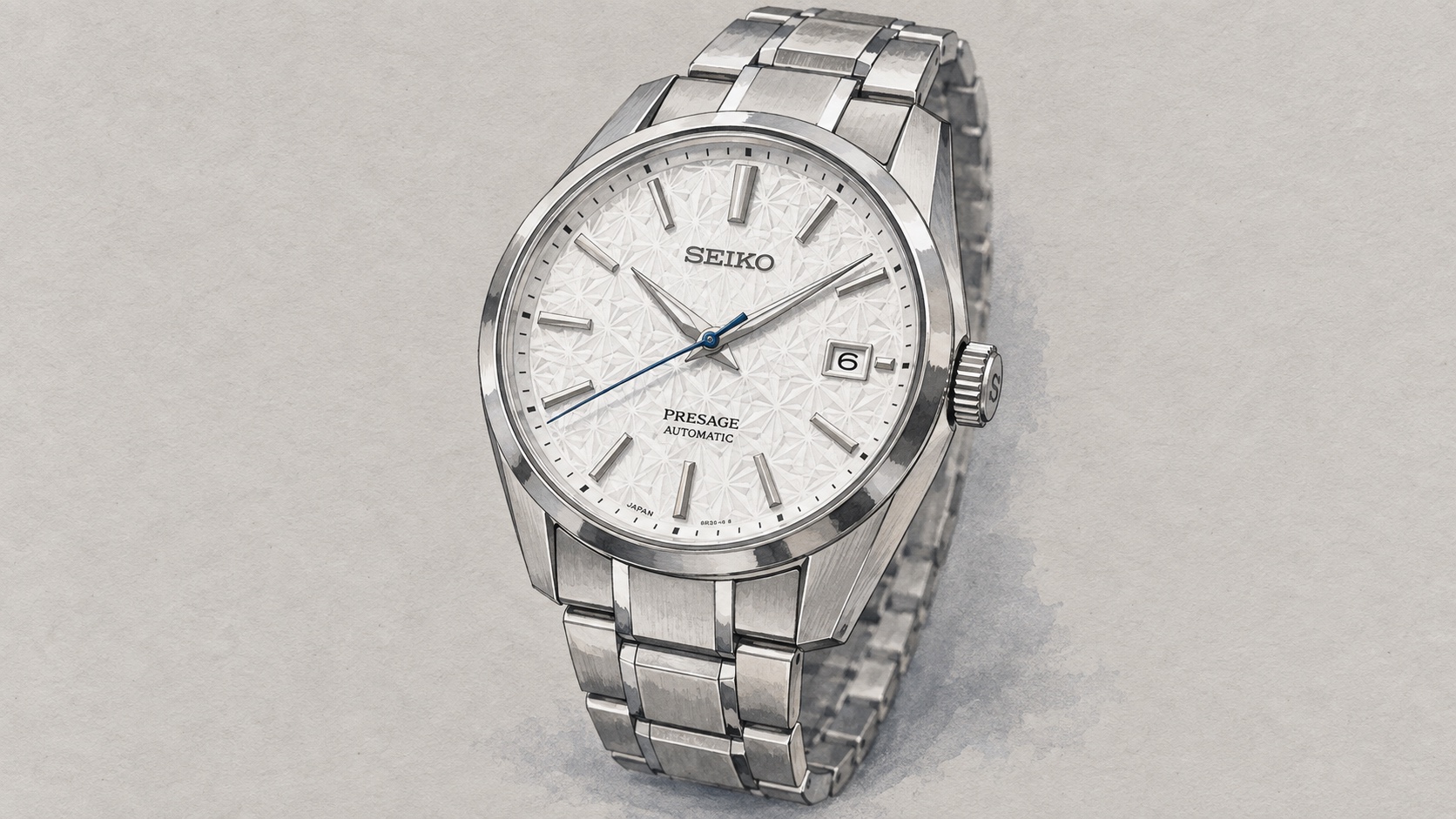
The Presage Sharp Edged makes texture and angular surfaces the first things you notice. The Grand Seiko SBGW231 does almost the opposite, giving a quiet dial and compact case room to speak. Moving between them is a change of design priorities, not simply a climb through two related names.
The practical distinction is equally clear. The Seiko winds itself during use and includes a date. The Grand Seiko is manually wound and calendar-free. A buyer who prefers the more expensive watch’s restraint should also want the routine that comes with it.
The references compared
| Feature | Presage SPB165J1 | Grand Seiko SBGW231 |
|---|---|---|
| Diameter | 39.3 mm | 37.3 mm |
| Thickness | 11.1 mm | 11.6 mm |
| Lug-to-lug | 47.2 mm | 44.3 mm |
| Movement | 6R35 automatic | 9S64 manual winding |
| Reserve | 70 hours | 72 hours |
| Calendar | Date | No date |
| Water resistance | 10 bar | 3 bar |
| Attachment | Steel bracelet; 20 mm lugs | Crocodile leather; 19 mm lugs |
| UK list, 8 Sept 2026 | £860 | £4,150; shown sold out |
Specifications: Seiko UK SPB165J1; Grand Seiko UK boutique SBGW231.
Japanese dial geometry and modern manual winding
Seiko introduced the Presage Sharp Edged series in 2020, using the Japanese asanoha hemp-leaf pattern to give the dial a repeating geometric structure. The angular case was developed as part of that same design language, so the interest is spread beyond the face.
The SBGW231 belongs to Grand Seiko’s modern manual-winding line. The 9S64 calibre was introduced in 2011, combining hand winding with approximately three days of reserve. That background explains the difference in emphasis: the Presage presents a contemporary decorative system within an everyday automatic, while the Grand Seiko makes a reduced display and a traditional winding interaction central to the experience. Shared corporate roots do not create identical purposes.
Smaller does not mean thinner
The SBGW231 is 2 mm smaller in diameter and 2.9 mm shorter lug to lug. Those are meaningful differences when you want the watch to occupy less of the wrist’s upper surface. Its shorter span deserves attention if you dislike long lugs.
It is also 0.5 mm thicker than the Presage, at 11.6 mm against 11.1 mm. That is a useful correction to the assumption that a quieter dress-oriented watch must be flatter. The Grand Seiko’s box-shaped sapphire contributes to its visual profile.
The Seiko’s bracelet extends the faceted steel appearance around the wrist. The Grand Seiko’s leather leaves the case more visually isolated. Compare those complete silhouettes rather than judging two bare circular measurements.
Do you want the dial to entertain?
The Presage’s pale geometric texture changes the role of the dial. It rewards looking beyond the hands, while the date introduces a small practical interruption to the pattern. The case’s sharp surfaces support that more active visual character.
The SBGW231 concentrates attention on the hands, hour markers and open space. It makes sense if you tend to tire of busy decoration, or want a watch whose face remains composed alongside patterned clothing.
Neither approach is inherently more mature. Someone drawn to texture should not buy restraint merely because it is associated with a higher price. The right dial is the one that remains interesting after the novelty of the brand name fades.
A similar reserve hides a different routine
Seventy and 72 hours are close enough that the reserve alone is a weak deciding argument. Both can offer roughly three days from a full wind, but the method of supplying that energy differs.
The 6R35 automatic replenishes its reserve through wrist movement and permits manual winding. The 9S64 requires hand winding. Choose the Grand Seiko if that direct interaction is something you want to repeat, especially when using it in a rotation.
The absence of a date also simplifies restarting the SBGW231. The Presage offers the calendar convenience during the week, with an additional indication to set if it has stopped. These are small differences that become familiar through ordinary ownership.
Everyday use favours different strengths
The Presage combines a steel bracelet, 10-bar rating and super-hard case coating. That makes it the stronger starting point here for a broad everyday brief, particularly when you want one watch to cover a varied working week.
The Grand Seiko’s 3-bar specification and crocodile strap point towards a more restrained role. Its attraction is not a larger list of sporting functions. It offers a particular case, dial and manual movement package that should be appreciated on those terms.
The official UK pages showed £860 and £4,150 on 8 September 2026, with the SBGW231 marked sold out. That substantial gap should buy a preference you can explain clearly, rather than an assumed improvement in every practical category.
Where each choice makes sense
Choose the Presage if geometric decoration, an automatic movement, a date and a bracelet belong in your everyday watch. It delivers a coherent design without requiring you to adopt a more formal routine.
Choose the SBGW231 if compact proportions, an uncluttered face and hand winding are the point of the purchase. Its case is shorter and narrower, but the strongest reason to spend more is that you prefer the complete watch, including what it deliberately leaves out.
Based on manufacturer information. Specifications checked on 8 September 2026.
Image: AI-generated editorial illustration of the Seiko SPB165J1. Design details are approximate; this is not a product photograph.


