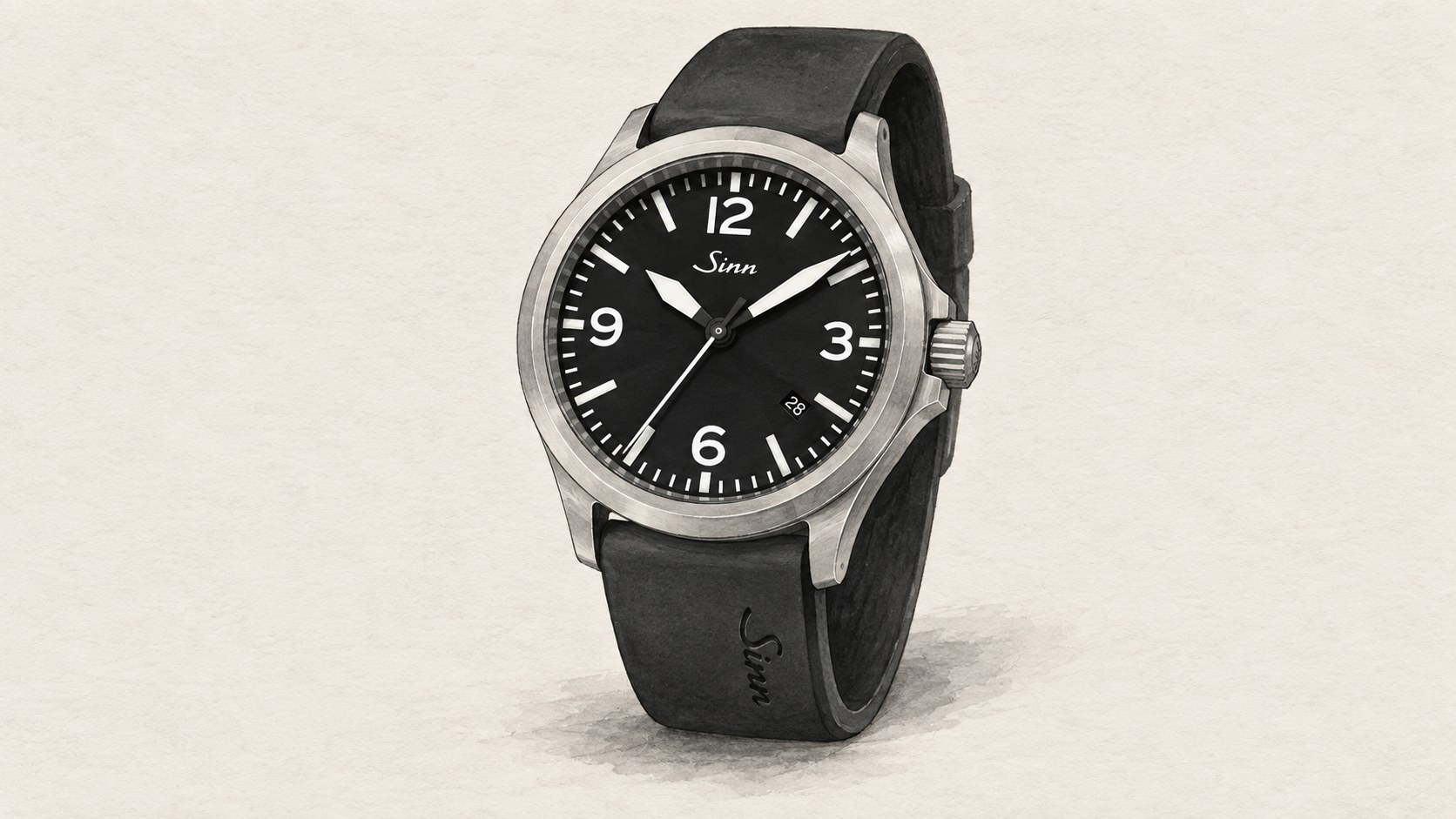
The Sinn 856 asks you to pay attention to features that are easy to miss in a photograph. TEGIMENT surface hardening, magnetic-field protection and an Ar-Dehumidifying system distinguish it from the simpler 556 I RS. Whether they justify the choice depends on what you want to protect against.
The 556 is smaller and exposes its movement through the back. The 856 uses a larger instrument-style case and concentrates more of its engineering on the environment around the movement. Neither is the universal everyday answer; they address different priorities.
The references compared
| Feature | Sinn 856 | Sinn 556 I RS |
|---|---|---|
| Case diameter / thickness | 40 / 11 mm | 38.5 / 11 mm |
| Head weight | 70 g | 65 g |
| Movement | Sellita SW300-1 automatic | Sellita SW200-1 automatic |
| Water resistance | 20 bar | 20 bar |
| Case surface | Bead-blasted; TEGIMENT | Satinised steel |
| Magnetic protection | 80,000 A/m | No equivalent figure in exact sheet |
| Ar-Dehumidifying | Yes | Not specified |
| Back | Nickel-free steel, not TEGIMENT | Sapphire display back |
| Lug width | 20 mm | 20 mm |
Specifications: Sinn standard 856 current specification sheet; Sinn 556 I RS current product sheet, August 2026.
How Sinn developed its protective engineering
Sinn’s history begins with Helmut Sinn’s instrument-making background in 1961, later followed by expanded technical development under Lothar Schmidt. That helps explain why the company offers both visually restrained watches and additional protective systems.
The TEGIMENT programme appeared in 2003 on the 756 Duochronograph, building on earlier work with hardened cases. Its purpose was to increase the hardness of the material’s surface rather than simply apply a protective coating. The 856 carries that development into an instrument-style three-hander. The 556 I RS retains the cockpit-clock influence in a more straightforward package. Their family resemblance is real, but it does not mean their construction is interchangeable.
The surface treatment is a specific upgrade
The 856’s TEGIMENT case offers increased scratch resistance. That is a useful attraction if visible case wear bothers you and the watch will be worn frequently. It is not a guarantee of a permanently unmarked watch.
The exact specification identifies a nickel-free steel caseback without TEGIMENT. That detail keeps the construction description precise: the treatment should not be assumed to cover every steel component. The 556’s satinised case instead presents a simpler finish and a different appearance.
Decide how much surface resistance matters to you before making it the centre of the purchase. A buyer who accepts ordinary marks as part of ownership may prefer the 556’s size and display back. A buyer specifically seeking harder case surfaces has a concrete reason to investigate the 856.
Environmental protection changes the brief
Sinn specifies magnetic-field protection to 80,000 A/m for the 856. It also includes the Ar-Dehumidifying system, described in the operating manual through measures intended to reduce moisture effects inside the watch.
Those features provide reasons beyond appearance to choose the 856. They should be understood as particular engineered protections rather than combined into a vague claim of invulnerability. The 556’s exact sheet does not claim an equivalent package.
If those capabilities address your priorities, the 856 offers more relevant equipment. If your everyday use does not make them a deciding concern, you can choose the simpler watch without treating it as inadequate.
The 556 is smaller, but not thinner
The 556 I RS measures 38.5 mm across and the 856 measures 40 mm. Both are 11 mm thick. That means the smaller watch changes the face and width more than the side profile.
The stated weights are 65 g and 70 g respectively, excluding a strap or bracelet. The 5 g difference describes the heads, not every possible finished configuration. Since both have 20 mm attachments, the strap you select will also influence the overall package.
The dial distinction matters as much as the size. The 556 I RS combines baton markers, glossy black and a red seconds hand. The 856 uses a more overt numeral-based instrument display. Choose the layout you prefer reading, since that is the feature you will encounter most often.
What the movement view gives up
The 556’s sapphire back lets you see the SW200-1 automatic. The 856 uses an SW300-1 behind a steel back. The latter’s protective brief does not require a view of the mechanism, but an owner who enjoys that view should recognise the trade.
The exact current sheets used here do not provide reserve figures, so no generic Sellita number is substituted. It would be misleading to invent a rotation advantage merely because the calibres have different names. Both offer ordinary automatic time-and-date ownership within their respective constructions.
When to choose each
Choose the 856 when the harder case surface, documented magnetic protection and moisture-control system are the reasons you want a Sinn. Its additional engineering makes the most sense as a response to a specific preference.
Choose the 556 I RS when its smaller face, red accent and visible movement are the more attractive complete watch. The shared 20-bar rating already gives the comparison a substantial common foundation. An upgrade is worthwhile when its particular benefits matter to you, not simply because it occupies a higher place in a catalogue.
Based on manufacturer information. Specifications checked on 8 September 2026.
Image: AI-generated editorial illustration of the Sinn 856. Design details are approximate; this is not a product photograph.


