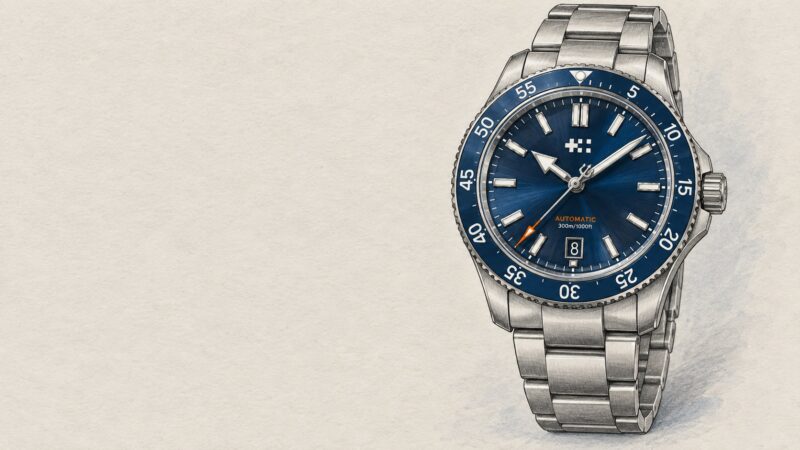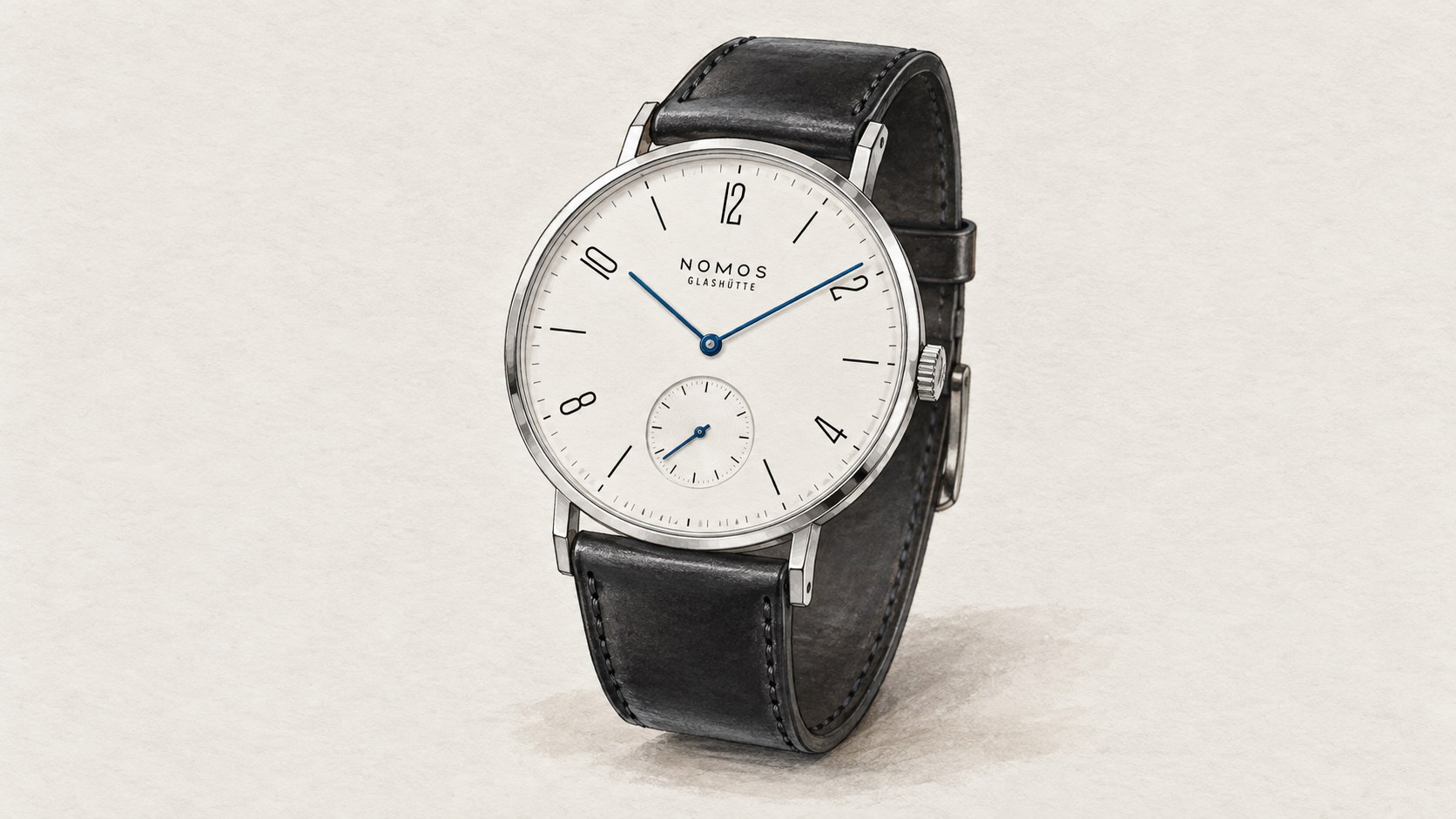
The Tangente and Max Bill are often placed together under a broad minimalist label. Their best qualities are more specific than that. The Tangente uses long angular lugs, a thin cylindrical case and separate seconds. The Max Bill creates a softer, more rounded composition beneath a domed crystal.
This comparison uses the current Tangente 139 with DUW 4001 and the sapphire-equipped automatic Max Bill 27/3500.02. Older specifications can change the apparent decision significantly. Choose between the actual manual and automatic references, then decide whether the Nomos’s sharper lines or the Junghans’s rounded arrangement makes the clearer statement to you.
The references compared
| Feature | Tangente 139 | Max Bill Automatic |
|---|---|---|
| Reference | 139 | 27/3500.02 |
| Diameter / thickness | 35mm / 6.6mm | 38mm / 10mm |
| Movement | Manual DUW 4001 | Automatic J800.1 |
| Reserve | Up to 53 hours | 38 hours |
| Seconds | Small seconds at six | Central seconds |
| Crystal | Sapphire; sapphire back | Domed antireflective sapphire |
| Water resistance | 5 ATM; maker says splash-proof | 5 bar |
| Strap | Black Shell Cordovan | Black leather |
Two histories behind the decision
Max Bill designed wristwatches for Junghans in 1961 after earlier clock work, bringing a concern for useful, restrained objects to the dial. The Tangente’s history follows another route: research by Roland Schwertner and Susanne Günther in 1990 drew on a 1937 Weber & Baral dial, with the watch reaching the market in 1992. Nomos carefully distinguishes that lineage from the idea that the Bauhaus school itself made wristwatches. These are therefore related design conversations rather than two versions of one historical object. The Junghans carries a named designer’s approach into a continuing collection; the Tangente reworks earlier typography and proportions into its own angular case and small-seconds arrangement.
The seconds hand changes the centre of attention
The Tangente’s small-seconds display occupies its own space at six, leaving the main hands to cross a relatively open central field. The Max Bill’s central seconds hand moves across the same broad face as the hours and minutes. That difference affects the visual activity even when both watches are simply running.
The Nomos’s typography and alternating markers also create a more linear composition. The Junghans’s fine markings and domed presentation encourage a rounder reading of the face. If you find one more immediately pleasing, that response is useful information. The purpose of restrained design is not to make every buyer reach the same preference.
Current Tangente specifications deserve a fresh look
Nomos now lists DUW 4001 and up to fifty-three hours of reserve for this reference. Describing every Tangente 139 as Alpha-powered would therefore blur the distinction between current production and earlier examples. The manual-winding requirement remains central to the ownership proposition.
The Junghans uses automatic J800.1 with a stated thirty-eight-hour reserve. Its rotor winding can be the more appealing interaction if you want the watch to gain energy through wear. The Nomos is the stronger choice when hand winding and the thinner case are positive attractions. Neither mechanism needs to be treated as a more legitimate expression of simple design.
A small diameter with relatively long lugs
The thirty-five-millimetre Tangente stretches to a published forty-five millimetres from lug to lug. Its long straight projections are an important part of the silhouette, so the small diameter should not be read as a promise of the shortest possible case.
The Max Bill has a broader dial and a thicker case, but a different relationship between the round body and attachment. Compare the full outlines on their black straps. Someone who likes the Tangente’s architecture may consider those lugs essential; someone who prefers the Junghans’s softer shape may find that its greater diameter does not create the same visual tension.
Do not transfer an older crystal specification
This Max Bill reference is listed with domed antireflective sapphire. Older Max Bill examples can have a different crystal, so a general statement that the whole collection uses acrylic would misdescribe the watch in this table. Both selected models provide modern sapphire specifications, although their shapes and coatings differ.
Choose the Tangente when its thin case, typography, small seconds and manual movement form a complete attraction. Choose the Max Bill when the rounded dial, central seconds and automatic winding are the design you want to live with. Their restrained faces are worth comparing closely precisely because there is less decoration to distract from the differences. A successful choice should feel particular, rather than merely satisfying a wish for something called minimalist.
Specifications and sources checked on 8 September 2026. Current Tangente specifications; Tangente design history; Exact Max Bill specifications; Max Bill design history.
Image: AI-generated editorial illustration of the Nomos 139. Design details are approximate; this is not a product photograph.