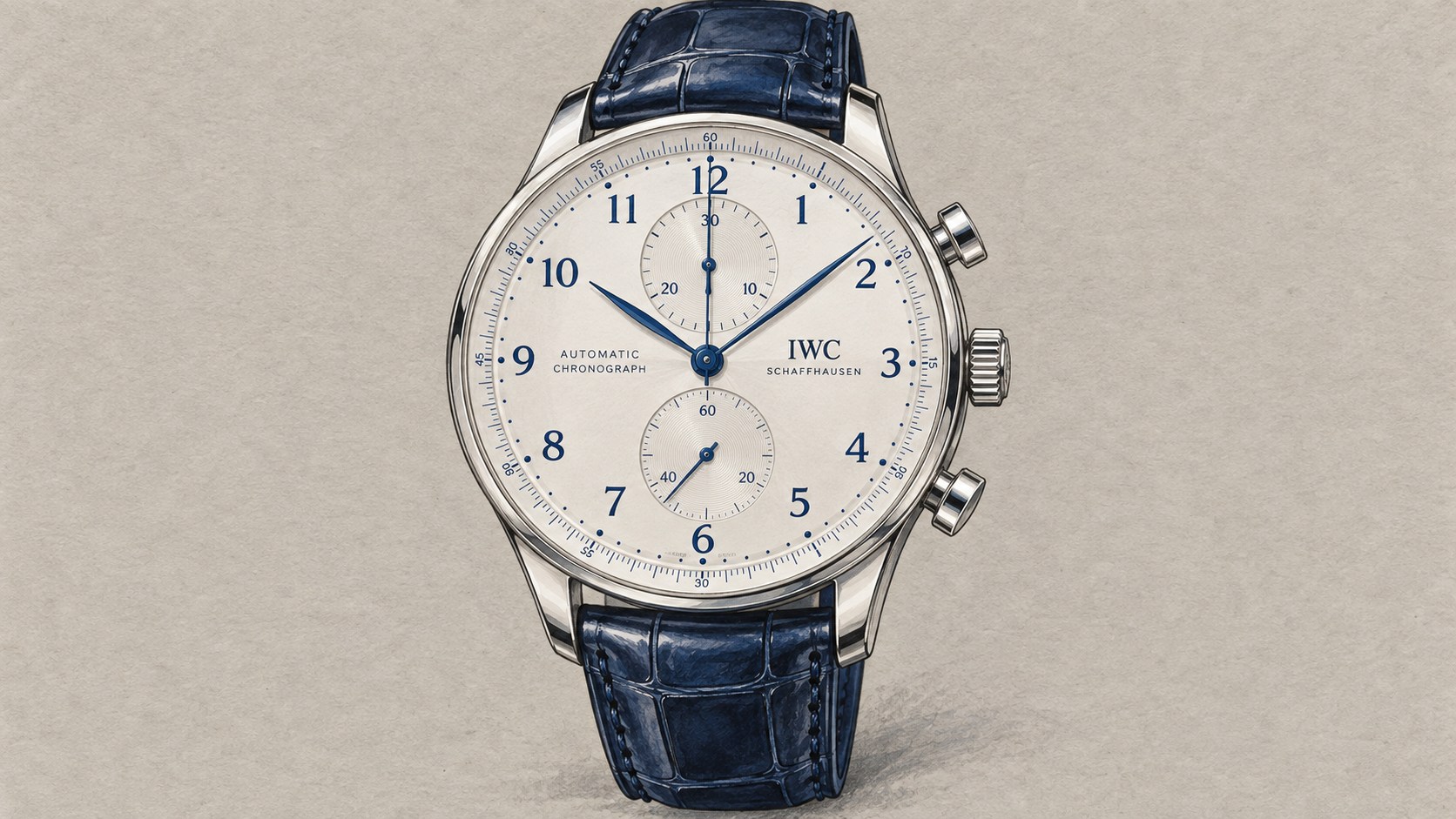
The Portugieser Chronograph makes a persuasive case for leaving the centre of a chronograph relatively calm. Its two subsidiary displays sit above and below the hands, creating a vertical axis rather than spreading registers across the whole face. The surrounding Arabic numerals remain part of a readable composition instead of disappearing into a wall of scales.
Reference IW371605 pairs that layout with a silver-plated dial and blue alligator strap. It is the IWC to consider when you want a chronograph’s mechanical interest without an overtly aggressive bezel. Its main attraction is balance, and that makes its compromises unusually easy to identify: the information it leaves out is part of why the design works.
The history behind the choice
IWC traces the Portugieser to a 1939 wristwatch project requested by two Portuguese businessmen. Large pocket-watch movement architecture informed the original, helping establish the family’s broad dial and clear numerals. The chronograph is a later development: a split-seconds model appeared in 1995, followed by the familiar vertical-counter Chronograph in 1998. The present watch preserves that recognisable arrangement while using IWC’s later 69355 movement. This layered history matters. The clean face is neither a recent attempt to simplify a sports chronograph nor an unchanged pre-war stopwatch. It brings the Portugieser’s original emphasis on an expansive, orderly display into a modern automatic chronograph. Subsequent dial colours have altered its mood without needing to abandon the underlying structure.
The exact reference
| Specification | Published detail |
|---|---|
| Reference | IW371605 |
| Case | Stainless steel; 41mm diameter; 13mm thick |
| Dial | Silver-plated |
| Movement | Automatic IWC-manufactured calibre 69355 |
| Reserve / frequency | 46 hours / 4Hz |
| Chronograph | Minutes and seconds; column-wheel control |
| Running seconds | Small hacking seconds at 6 |
| Water resistance | 3 bar |
| Crystal | Convex sapphire; antireflective both sides |
| Back | Sapphire display back |
| Strap | Blue alligator; 20mm width |
Why the counters work vertically
Stopped minutes occupy the upper counter, while the lower one shows the watch’s running seconds. The central chronograph hand provides the other part of elapsed-time reading. This separation lets the two small circles act as anchors above and below the hand stack.
The layout is particularly attractive if conventional three-register chronographs feel crowded. It does, however, ask you to learn which hand belongs to ordinary timekeeping and which belongs to the stopwatch. The lower seconds display continues doing its own job when the chronograph is idle. Understanding that distinction is more useful than simply calling the dial symmetrical, because the visual balance contains two different functions.
A broad face without a timing bezel
A comparatively restrained surrounding bezel leaves the dial as the main event. The numerals, hands and outer divisions consequently have room to establish their own hierarchy. It is a different emphasis from a diver’s chronograph or a watch framed by a heavily marked external tachymeter.
This gives the Portugieser its particular versatility of appearance. It can remain recognisably technical without using every available surface for a scale. Yet the exposed dial area also means you need to like the complete typography and counter spacing. There is no large coloured bezel to redirect attention. The watch succeeds through the arrangement you see most often, not through a dramatic case feature around it.
The 69355 is a proper part of the story
The automatic calibre uses a column wheel to control the chronograph functions, and the transparent back allows the mechanism to participate in the ownership experience. It gives the composed front a mechanical counterpart rather than hiding everything behind a plain cover.
Its reserve is more modest than the extended figures now available in some competing movements. That does not change the appeal of the dial, but it is a meaningful comparison for someone rotating several watches. The choice is between complete designs and mechanisms, not a league table in which the longest reserve automatically wins. Here, the movement supports a familiar display with a clear chronograph identity; the caseback adds something to examine beyond the face.
What the cleaner display leaves out
There is no date aperture interrupting this reference’s dial. For a buyer who regularly checks the calendar on a watch, that omission matters. For someone who dislikes an isolated window breaking the layout, it is part of the appeal. A calendar is useful only if its usefulness outweighs the compositional change for the person choosing it.
The chronograph also emphasises minutes and seconds rather than adding a separate elapsed-hours register. That keeps the vertical arrangement clear, but a full three-counter alternative may be more appropriate for timing longer activities. The Portugieser becomes a stronger purchase when these are conscious preferences, rather than features you discover you wanted after falling for the dial.
A dressier appearance does not mean a thin case
The current product specification lists a thirteen-millimetre case height and a three-bar water-resistance rating. The broad dial and leather strap can give a more formal impression than the physical profile suggests. During a fitting, inspect the side view as well as the face; both belong to the same watch.
A Breitling Premier offers another approach to a more composed chronograph, while a Chronomat places greater emphasis on external hardware and bracelet design. Choose the Portugieser when its vertical organisation, uninterrupted calendar-free face and visible automatic movement form the combination you want. It is particularly convincing for someone who likes chronographs but wants the everyday act of reading the time to remain the centre of the design.
Specifications and sources checked on 8 September 2026. Portugieser Chronograph exact specifications; IWC chronograph layout and 1998 history; Portugieser origins in 1939.
Image: AI-generated editorial illustration of the IWC IW371605. Fine dial details and finishing may differ from the production watch.


