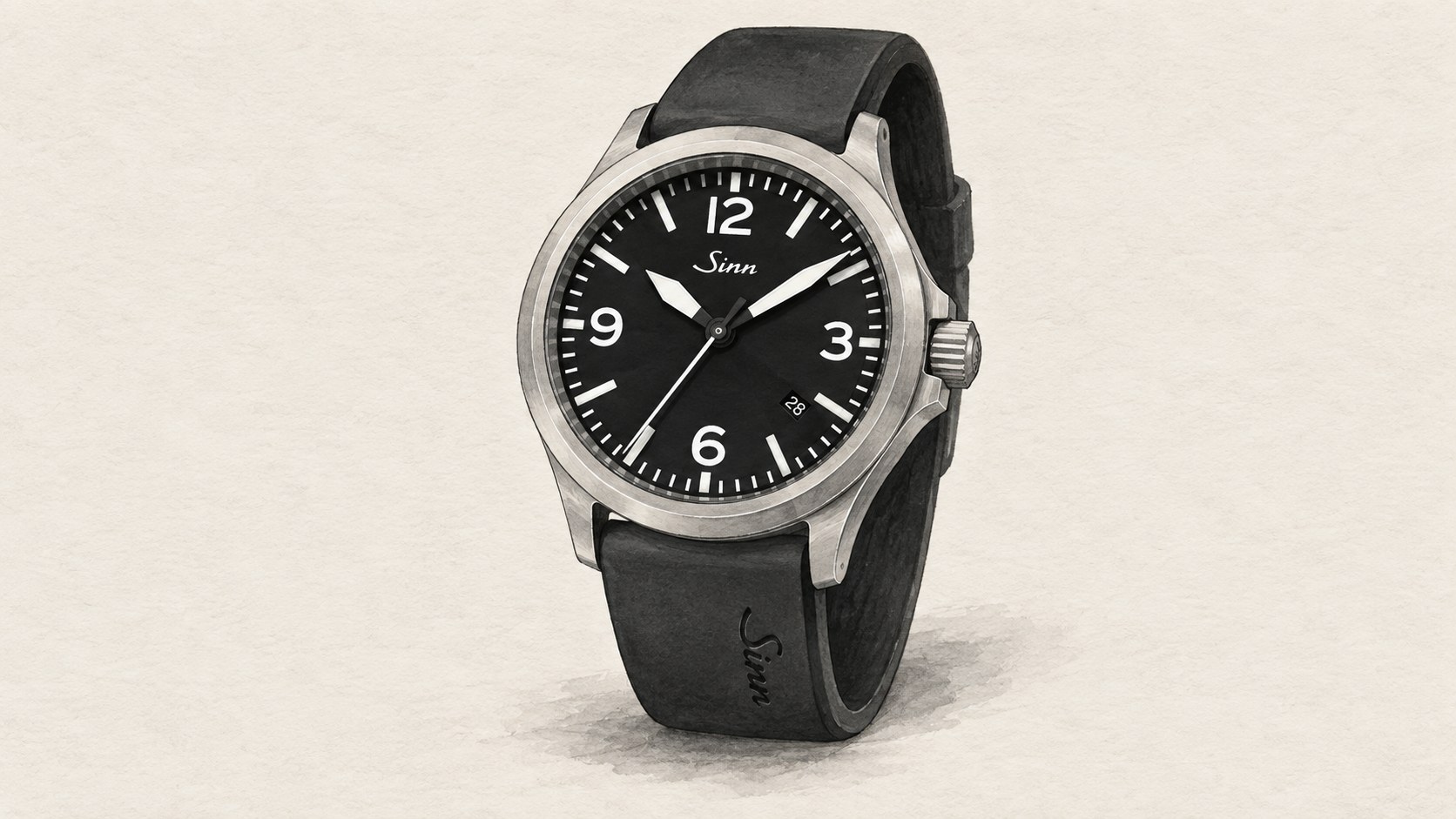
Based on Sinn’s published information. Specifications checked on 8 September 2026.
The Sinn 856 is worth considering if visible case wear bothers you but you still want a mechanical watch for regular use. TEGIMENT increases the hardness of the steel’s surface, making it more resistant to scratching. It is a practical improvement, not a promise that the watch can never acquire a mark.
That distinction is the key to buying it well. Pay for an increased margin of resistance and the 856’s other protective features. If your expectation is permanent cosmetic perfection, the same watch may become a source of frustration the first time its finish changes.
Why Sinn developed surface hardening
Sinn introduced TEGIMENT on the 756 Duochronograph at Baselworld in 2003, following an earlier ice-hardening approach presented in 2002. Its technical history describes a move towards hardening the material’s surface itself, rather than applying a separate protective coating. The technology subsequently spread beyond the original steel cases. The 856 combines that development with a display influenced by the brand’s cockpit navigation clocks: prominent numerals, strong contrast and little decoration. This is a coherent piece of the company’s evolution from instrument-style watches towards additional material and environmental protection. It also explains why two superficially similar steel Sinn watches can have meaningfully different ownership propositions. The finish is part of an engineered specification, rather than merely a different shade of grey.
The three-hand 856, precisely
This guide concerns the standard steel 856 with a date, not the black 856 S or the additional-time-zone 856 UTC. The figures are from Sinn’s model sheet and the series manual.
| Specification | Sinn 856 |
|---|---|
| Case diameter and thickness | 40 × 11mm |
| Weight without strap | 70g |
| Lug width | 20mm |
| Case | Bead-blasted steel with TEGIMENT |
| Case back | Nickel-free steel, without TEGIMENT |
| Movement | SW300-1 automatic; 25 jewels |
| Frequency | 28,800 vibrations per hour |
| Crystal | Sapphire, anti-reflective on both sides |
| Water resistance | 20 bar |
| Magnetic-field protection | Up to 80,000A/m |
| Moisture-control system | Ar-Dehumidifying Technology |
What the treatment changes
Sinn’s explanation describes a hardened surface that transitions towards the base material beneath. That differs from covering ordinary steel with a separate layer. The standard silver-coloured 856 does not need a black finish to receive TEGIMENT; the black S variants add another treatment.
It is sensible to expect better resistance to incidental scratching than from the untreated base material. It is not sensible to infer that every contact will leave the watch untouched. The hardness and shape of the object, the force involved and the part of the watch affected all matter. A case-hardening process also does not eliminate damage from a substantial impact.
Coverage deserves attention when ordering. Sinn specifically identifies the 856’s case back as nickel-free and untreated. If you choose a bracelet or a different clasp, confirm whether those components have TEGIMENT too. A description of the case cannot stand in for the specification of every attached part. This is particularly relevant when comparing complete packages or buying a watch that has acquired a replacement bracelet.
The less visible protections
The 856/857 manual explains Ar-Dehumidifying Technology as a combination of a drying capsule, special seals and protective gas. Its purpose is to reduce the conditions that allow moisture inside the case to cause fogging and affect the movement. The capsule’s colour provides an ownership cue: Sinn recommends replacement when it becomes deep blue.
The magnetic-field protection is another separate feature, rated by Sinn up to 80,000A/m. It makes the 856 a more technically protected choice than a watch that merely resembles a cockpit instrument. It does not create a reason to expose the watch deliberately to powerful magnets, any more than a water-resistance rating creates a reason to neglect the seals.
These systems also give you a reason to plan servicing through a route familiar with the model. Ask how the protective systems are checked when the watch is opened. The point is to preserve what you bought, not simply to get the hands running again.
The ordinary watch still has to suit you
At 40mm across and 11mm thick, the 856 avoids relying on exceptional bulk to communicate its purpose. Its matte black dial, large numerals and luminous indications offer a clear visual brief. Try the watch in the strap configuration you intend to wear and check how the case sits when you bend your wrist.
The automatic SW300-1 supplies time and date without turning the dial into a complication display. Sinn’s exact sheet does not state a power-reserve figure, so ask the seller about the particular production example if that is central to your rotation. A movement family name alone is not enough to assume every version has an identical reserve.
The 556 I RS is the useful alternative if you mainly want a simple Sinn automatic. It has a 38.5mm case, sapphire display back and 20-bar water resistance. Choose the 856 when its hardening, magnetic protection and moisture-control system are benefits you actively want. Choose the simpler model if the design and fit are the main attraction. TEGIMENT can make regular wear easier to accept, provided you buy increased resistance rather than an impossible guarantee against every scratch.
Image: AI-generated editorial illustration of the Sinn 856. Design details are approximate; this is not a product photograph.


