Based on Casio’s published information. Specifications checked on 8 September 2026.
If your hardest daily obstacle is a crowded train, the Mudmaster GG-B100-1A3ER provides more outdoor equipment than you need. That does not make it a bad city watch. It makes the decision unusually straightforward: buy it because you enjoy its substantial shape and will use its sensors, while accepting the space it occupies on your wrist.
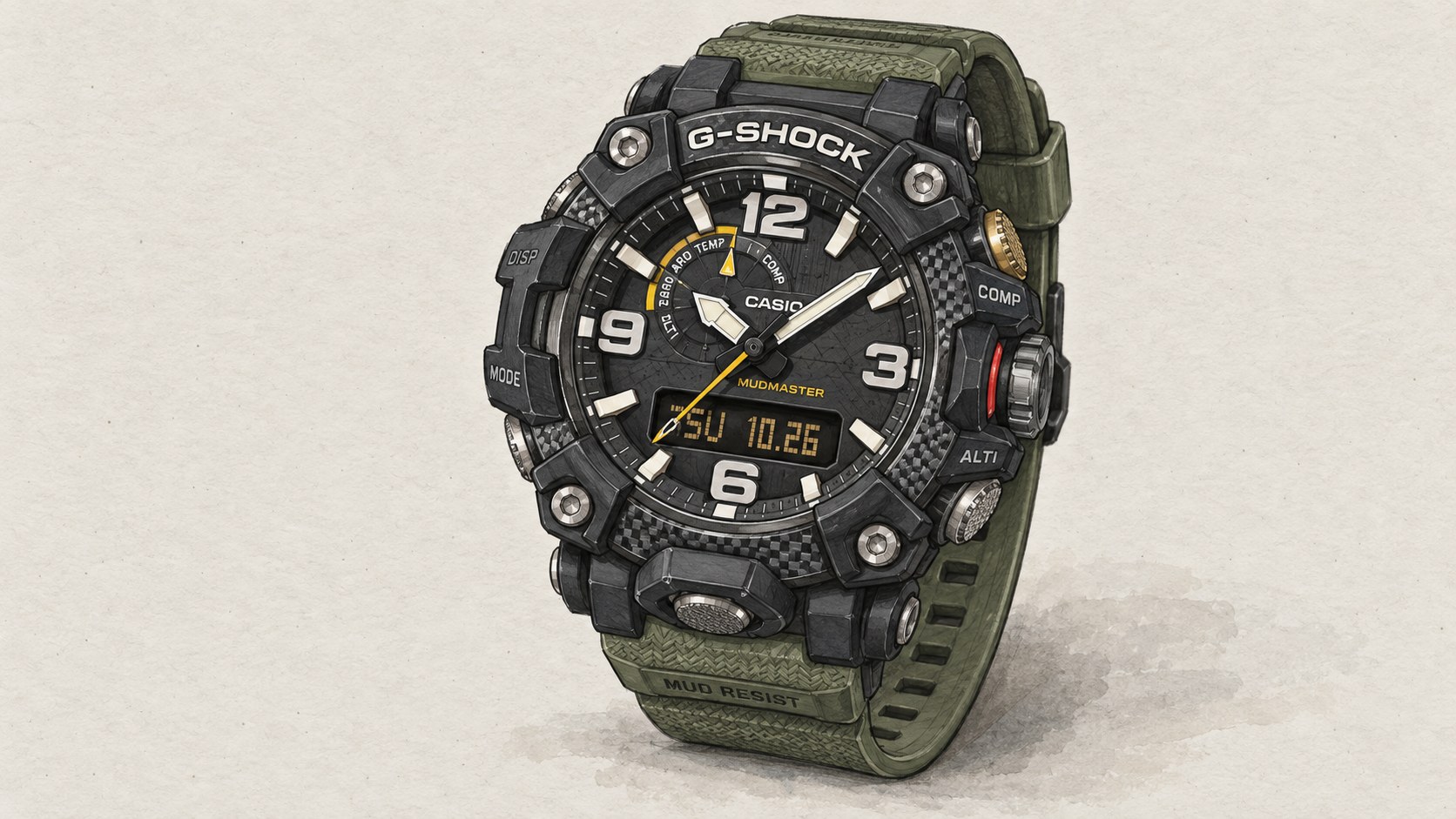
The green resin strap and layered black case give this reference a purposeful appearance. The more consequential detail is its 19.4mm thickness. Before considering compass modes or carbon construction, try it with your usual jacket and with your hand resting on a desk. Those are the places where a large watch must earn its place.
Where this Mudmaster fits
Casio dates the Mudmaster family to 2015. The GG-B100 arrived within the brand’s 2019 expansion of carbon construction, documented in its carbon G-Shock catalogue. That development was more specific than another oversized case: carbon-reinforced resin supported the protective structure, while four sensors and phone communication expanded what a land-focused watch could record. A Japanese launch listing places the original GG-B100 colour range in July 2019. The family has since grown to include other movements and construction methods, which is why the Mudmaster name alone tells a buyer too little. The GG-B100 remains the battery-powered, phone-linked interpretation discussed here. A newer Mudmaster carrying Tough Solar or a different sensor package should be assessed as a separate watch.
The figures that affect the choice
These are the measurements and functions in Casio’s UK listing. Length is the complete case dimension, not an independently measured lug span.
| Specification | GG-B100-1A3ER |
|---|---|
| Case length × width × height | 55.4 × 51.3 × 19.4mm |
| Weight | 92g |
| Construction | Carbon Core Guard; shock and mud resistant |
| Crystal and strap | Spherical mineral glass; resin strap |
| Water resistance | 200 metres |
| Power | CR2025 battery; approximately 2 years |
| Unlinked accuracy | ±15 seconds per month |
| Sensors | Compass, pressure/altitude, temperature, step counting |
| Connection | Bluetooth through CASIO WATCHES |
Useful instruments, with a phone doing part of the work
A compass bearing can help orient a walk, while a pressure trend and altitude record provide another way to follow a day outdoors. Step counting has an equally ordinary use: it lets you check activity without turning the watch into a screen of notifications. You can enjoy those functions without planning an expedition.
It helps to understand where the information comes from. The altimeter estimates height from air pressure, so weather changes can affect a reading. Casio’s module 5594 guide recommends calibration against known local elevation. The thermometer also needs time away from body heat to represent the surrounding air. These are measuring routines to learn, not reasons to dismiss the sensors.
Mission Log combines altitude measured by the watch with route data from your smartphone’s GPS. The GG-B100 does not supply an independent satellite track. For someone who already carries a phone, that division of work may be entirely sensible. For someone seeking a route-recording watch to use without a phone, it is a decisive limitation.
Daily life with a very large case
The resin construction keeps the quoted weight manageable relative to the dimensions, but low mass and small size are different advantages. A case can feel acceptably light while still catching a cuff or occupying much of the wrist. Look at how its strap starts to curve downward, then check whether you can bend your wrist freely.
The analogue hands give a familiar time display, with a smaller digital area serving the additional functions. That arrangement suits a buyer who wants a conventional clock face first. It also means the menus need practice. Set up the modes you actually use and learn the direct route back to timekeeping before taking it on a trip.
Its battery is replaceable rather than solar rechargeable. Casio’s two-year estimate assumes a defined pattern of operation; frequent lighting, sensor activity and connection use can change the result. Budget for professional battery replacement and a water-resistance check, especially if swimming is part of your routine. Mud protection does not make accumulated dirt desirable, so regular gentle cleaning still belongs in ownership.
A smaller G-Shock may answer the same question
The GA-2100-1AER is the useful counterexample: 51g and 11.8mm thick, with 200-metre water resistance. It gives up the GG-B100’s sensor package and Bluetooth. If what you really want is a tough everyday watch with analogue hands, those omissions might remove features you would rarely use while making the watch easier to accommodate.
Keep the GG-B100 on the shortlist if its compass, activity display and pressure information are part of the appeal, or if the larger design is simply the one you prefer. There is no requirement to justify a personal watch through an extreme occupation. The practical test is whether you still want its size after the novelty of the specifications has passed.
For city use alone, the GG-B100 is generous equipment. For mixed daily wear and regular outdoor time, it can be a coherent choice, provided you accept the thickness, learn the sensors and understand the phone’s role. Buy the exact reference with those expectations, and its strengths become much easier to judge.
Image: AI-generated editorial illustration of the G-Shock GG-B100-1A3ER. Design details are approximate; this is not a product photograph.


