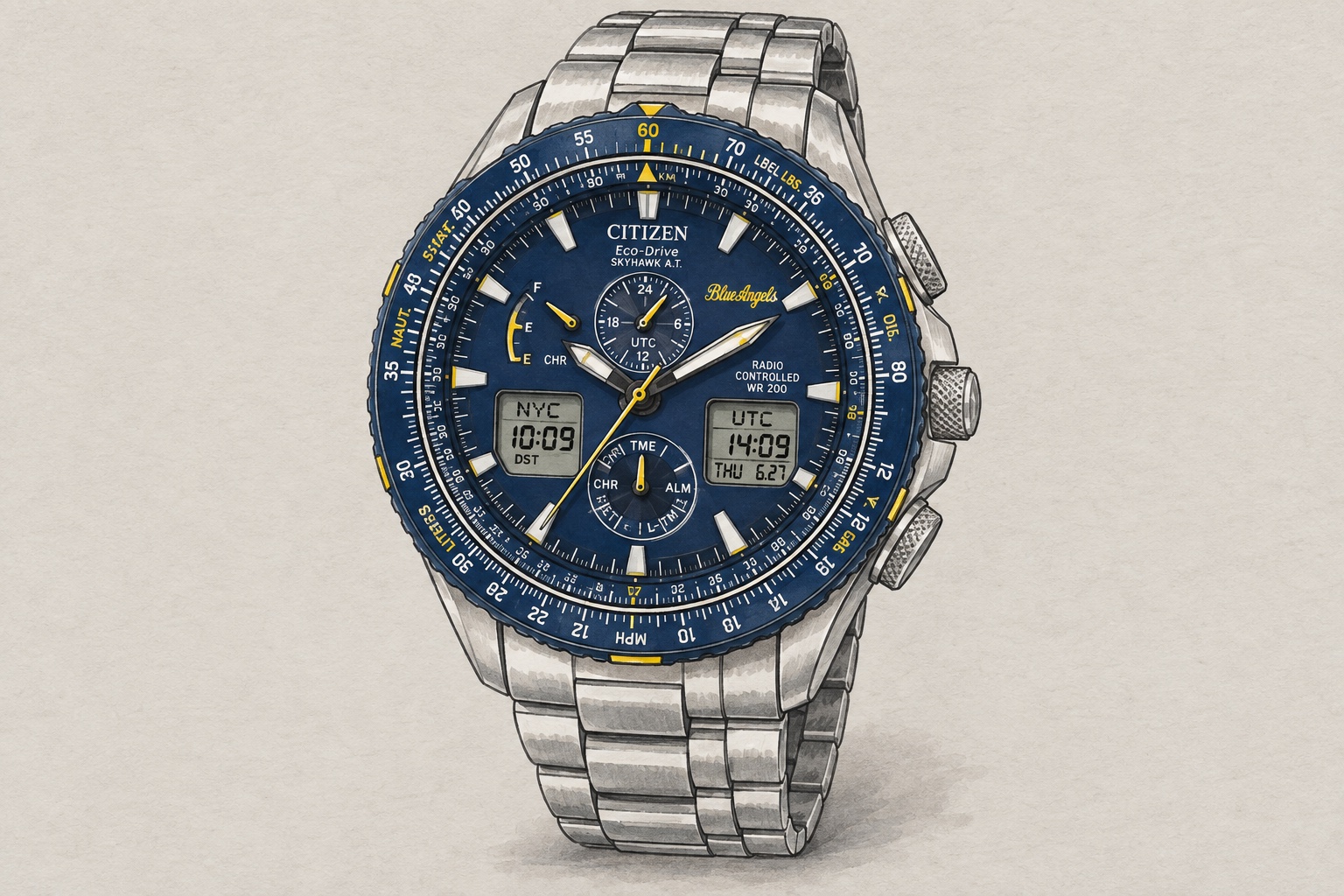
The rotating scales on the Citizen JY8078-52L can perform real calculations. Whether you will use them after the first week is the more important buying question. This Blue Angels Promaster Skyhawk A.T combines that mechanical calculator with light-powered timekeeping and a substantial collection of digital functions. It suits someone who enjoys learning a watch as much as looking at it.
Citizen’s UK listing for JY8078-52L showed £649 on 8 September 2026. The blue dial, yellow accents and steel bracelet give this exact version a conspicuous aviation character.
Based on Citizen’s published information. Specifications checked on 8 September 2026.
How the Skyhawk arrived here
Citizen launched Promaster in 1989 around watches for land, sea and air, with the first Promaster Sky models arriving that year. The company’s historical account highlights the 1994 Navihawk, which combined analogue and digital time-zone displays. In 2003, a full-metal Promaster brought together Eco-Drive and radio-controlled timekeeping. These are useful steps in understanding the Skyhawk: its busy face comes from a tradition of showing and managing several kinds of information. Citizen also records the long-running Blue Angels association within that history. The JY8078-52L is a later expression of this approach, rather than a reproduction of one early pilot’s watch. The Promaster timeline explains why the collection values functions and technical displays so visibly.
The exact reference in numbers
| Detail | Published specification |
|---|---|
| Movement | U680 Eco-Drive, analogue and digital display |
| Case size | UK: 46 mm; Canadian listing: 45 mm |
| Case and bracelet | Stainless steel; folding clasp |
| Weight | 189.94 g, Canadian specification |
| Lug width | 22 mm, Canadian specification |
| Crystal | Sapphire with anti-reflective treatment |
| Water resistance | 200 m / 20 bar |
| Chronograph | 1/100 second; maximum 24 hours |
| Timer and alarms | 99-minute countdown; two alarms |
| Full-charge duration | About six months normally; about 3.5 years in power saving |
The UK and Canadian product pages disagree by 1 mm on case size. Both describe a large watch. Neither figure establishes how it sits on a particular wrist, and no confirmed thickness or lug-to-lug dimension is supplied here.
What the slide rule actually does
The U680 manual includes multiplication, division, ratios and conversions. Its two scales work through alignment: putting one known value beside another establishes a relationship that can be read elsewhere around the dial. The slide rule works independently of the electronic movement.
For an everyday example, multiply 12 by 8. Align 12 on the outer scale with 10 on the inner scale, then read the outer value opposite 8. It corresponds to 96 once you place the decimal correctly. The scale supplies a proportion; you still need a rough idea of the answer’s size. The same alignment can show other multiples of 12 without starting again.
This makes it enjoyable for checking rough quantities or exploring proportional relationships. It is less attractive for a shopping total involving addition, subtraction and exact pennies. Tiny printed divisions also limit the precision you can read. A phone calculator is usually easier for a result you need to record exactly.
Before buying for the slide rule, try reading its smaller numbers under ordinary indoor light. If those marks are uncomfortable to resolve, the mechanism will mostly become decoration for you. That can still be a perfectly reasonable aesthetic choice, provided it is the choice you intend to make.
The functions you may use more often
World time, a second time display and the perpetual calendar are likely to matter more on a normal journey than the calculating scales. The distinction between world-time selection and radio reception is important: 43 city settings do not mean a receiver works everywhere. The U680 receives regional time signals, including Germany’s DCF77 for Europe. Buildings and location can affect reception.
Without a successful signal, the movement continues as a quartz watch; Citizen specifies approximately ±15 seconds per month at normal temperatures. Set the correct home city and check the reception indicator when learning the watch. An apparently clever feature becomes useful only when you know how to confirm its status.
The practical cost is attention. Several functions share buttons and displays, so occasionally used settings may send you back to the instructions. Someone who changes time zones often could welcome that flexibility. Someone who only wants the local time may see a collection of labels competing with the hands.
Choose the complexity deliberately
At around 190 g before individual bracelet adjustment, the published weight makes fit worth taking seriously. Have the bracelet sized carefully and move your wrist through your usual range. Decide whether the case and clasp remain comfortable while typing, driving or bending your hand. A brief look in a shop mirror will not answer those questions.
Keep the dial exposed to light regularly and use the charge indication as intended. Power saving explains why the hands or displays may pause during storage. The long storage figure is different from six months of normal operation, so it should not become a reason to ignore charging indefinitely.
If your real priorities are solar power, travel settings and alarms with less weight, the Casio GA-B2100-1AER offers Tough Solar, Bluetooth adjustment and a published 52 g weight. It approaches the same everyday needs through a very different display and case.
Choose the JY8078-52L when its aviation styling and layered controls are part of the pleasure. The slide rule is functional, but it works best as an occasional estimating tool and an absorbing mechanical interface. The stronger everyday justification is the combination of solar power, useful travel functions and a design you are willing to learn.
Image: AI-generated editorial illustration of the Citizen JY8078-52L. Design details are approximate; this is not a product photograph.


