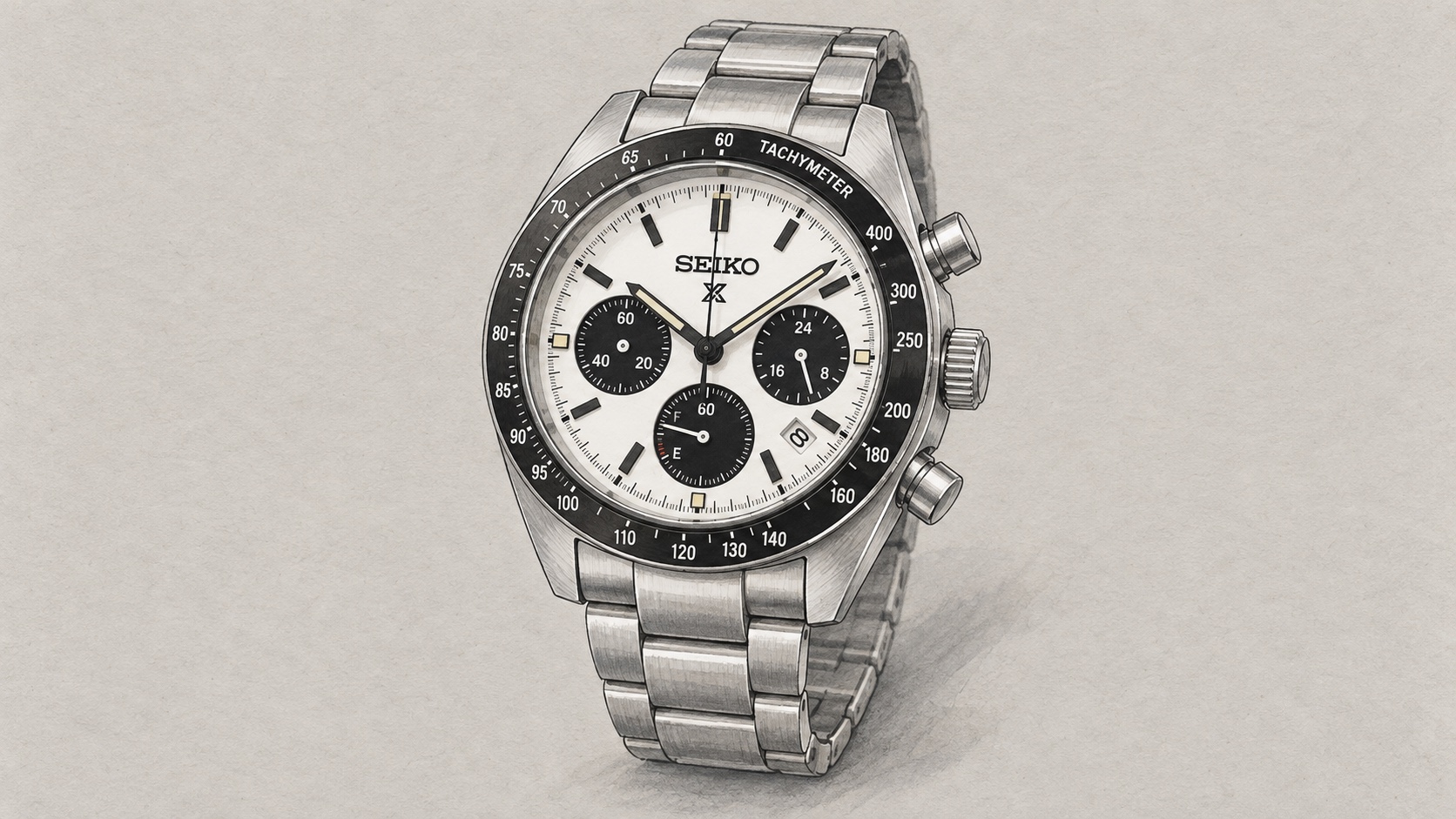
A chronograph ought to give you an extra thing to do, rather than an extra thing to worry about. The Seiko SSC813 puts a stopwatch in a solar-powered watch, so the practical attraction is a useful complication without the winding routine of a mechanical chronograph.
The white dial and black registers supply plenty of visual interest before you press anything. The harder question is whether you want to read all that information on a 39 mm watch. This Speedtimer is an attractive candidate for everyday use when its stopwatch will earn its space. A compact case cannot by itself make a crowded display simple.
Based on Seiko’s published information. Specifications checked on 8 September 2026.
The exact reference
| Movement | V192 solar quartz chronograph |
|---|---|
| Case | Steel; 39 mm diameter; 13.3 mm thick |
| Lug-to-lug | 45.5 mm |
| Lug width | 20 mm |
| Weight | 161 g |
| Crystal | Curved sapphire; inner anti-reflective coating |
| Water resistance | 10 bar |
| Stopwatch | Up to 60 minutes; 1/5-second measurement |
| Rated accuracy | ±15 seconds per month |
| Running time | Approximately six months from full charge |
| UK listed price | £640; out of stock when checked 8 September 2026 |
Specification source: Seiko UK boutique SSC813P1.
The history is mechanical, the daily routine is solar
Seiko’s original Speedtimer arrived in 1969 as an automatic chronograph. The current solar family draws from that period and from the broader sports-chronograph language of the 1960s and 1970s. It is a contemporary interpretation of those ideas, rather than a reproduction of the original movement inside a new case. Seiko’s own design material points to the modest case diameter, strong dial contrast and textured dial treatment as part of that approach.
The distinction matters when buying. You can enjoy the historic timing connection without buying a vintage movement or choosing a modern mechanical chronograph. The V192 changes the ownership routine substantially while keeping a traditional stopwatch display. Seiko’s Speedtimer account is useful context for understanding that deliberate combination.
What each part of the dial contributes
The central chronograph hand measures elapsed time when you start the stopwatch. Separate displays handle running seconds, 24-hour information and the stopwatch’s minutes, with a charge indication also built into the layout. This is a watch to learn before deciding whether its display is intuitive. Do not mistake a stationary central stopwatch hand for evidence that the movement has stopped.
The stopwatch measures up to 60 minutes in fifths of a second. That is appropriate for many short activities, but it is not a twelve-hour recording instrument. If your imagined use is timing a long journey, establish how you will keep track after its minute capacity ends. The V192 specification on Seiko’s product page makes the limit clear.
A fixed tachymeter scale adds another timing application, but it also occupies visual space around the dial. You do not have to use it to enjoy the watch. It is worth recognising when a feature is a functional priority and when it is primarily part of the look you like.
Solar power rewards a sensible storage habit
Seiko quotes around six months of running from a full charge. That is a reserve figure, not a promise that a newly delivered watch is already fully charged. A solar watch benefits from regular exposure to suitable light; placing it in a dark drawer between occasional outings works against its power source.
The attraction is that a watch rotation does not automatically create the short reset cycle associated with a mechanical reserve measured in hours. You can choose it for a day without first rebuilding the spring’s reserve. That makes it especially plausible as a second watch for someone whose main watch is an automatic.
Solar power does not remove maintenance or make every component permanent. Keep the instructions available, follow the charging guidance and have water-resistance work assessed when the case is opened. The sensible expectation is fewer routine interruptions from an exhausted ordinary battery, not a lifetime free from attention.
Compact across, substantial from the side
The diameter may appeal to buyers avoiding oversized chronographs, but 13.3 mm of thickness is still relevant under a shirt cuff. Assess the side profile as well as the face. The comparatively short 45.5 mm lug-to-lug measurement is helpful information, while bracelet articulation and clasp position remain personal fit checks.
At a try-on, look at the time quickly from your normal reading distance. Then read the small registers without bringing the watch unusually close. If you need to hunt for the minute hand among the dial details, no amount of appreciation for the colour scheme will turn it into your preferred quick-reading watch.
The curved sapphire and contrasting registers also deserve a look in several directions of light. Published anti-reflective treatment tells you how the glass is specified; it cannot replace checking reflections with your own eyes in the conditions where you will use it.
When a simpler quartz watch is the better answer
If your interest disappears once the stopwatch is running, compare a plain three-hand quartz watch such as the Casio Edifice EFV-100D-1AV. Its date-only dial removes the register-reading exercise. Casio marks that reference as an older model, so availability needs checking, but it makes a useful conceptual comparison: do you want a stopwatch or simply a sports watch with hands?
The SSC813 earns its extra dial complexity if you enjoy operating the buttons, following an interval or reading the timing displays. It also offers a distinctive appearance to buyers who use the stopwatch only occasionally. Neither justification needs a fictional motorsport lifestyle.
The buying verdict
Choose the SSC813 if solar convenience and a traditional chronograph face both matter to you, and you can comfortably read the registers at normal wrist distance. Its measured proportions make it worth trying even if larger chronographs have put you off.
Pass if you require long-duration elapsed-hour recording or the open simplicity of a three-hand dial. The official UK boutique listed £640 but showed no stock on 8 September 2026, so confirm availability before treating that price as an immediate purchase option. Buy the useful combination, with its actual limits understood.
Image: AI-generated editorial illustration of the Seiko SSC813P1. Design details are approximate; this is not a product photograph.


