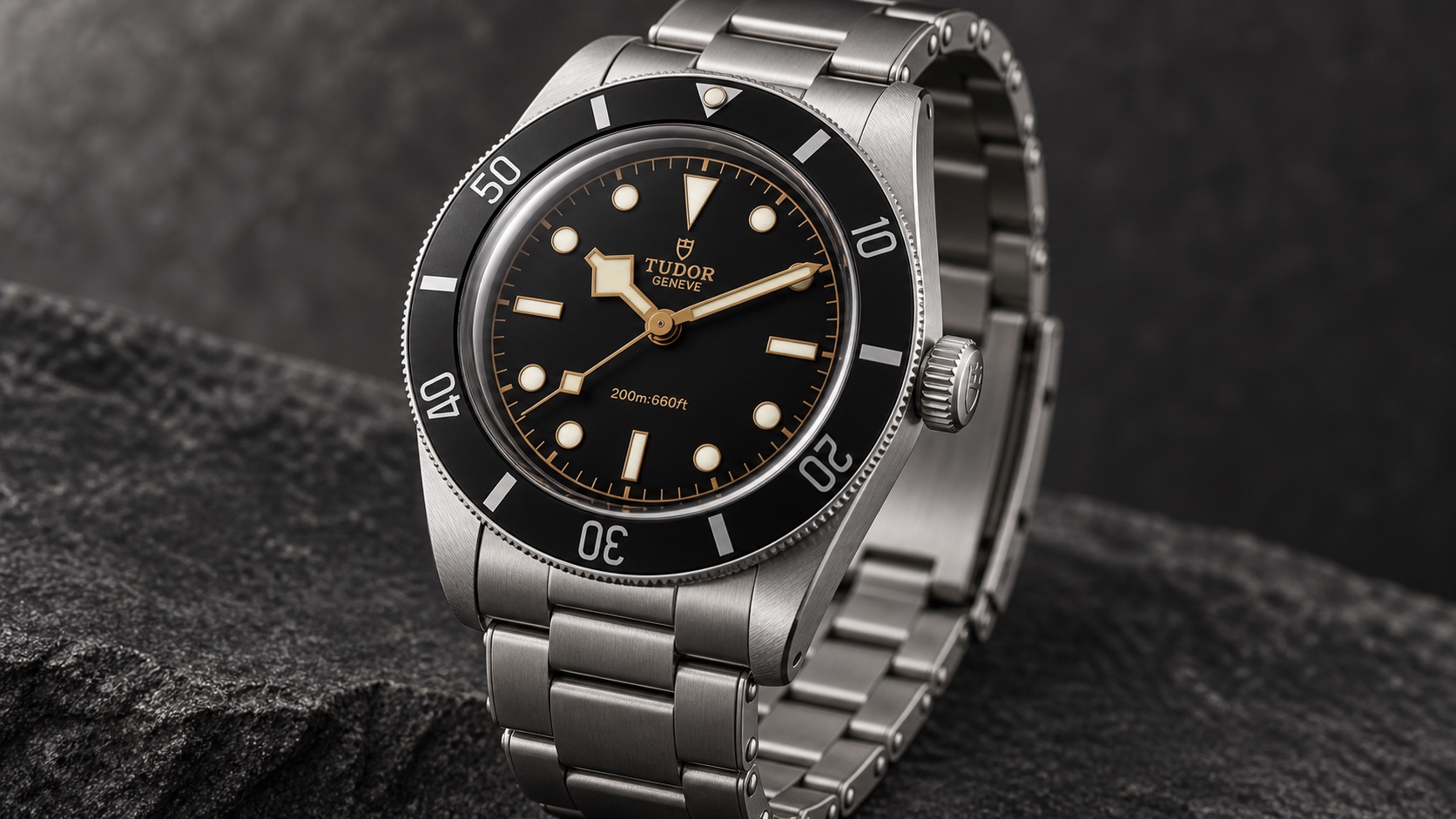
The Black Bay 54 works because its details agree with one another. A compact case, small crown and restrained black bezel all support the same idea of a straightforward diver. Reducing another watch to 37mm would not necessarily produce that result.
Reference M79000N-0001 is the black-dial model on a steel bracelet. Its historical appearance is supported by a modern movement, sapphire crystal and adjustable clasp, so choosing the older visual language does not require choosing an actual vintage watch. The question is whether you enjoy that restrained design more than the brighter materials and sharper modern identity of a Pelagos.
The history behind the choice
The number 54 points to Tudor’s first diving watch, the reference 7922 introduced in 1954. The modern model takes specific cues from that beginning, including the compact case concept and relatively small crown. Its bezel omits the red triangle and the individual minute graduations often associated with later diving designs. Tudor also draws attention to the lollipop seconds hand and the pinched bases of the hands. These details matter more than a general claim of vintage inspiration because they explain the particular face of this watch. It remains a present-day interpretation, with contemporary sealing, movement and bracelet features. The pleasure lies in the correspondence between those early design decisions and the clean modern result, rather than in pretending the two watches are identical.
The exact reference
| Specification | Published detail |
|---|---|
| Reference | M79000N-0001 |
| Case | 37mm steel; 11.2mm thick |
| Lug width | 20mm |
| Dial | Domed black; no date |
| Bezel | Unidirectional steel; black aluminium insert |
| Movement | Automatic MT5400; COSC certified |
| Stated reserve | Approximately 70 hours |
| Water resistance | 200m |
| Crystal | Domed sapphire |
| Bracelet | Three-link steel; T-fit clasp |
A bezel with breathing room
The aluminium insert carries a sixty-minute scale without filling the opening section with individual minute marks. The effect is comparatively open. Against the domed black dial, the bezel frames the hands without demanding the same attention as a heavily graduated modern diving ring.
That restraint is an aesthetic choice with a functional consequence: there is less fine information on the bezel to read. Someone who prefers a densely marked elapsed-time scale may favour another diver. Someone who mainly sets approximate everyday intervals may appreciate the simpler face. The 54’s appeal is not that every omitted detail makes it better, but that the chosen omissions produce a very consistent appearance.
Small crown, distinct hands, no calendar
The crown is deliberately modest in relation to the case. It supports the early-diver silhouette rather than advertising a large control as the defining feature. The domed crystal and dial add another layer of historical character, while the hand shapes keep the result recognisably Tudor.
There is no date window. That allows the hour markers to occupy the face without a calendar cutting into the arrangement. It also means the watch offers one fewer everyday function than a date-equipped diver. The lollipop seconds hand supplies a different shape from the hour and minute hands, giving the display variety within its limited palette. These are small decisions, but together they explain why the watch feels like a complete design rather than simply a smaller Black Bay.
A modern engine inside the old vocabulary
The MT5400 is an automatic, COSC-certified movement with approximately seventy hours of reserve. Its time-only role matches the dial. The sapphire crystal and 200-metre water-resistance specification likewise belong to a modern ownership proposition, even though the exterior takes its cue from an earlier period.
That combination is the strongest alternative to buying a vintage diver for everyday use. You can choose the 54 for its current construction while enjoying the older proportions. It does not replace the historical interest of an original 7922, and it does not need to. The two purchases answer different desires: one delivers a modern interpretation to use, while the other centres on a particular surviving historical object.
Compact does not mean stripped of bracelet features
The steel bracelet uses three-link construction and the T-fit clasp. A practical adjustment system is particularly welcome on a watch whose attraction is that its proportions seem carefully resolved. The clasp should support that coherent feel rather than force the owner to accept an awkward setting for the sake of the small case.
The 20mm lug width also creates a different case-to-strap relationship from a narrower opening. Before buying, look at the complete watch on its adjusted bracelet, including the underside of the wrist. The 37mm diameter and 11.2mm thickness give you a useful starting point, but the bracelet’s line is part of the appearance you are choosing.
The alternatives reveal the 54's priorities
A Pelagos 39 substitutes titanium and a ceramic bezel insert for the 54’s steel and aluminium. Its sunray surfaces and luminous ceramic composite markers give the familiar Tudor hand language a more contemporary setting. Choose that watch when materials and modern diving design are the attraction, rather than assuming it is simply a larger version of this one.
The 39mm Ranger takes away the rotating bezel and uses a numeral-led field-watch display. Interestingly, its published 12mm thickness exceeds the 54’s 11.2mm, so a simpler complication count does not automatically mean a thinner watch. Choose the Black Bay 54 when its compact diving architecture and restrained historical details are precisely what you want. Its success is the way those choices reinforce one another.
Specifications and sources checked on 8 September 2026. Black Bay 54 specifications; Black Bay 54 origins and design; Tudor diving history; Pelagos 39 comparison; Ranger comparison.
Image: AI-generated editorial illustration of the Tudor Black Bay 54 reference M79000N-0001. Fine dial details, hand shapes and finishing may differ from the production watch.


