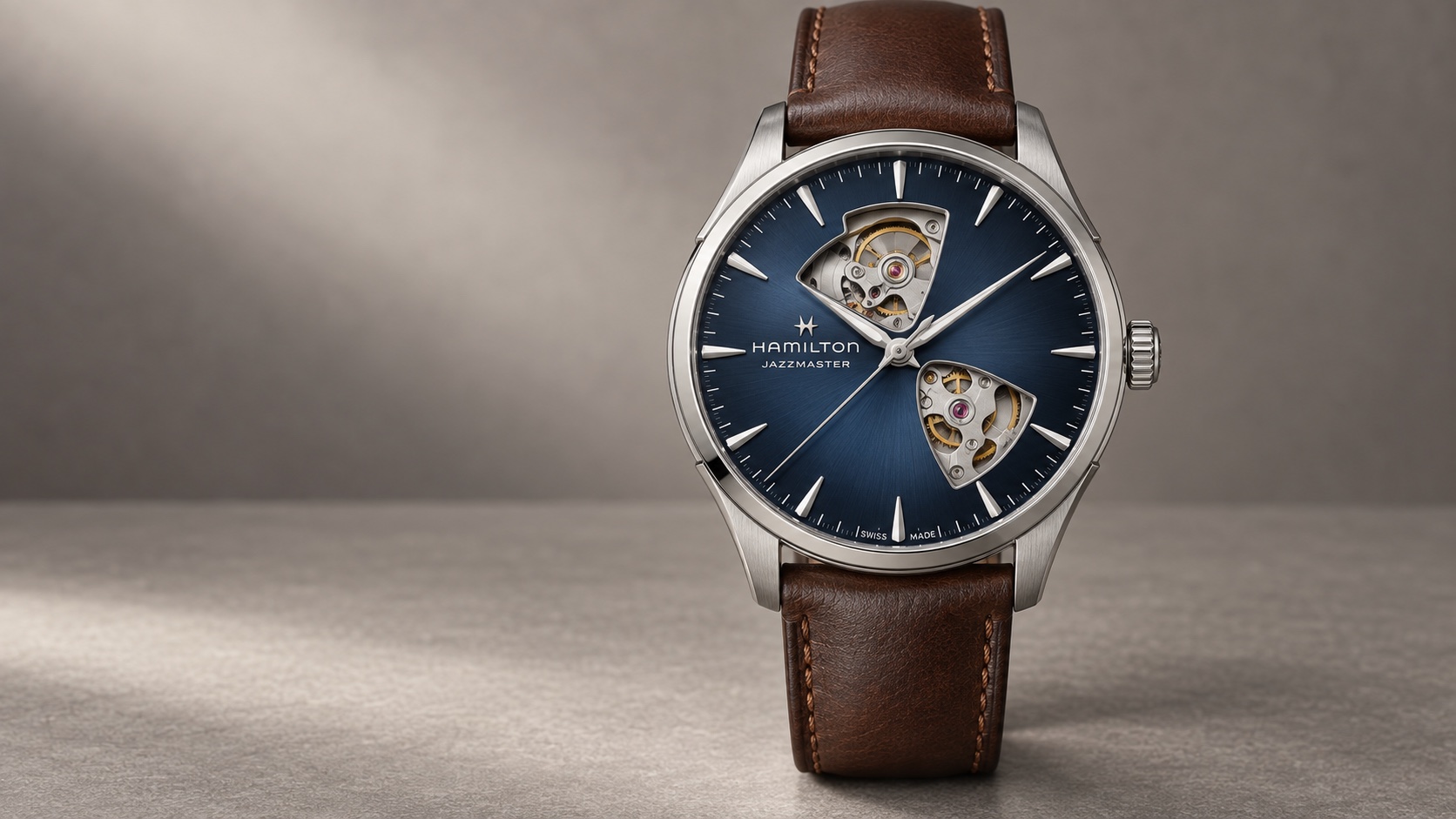
The most important test for a Hamilton Jazzmaster Open Heart takes only a moment: look at it when you actually need to know the time. If your eye enjoys the moving mechanism and still finds the hands naturally, the design may be a pleasure to live with. If you keep hunting through the dial, no movement specification will make that irritation disappear.
The blue H32675540 is for someone who wants the machinery to participate in the appearance of the watch. At £990, that preference deserves a proper fitting rather than a decision based entirely on an enlarged close-up.
The history behind the choice
Hamilton began in Lancaster, Pennsylvania in 1892, making pocket watches and developing a reputation around accurate timekeeping. The Jazzmaster expresses a different side of the company from that practical railway story: mechanics can also be something an owner chooses to see. In a February 2026 statement on the Open Heart family, Hamilton again made that visible mechanism central to the collection’s identity, describing a contemporary approach shaped by dial texture and proportion. That announcement concerns the continuing family, not the launch date of this exact blue reference. The historical interest lies in the shift from concealing a movement behind an orderly time display to making its activity part of the attraction. It is a design choice rather than a technical necessity.
The exact reference
| Specification | Published detail |
|---|---|
| Reference | H32675540 |
| UK price checked | £990 |
| Diameter / thickness | 40mm / 11.05mm |
| Case | Stainless steel |
| Movement | H-10 automatic; Nivachron spring |
| Stated reserve | 80 hours |
| Water resistance | 5 bar / 50m |
| Crystal | Sapphire; antireflective treatment |
| Dial | Blue smoked; open-heart cutouts |
| Strap / buckle | Cow leather / pin buckle |
| Strap attachment | 20mm |
Decide whether you want a window or a whole view
An open-heart dial and a fully skeletonised watch are different propositions. Here, the areas of dial left in place remain an important part of the composition. If you love the idea of visible mechanics but still want a conventional outline, that balance may be more appealing than a watch in which nearly everything has been opened up.
Try not to turn this into a contest over how much machinery is exposed. More visibility is not automatically a more rewarding design. Ask whether the cutouts look intentional at normal distance, and whether the surrounding blue dial gives your eye somewhere to settle. The relevant comparison is with the sort of face you enjoy seeing repeatedly, rather than with a specification for visual complexity.
Give the dial an ordinary lighting test
Product photographs are designed to show the watch clearly. Your desk, a restaurant and an overcast pavement may present it differently. Look at the hands against several parts of the dial and check the time with the same quick glance you would use during a conversation. You do not need to conduct a laboratory test to notice a personal preference.
The question becomes particularly useful if this would be your main watch. A decorative dial that you enjoy studying slowly may not be the one you want when moving between appointments. Conversely, if you already own a very straightforward daily watch, the Jazzmaster can earn its place precisely because it asks you to look a little longer.
A dressier watch still needs a proper fit
The case height and leather strap give you two practical checks before concentrating on the movement. Try the watch beneath a real sleeve, then check the available buckle holes with your wrist in a relaxed position. An attractive case can still sit awkwardly if the strap adjustment you need falls between holes.
Consider the clothes with which you would wear this blue reference. A watch does not need to match everything, but it should match something you actually own. If you are buying it as a more expressive alternative to a plain dial, give it a clear role. A watch purchased for an imagined dress code can become an expensive object that you appreciate mainly while it is off the wrist.
The mechanism is a pleasure, not a performance claim
The automatic movement is part of the display, and the stated reserve offers flexibility between wears. Neither establishes how an individual example will keep time in your routine. This article does not claim to have measured accuracy, winding efficiency or the duration of a full charge.
Ask the retailer to explain setting and winding before leaving with it. If this is your first mechanical watch, understanding the small routines makes the visible movement more interesting rather than mysterious. Follow the maker’s care guidance around water and the supplied leather strap. Do not assume that a dressier appearance makes a watch fragile in every respect, or that a published case rating removes the need for appropriate handling.
The plain-dial comparison is the useful one
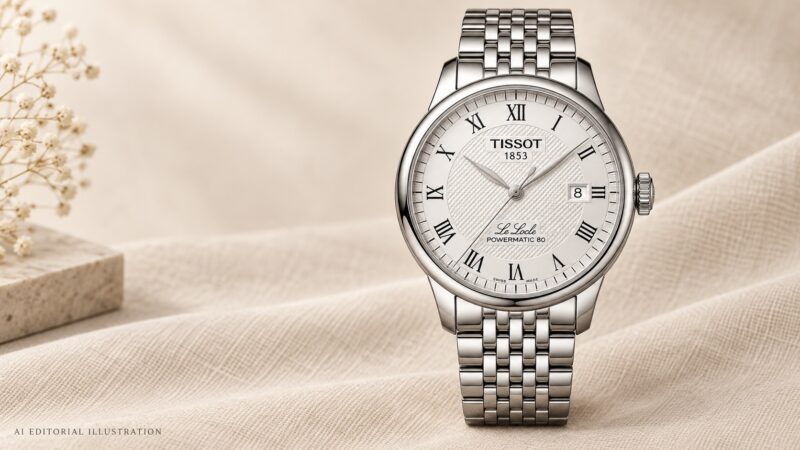
Try a closed-dial watch such as the Tissot Le Locle during the same visit. The point is not to rank brands. It is to find out whether your interest comes from mechanical ownership generally or from this particular way of displaying it. If you prefer the calmer dial immediately, take that reaction seriously.
Choose the Jazzmaster Open Heart if the openings still delight you when you are reading the time rather than studying the mechanism. Choose a simpler dial if the visual interruption repeatedly bothers you. The novelty can start the attraction, but it should not carry the entire purchase. A successful decorative watch rewards repeated attention without demanding more attention than you want to give it.
Based on manufacturer information. Specifications and sources checked on 8 September 2026. Sources: Jazzmaster Open Heart specifications; Hamilton history; Hamilton’s 2026 Open Heart design statement; Le Locle alternative. Prices, where included, are dated UK manufacturer listings and may change.
Image: AI-generated editorial illustration of the Hamilton Jazzmaster Open Heart 40mm, reference H32675540. Fine design details may differ from the production watch.