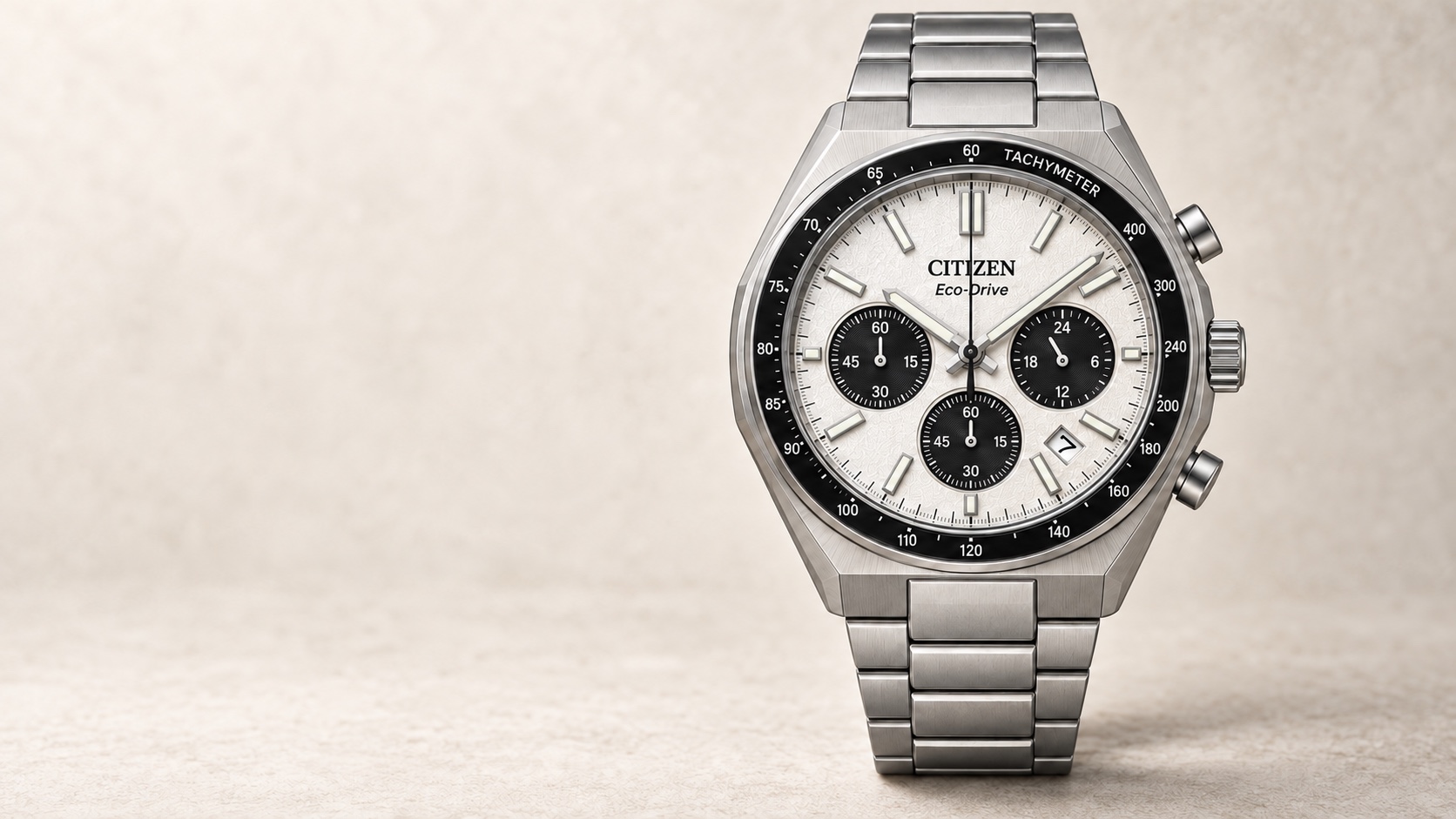
If you like the look of an analogue chronograph but want it ready whenever you choose to wear it, the Citizen Zenshin CA4610-85A makes a persuasive starting point. It combines a light-powered quartz movement with a titanium case and bracelet. You get the registers and pushers without adding a mechanical winding routine to the decision.
Citizen UK’s published price is £499. At that level, the important questions are whether the fairly broad case fits, whether you can read the information comfortably, and whether the chronograph earns its space on the dial. A long feature list cannot answer those questions for you.
What this exact reference offers
| Specification | CA4610-85A |
|---|---|
| UK listed price | £499, checked 8 September 2026 |
| Case dimensions | 42.5 mm diameter; 11.6 mm thick, per Citizen Europe |
| Published weight | 101 g, per Citizen Europe |
| Case and bracelet | Super Titanium with Duratect TiC treatment |
| Movement | B620 Eco-Drive quartz chronograph |
| Crystal | Sapphire |
| Water resistance | 10 bar / 100 metres |
| Dial | Textured white/silver with black registers |
| Closure | Folding clasp with push buttons |
The UK listing rounds the diameter to 42 mm; the more detailed European specification provides the dimensions above. A dependable lug-to-lug figure was not verified. The listing price establishes a comparison point, while stock and the price of a particular offer need checking when you buy.
A recent design built on established Citizen ideas
The CA4610 chronographs formed part of Citizen’s 2024 Zenshin collection. The company connected the range’s case shapes and integrated bracelets to its own 1980s watches. That explains the period influence without making this model a literal vintage reissue. Its material has a longer history: Citizen’s official timeline records the titanium-cased X-8 in 1970.
The other important strand arrived in 1976, when Citizen introduced the light-powered Crystron Solar Cell. The company’s Eco-Drive anniversary history traces the development from that starting point. The CA4610 therefore brings two established interests together: titanium construction and power gathered from light. Those connections help explain its specification today, even though the textured dial and contrasting registers give this particular reference its own identity.
What the stopwatch actually does
The B620 manual specifies a chronograph reading in fifth-second increments, with an hour of timing available. It stops automatically at that limit. This is useful for a short session in the kitchen, a journey segment or another task where you want elapsed time in front of you. For a process lasting several hours, its timing range is the wrong tool.
The 24-hour indication follows the main time and helps identify AM or PM. The date provides another everyday convenience, with a correction needed after shorter months. Before buying, look closely at the full dial at a normal viewing distance. A register arrangement that looks appealing enlarged on a screen may not be the one you find easiest to consult quickly.
You should also try operating the pushers. That is a more useful shop check than deciding from photographs that they must feel crisp or substantial. A minute spent trying the controls is worthwhile if you plan to time things often, particularly if small pushers have proved awkward on previous watches.
Readiness depends on keeping it charged
Citizen gives approximately nine months from full charge without further light, assuming chronograph use for an hour each day. That is a substantial reserve for someone who rotates watches. It does not remove the need to think about storage. Let the dial receive light between outings, rather than treating the reserve as a reason to leave it in a dark drawer indefinitely.
The manual’s charging table shows why a little indoor light and a full recharge are different things. Light levels have a large effect on charging time. A watch that starts moving again after depletion may still need more exposure to rebuild its reserve. Follow the charging guidance rather than assuming that moving hands mean a full cell.
Eco-Drive still uses a rechargeable cell, and ordinary watch care still applies. The practical benefit is avoiding regular winding and routine disposable-battery changes. If that removes two chores you dislike, it is a stronger reason to buy this movement than the number of subdials around it.
Fit matters more than the material name
Titanium is a compelling part of this watch’s specification, but a low published weight cannot make an unsuitable case fit. Check how the bracelet leaves the case, whether it follows your wrist and how the clasp sits after sizing. Try it under the cuffs you normally wear. Those checks are especially useful when a continuous case-and-bracelet design is part of the appeal.
The dial deserves the same honesty. The black registers, textured background and outer scale compete for attention. If you enjoy that density, it is a reason to choose this reference. If you repeatedly favour simple three-hand faces, buying a chronograph for occasional timing may leave you looking at a busier watch every day.
Choose the functions you will use
The Zenshin NJ0180-80X keeps the titanium bracelet approach but uses an automatic movement and small seconds. Choose it if the mechanics are part of the enjoyment. The Promaster BN0150-10E keeps light-powered quartz and substitutes a rotating bezel and diving specification for the chronograph arrangement.
Buy the CA4610-85A if its bracelet fits, its dial remains readable to you and you want a stopwatch without a winding routine. If the registers are mainly decoration to your eye, compare a simpler watch before committing. Its strongest proposition is a set of useful features that remain ready with sensible charging, rather than complexity for its own sake.
Based on Citizen’s published information. Specifications checked on 8 September 2026.
Image: AI-generated illustration. Fine details may differ from the watch.


