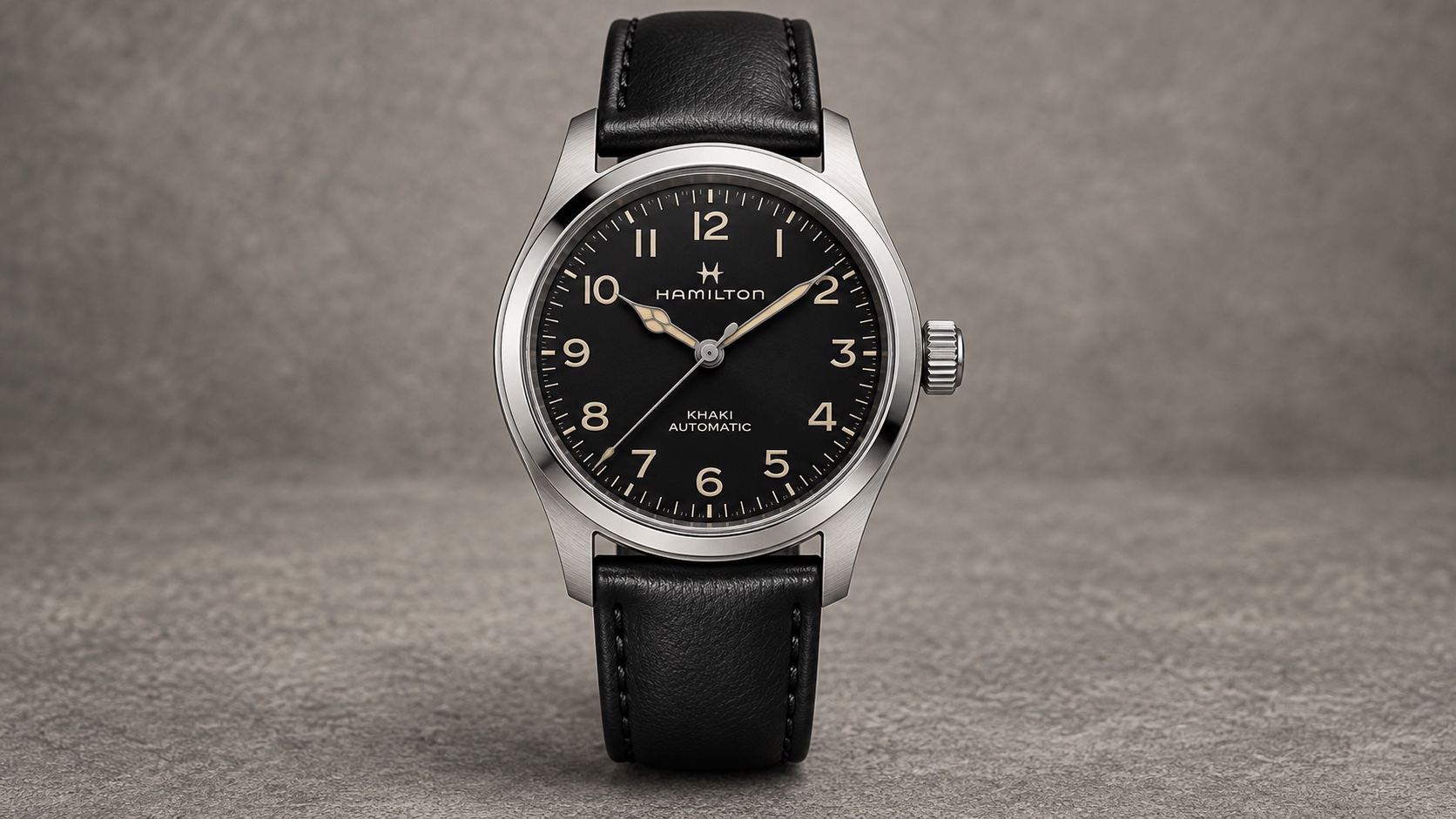
The Murph 38 and Khaki Field Mechanical are closely matched where a quick shopping filter begins. Both are thirty-eight-millimetre steel watches with black dials, no date and a long stated reserve. The difference becomes clear in the winding method and the character of the face.
The Murph uses automatic winding and a more decorative handset, with its connection to Interstellar adding another reason to care about the design. The Khaki Field Mechanical makes hand winding and a more overtly instrumental dial the centre of the proposition. Choose the relationship with the object that appeals, rather than assuming the two watches are interchangeable because they share a size and brand.
The references compared
| Feature | Murph 38 | Khaki Mechanical |
|---|---|---|
| Reference | H70405730 | H69439931 |
| Diameter / thickness | 38mm / 11.1mm | 38mm / 9.5mm |
| Movement | H-10 automatic | H-50 manual |
| Reserve | 80 hours | Up to 80 hours |
| Calendar | No date | No date |
| Water resistance | 100m | 50m |
| Crystal | Sapphire; antireflective treatment | Sapphire |
| Supplied strap | Black leather | Textile NATO-style |
Two histories behind the decision
Hamilton created the original Murph for Interstellar, released in 2014, then introduced a commercial version in 2019 after interest from fans. The smaller thirty-eight-millimetre model translated that design into a different case size; it is not the exact prop used on screen. The Khaki Field Mechanical draws on another source, which Hamilton identifies as its 1960s military-watch design. These histories give the watches different emotional settings. One connects a recognisable object with a fictional story, while the other continues a functional field-watch vocabulary. Neither history changes how the present movement works, but each can explain why a similar black dial and steel case mean something different to the buyer.
Automatic winding is the biggest practical difference
The H-10 in the Murph replenishes energy through its automatic mechanism during suitable wear. The H-50 requires the owner to wind it through the crown. Both can offer around eighty hours of reserve, so the decision is not between a long-running movement and an inherently short-lived one.
Manual winding can make the Khaki more engaging if the interaction is part of the pleasure. It is an unnecessary demand if you chiefly want to put on a watch and leave the mechanism to do its work. The Murph’s automatic operation therefore has a clear practical appeal, but it should be chosen because it supports your preference rather than because a rotor automatically makes a field watch more interesting.
The dial is more than a shared colour
The Murph’s hands and numeral treatment create a softer, more decorative impression than the Mechanical’s compact instrument markings. Both keep a no-date face, but the information around their centres has a different emphasis. The Mechanical’s inner hour markings reinforce the functional appearance, while the Murph leaves more attention for its distinctive handset.
This is a good place to separate film enthusiasm from ordinary visual preference. You can enjoy the Murph without caring about the film if the dial is the reason you want it. Equally, a strong connection to the story does not make it the right everyday face if you consistently prefer the Mechanical’s more utilitarian arrangement. The watch will remain that design after the initial association becomes familiar.
The case and strap reinforce the difference
The Mechanical is thinner in the published figures and uses a textile NATO-style strap in this reference. The Murph is thicker and arrives on leather. Those combinations support different appearances before any aftermarket strap is considered.
Both have twenty-millimetre attachment widths, but the possibility of changing straps does not erase their case and dial distinctions. A fitting should compare the supplied configurations first, including the way the straps meet the lugs. That establishes whether you like the complete watch being offered, rather than a version assembled in your imagination from the preferred parts of both.
The rating supports a clearer verdict
The Murph’s stated hundred-metre water resistance is higher than the Mechanical’s fifty-metre rating. That is a concrete difference, alongside winding method and thickness. It should carry more weight than general claims that any military-looking watch must have the same capabilities.
Choose the Murph 38 when automatic winding, its particular hands and the film connection all contribute to a watch you want to use. Choose the Khaki Field Mechanical when the thinner case, textile strap and hand-winding interaction make the simpler instrument brief more appealing. The shared reserve and diameter remove two easy distractions. What remains is a useful choice between a more decorative automatic and a deliberately involved manual field watch.
Specifications and sources checked on 8 September 2026. Murph 38 specifications; Khaki Mechanical specifications and origins; Murph film and collection history; 2019 Murph announcement.
Image: AI-generated editorial illustration of the Hamilton Murph 38mm, reference H70405730. Fine design details may differ from the production watch.


