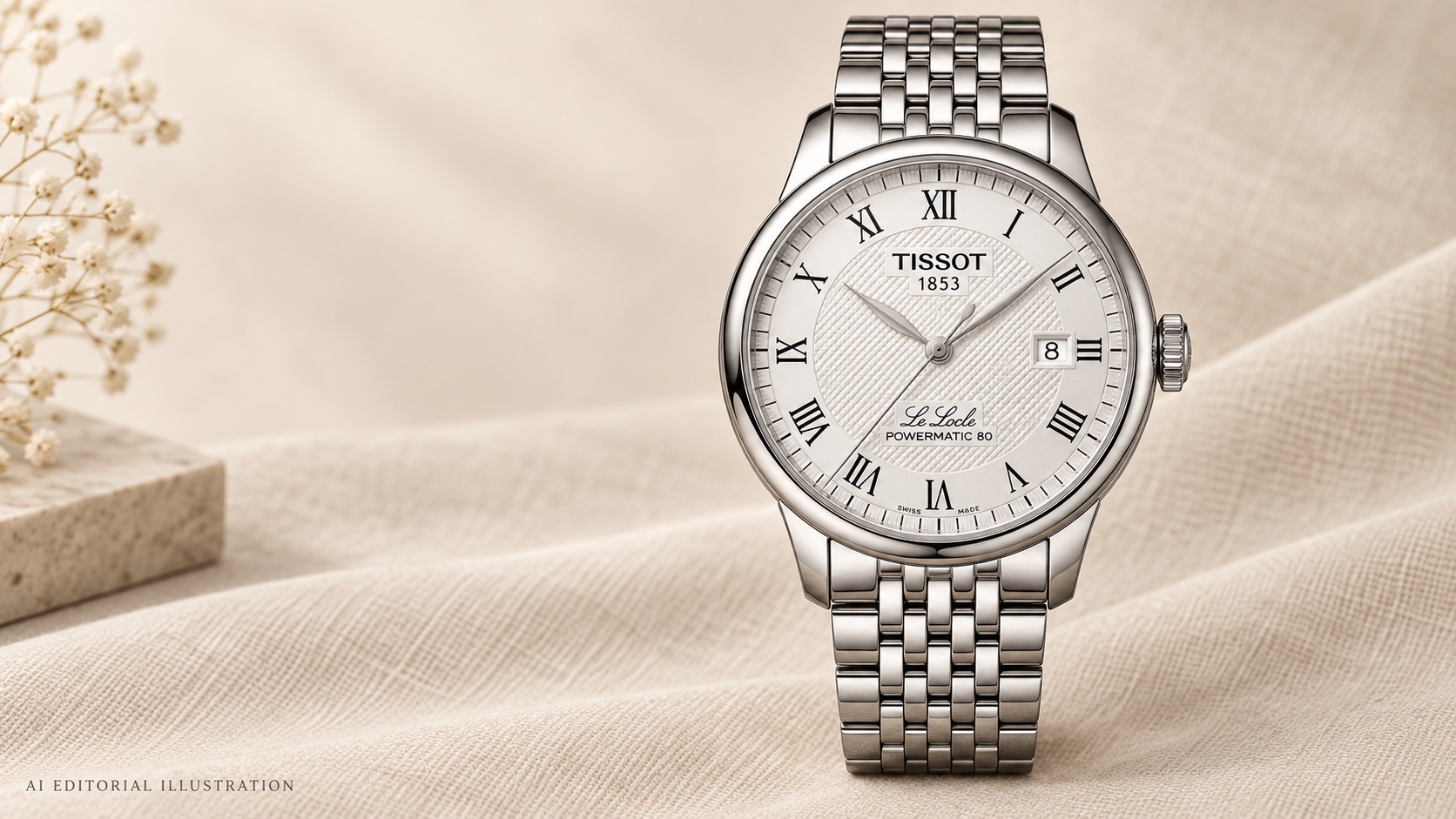
A decorated dial can make an ordinary working day feel more considered. The Tissot Le Locle and Omega De Ville Prestige both pursue that idea, using silver tones and Roman numerals within relatively slim automatic watches. Their differences are more subtle than those between two divers.
The Tissot here comes on a steel bracelet, while the Omega uses black leather. That immediately changes how each fits into a wardrobe. The more expensive watch also has the shorter reserve, so this comparison cannot be reduced to buying a better number in every row.
The references compared
| Feature | Tissot T006.407.11.033.00 | Omega 434.13.40.20.02.001 |
|---|---|---|
| Diameter | 39.3 mm | 40 mm |
| Thickness | 9.75 mm | 9.93 mm |
| Movement | Powermatic 80 automatic; Nivachron spring | 8800 automatic; Master Chronometer |
| Reserve | Up to 80 hours | 55 hours |
| Dial | Silver; Roman numerals | Domed silvery; Roman and cabochon markers |
| Calendar | Date | Date at 6 |
| Water resistance | 3 bar | 30 m |
| Attachment | Steel bracelet | Black alligator surface; calf underside |
| Attachment width | 19 mm | 19 mm |
Specifications: Tissot Le Locle specifications; Omega De Ville Prestige specifications.
The modern origins of two classical dress-watch families
The Le Locle collection takes its name from Tissot’s Swiss home, but the modern family was introduced in 2003 to mark the manufacturer’s 150th anniversary. Its decorative conventions express that association with traditional watchmaking rather than reproducing an unchanged nineteenth-century watch.
Omega dates the Prestige collection to 1994, with the third generation presented in 2022. This reference belongs to that later development, combining classical dial details with calibre 8800. Both histories describe contemporary interpretations of formal watch design. The buying question is how you want those conventions presented now: a bracelet watch with a longer reserve, or a leather-strapped Omega with its own movement and dial treatment.
The cases are closer than the names suggest
The Le Locle measures 39.3 mm across and 9.75 mm thick. The De Ville Prestige is 40 mm across and 9.93 mm thick. Both dimensions are close, making a dramatic difference in basic case size a weak reason to choose one.
Omega also gives a 46.26 mm lug-to-lug measurement. That provides a useful guide to its span, especially when checking how a relatively broad dress-watch dial sits on your wrist.
Try both beneath the cuff you actually wear. Their similar thicknesses make the case shape, strap or bracelet fit and your preferred wearing position more important than a fractional numerical advantage.
The dial details create the personality
The Le Locle places Roman numerals around a decorated silver dial. Its formal lettering and texture are part of the attraction. It is a good candidate if you want an obvious visual change from a plainer everyday sports watch.
The Omega mixes Roman numerals with rounded cabochon markers on a domed silvery face. The date at six keeps the lower part of the display organised around the centre line.
Compare those details without magnification. A dress watch is often seen at a glance beside clothing, so the overall rhythm matters as much as the smallest decoration. Choose the arrangement that still appeals when the brand name is not your first point of attention.
Steel and leather create different routines
The Tissot’s steel bracelet gives the formal dial a more casual counterweight. It may make the watch easier to include in ordinary office or weekend clothing, depending on your style.
The Omega’s black strap has an alligator outer surface and calf underside, with a pin buckle. That creates a more conventional dress-watch outline and allows the case to stand apart visually.
Both have 19 mm attachments, but the supplied configurations deserve to be judged before planning changes. A watch you like on its original bracelet or strap is a clearer purchase than one whose appeal depends on immediately replacing a major component.
The longer Tissot reserve is a real benefit
The Powermatic 80 offers up to 80 hours, compared with 55 hours for the Omega 8800. If you often leave a dress watch for a couple of days, the Tissot has more margin before it stops.
The Omega answers with its Master Chronometer specification and a particular movement package, rather than a longer running duration. Someone interested in that technical identity may prefer it, but should not pretend the reserve comparison points the same way.
Both are automatic watches with dates, so occasional restarting and calendar setting remain part of ownership. If the watch is used only for infrequent events, consider whether you enjoy that small preparation routine.
Give the watch a place in your week
Both publish a 30 m equivalent water rating. Their purpose is more focused than that of a modern steel diver, even when a bracelet makes the Tissot look ready for broader casual use.
Choose the Le Locle when its Roman-numeral decoration, bracelet and long reserve make a watch you would wear regularly. Choose the De Ville Prestige when the domed face, mixed markers, black leather and calibre 8800 are the specific combination you want.
The useful distinction is how each changes the tone of your ordinary clothing and ownership routine. A dress watch earns its place by being worn, not by waiting for an imaginary calendar of formal occasions.
Based on manufacturer information. Specifications checked on 8 September 2026.
Image: AI-generated editorial illustration of the Tissot Le Locle Powermatic 80, reference T006.407.11.033.00. Fine design details may differ from the production watch.


